

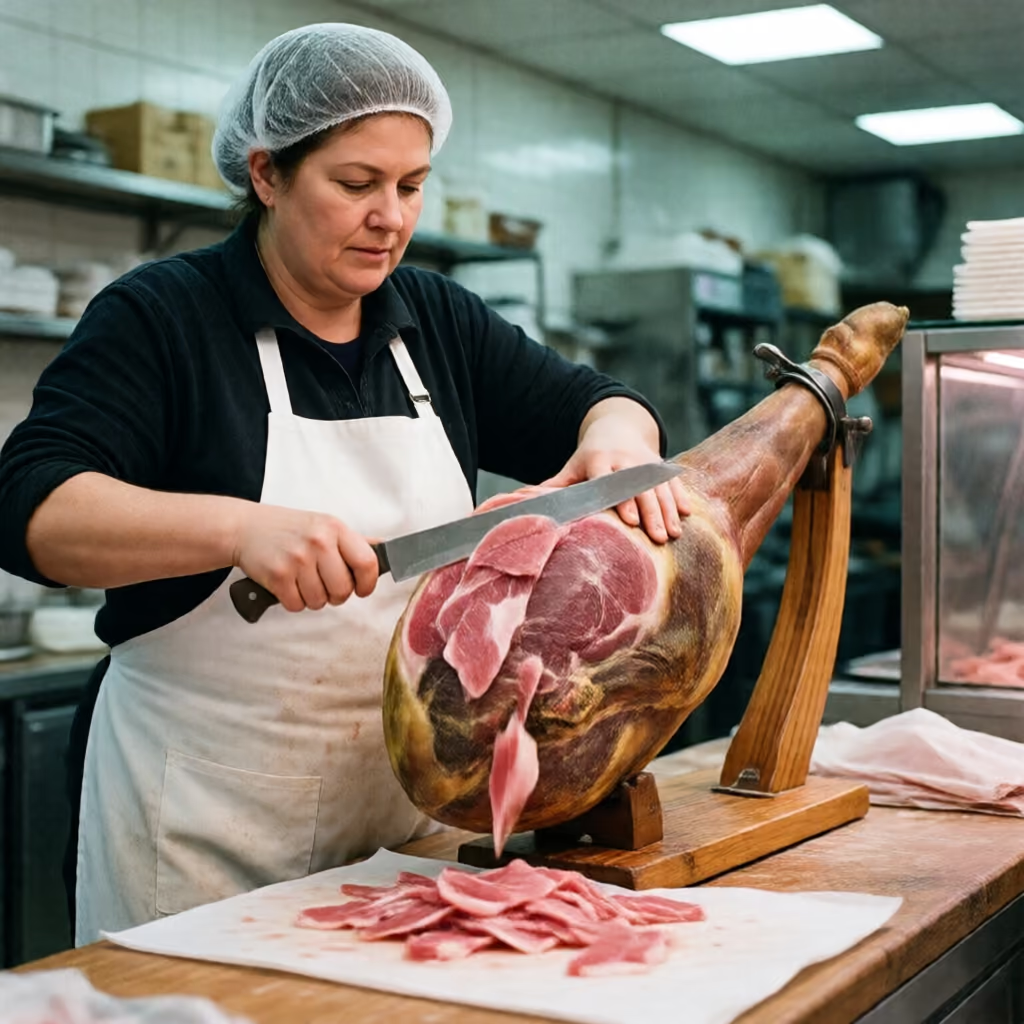
der Schinken
ham
The leg of a pig, used as food when fresh, cured, smoked, or cooked.
EXAMPLE
Zum Frühstück gab es Brot mit Schinken.
There was bread with ham for breakfast.
ham / tome
der Schinken, die Schinken
Loading your saved state.
ham
The leg of a pig, used as food when fresh, cured, smoked, or cooked.
Zum Frühstück gab es Brot mit Schinken.
There was bread with ham for breakfast.

old painting
A large painting, usually old or of little artistic value.
Der teure Schinken passte überhaupt nicht in das moderne Wohnzimmer.
The expensive old painting didn’t fit in the modern living room at all.

tome / long film
A lengthy book or long film, usually with a disparaging or joking undertone.
Für den Urlaub habe ich mir einen dicken Schinken eingepackt.
I packed a thick tome for my vacation.
| gender | masculine der |
|---|---|
| plural | die Schinken |
| genitive | des Schinkens |
| singular | plural | |
|---|---|---|
| nominative | der Schinken | die Schinken |
| accusative | den Schinken | die Schinken |
| dative | dem Schinken | den Schinken |
| genitive | des Schinkens | der Schinken |
The article changes with the case; it is shown in colour.
The meaning can often be recognized from the verbs and the surrounding context: when it refers to food, the context may involve buying, slicing, or eating it; when it refers to a painting, it may involve hanging it up or looking at it; and when it refers to a book or film, it may involve reading or watching it.
Der Schinken lag bereits geschnitten auf dem Teller.
The ham was already sliced and lying on the plate.
Der Schinken hing über dem Kamin und war stark vergilbt.
The old painting was hanging above the fireplace and was badly yellowed.
Den dreistündigen Schinken schauen wir uns lieber am Wochenende an.
We’d rather watch the three-hour film at the weekend.
When used to mean food, „Schinken“ often appears with information about how it was made or prepared, for example „geräucherter Schinken“ (smoked ham), „roher Schinken“ (raw ham), „Schinkenwürfel“ (diced ham), or „Schinkenbrot“ (bread with ham).
Für den Salat brauche ich noch geräucherten Schinken und frisches Gemüse.
I still need smoked ham and fresh vegetables for the salad.
When referring to a painting, „Schinken“ is often used colloquially and disparagingly or jokingly. The speaker’s evaluation is often indicated by adjectives such as „kitschig“ (tacky), „alt“ (old), or „teuer“ (expensive).
Was für ein kitschiger Schinken hängt denn da im Flur?
What kind of tacky old painting is that hanging in the hallway?
The fixed expression „ein dicker Schinken“ (a thick tome) is very common for a particularly lengthy book. When used for books and films, „Schinken“ often sounds joking or disparaging.
Sie hat einen dicken Schinken über die Geschichte Europas gelesen.
She read a thick tome about the history of Europe.