

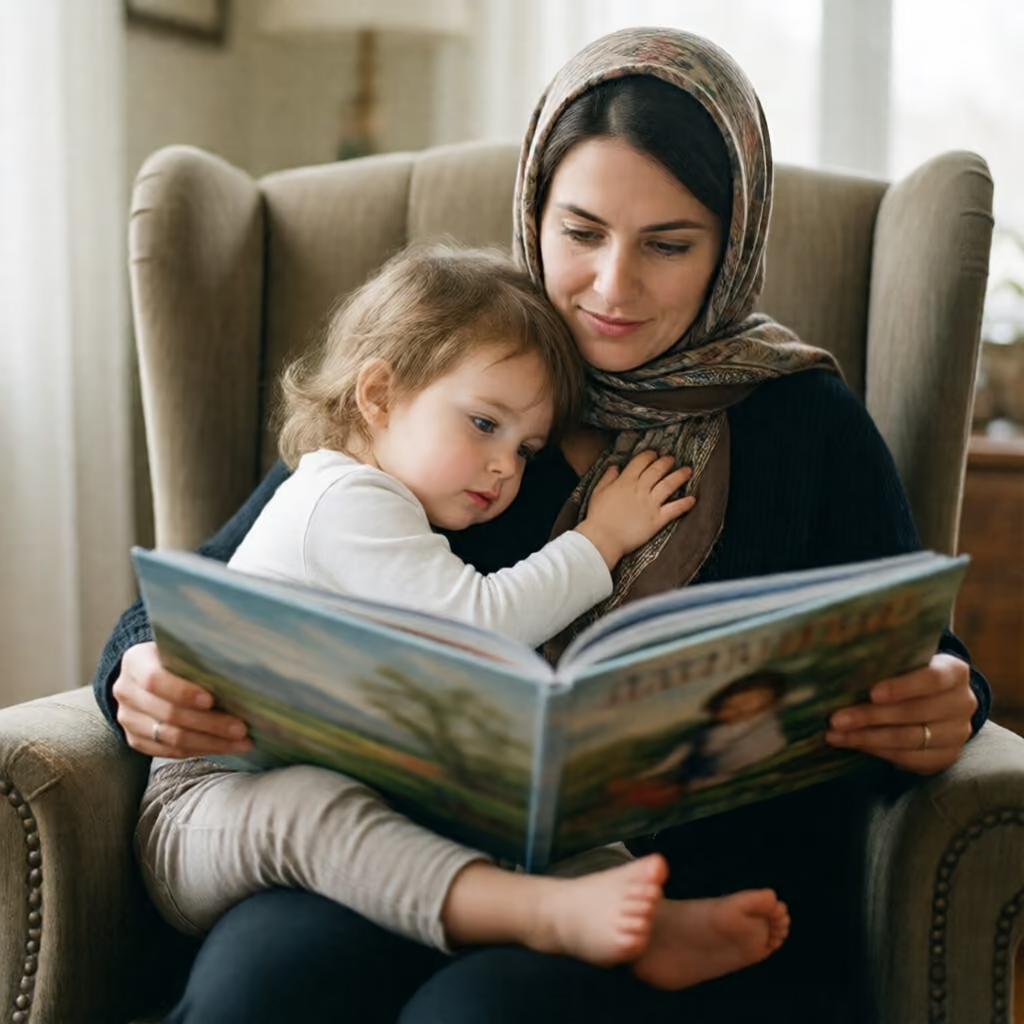
der Schoß
lap
The area formed by the thighs and hips when sitting, where one can hold something or someone.
EXAMPLE
Das Kind setzte sich auf den Schoß seiner Mutter.
The child sat on its mother’s lap.
lap / womb
der Schoß, die Schöße
Loading your saved state.
lap
The area formed by the thighs and hips when sitting, where one can hold something or someone.
Das Kind setzte sich auf den Schoß seiner Mutter.
The child sat on its mother’s lap.

womb
A woman’s uterus; this meaning is elevated or archaic.
Das ungeborene Kind wächst im Schoß der Mutter heran.
The unborn child grows in its mother’s womb.

in the bosom of the family
In a protective community or environment, especially in the family where someone grows up.
Sie wuchs im Schoß einer liebevollen Familie auf.
She grew up in the bosom of a loving family.

to fall into someone’s lap
To come to someone or be given to them without any effort on their part.
Ihm ist das große Erbe einfach in den Schoß gefallen.
The large inheritance simply fell into his lap.

coat skirt
The lower part of a garment that falls downward below the waist; this meaning is found especially in the expression “die Schöße eines Mantels” (the skirts of a coat).
Die Schöße seines Mantels waren vom Regen ganz nass.
The skirts of his coat were completely wet from the rain.
| gender | masculine der |
|---|---|
| plural | die Schöße |
| genitive | des Schoßes |
| singular | plural | |
|---|---|---|
| nominative | der Schoß | die Schöße |
| accusative | den Schoß | die Schöße |
| dative | dem Schoß | den Schößen |
| genitive | des Schoßes | der Schöße |
The article changes with the case; it is shown in colour.
| gender | feminine die |
|---|---|
| plural | die Schoßen |
| genitive | der Schoß |
| singular | plural | |
|---|---|---|
| nominative | die Schoß | die Schoßen die Schöße |
| accusative | die Schoß | die Schoßen die Schöße |
| dative | der Schoß | den Schoßen den Schößen |
| genitive | der Schoß | der Schoßen der Schöße |
The article changes with the case; it is shown in colour.
When describing movement onto someone’s lap, “auf” (onto) takes the accusative; when describing a fixed position on someone’s lap, “auf” (on) takes the dative. Typical verbs are “setzen” (to put/sit someone down) for movement and “sitzen” (to sit) for staying in a position.
Das Mädchen setzte den Teddy auf den Schoß seiner Schwester.
The girl put the teddy bear on her sister’s lap.
Der kleine Hund sitzt auf meinem Schoß.
The little dog is sitting on my lap.
With this meaning, “Schoß” (lap) often occurs in phrases such as “jemanden auf den Schoß nehmen” (to take someone onto one’s lap), “auf dem Schoß halten” (to hold on one’s lap), and “auf dem Schoß sitzen” (to sit on someone’s lap).
Die Großmutter nahm das müde Kind auf den Schoß.
The grandmother took the tired child onto her lap.
The meaning “Gebärmutter” (womb) mainly belongs to elevated, poetic, or older language. It occurs especially in figurative texts about pregnancy, birth, or origins.
Schon im Schoß der Mutter hört das Kind ihre Stimme.
Even in the womb, the child hears its mother’s voice.
In “im Schoß der Familie” (in the bosom of the family), “im” is short for “in dem” and refers to a protective environment. Common verbs used in this expression are “aufwachsen” (to grow up), “leben” (to live), and “bleiben” (to stay).
Er durfte im Schoß seiner Familie in Ruhe aufwachsen.
He was able to grow up peacefully in the bosom of his family.
In “jemandem in den Schoß fallen” (to fall into someone’s lap), the person is in the dative, while “in den Schoß” uses the accusative. The expression describes something coming to someone without any effort on their part.
Der jungen Unternehmerin fiel der Auftrag ganz unerwartet in den Schoß.
The assignment fell into the young entrepreneur’s lap completely unexpectedly.
This meaning occurs especially in the fixed expression “die Schöße eines Mantels” (the skirts of a coat). It refers to the lower parts of a longer garment that hang down.
Im Wind flatterten die Schöße ihres langen Mantels.
The skirts of her long coat fluttered in the wind.