

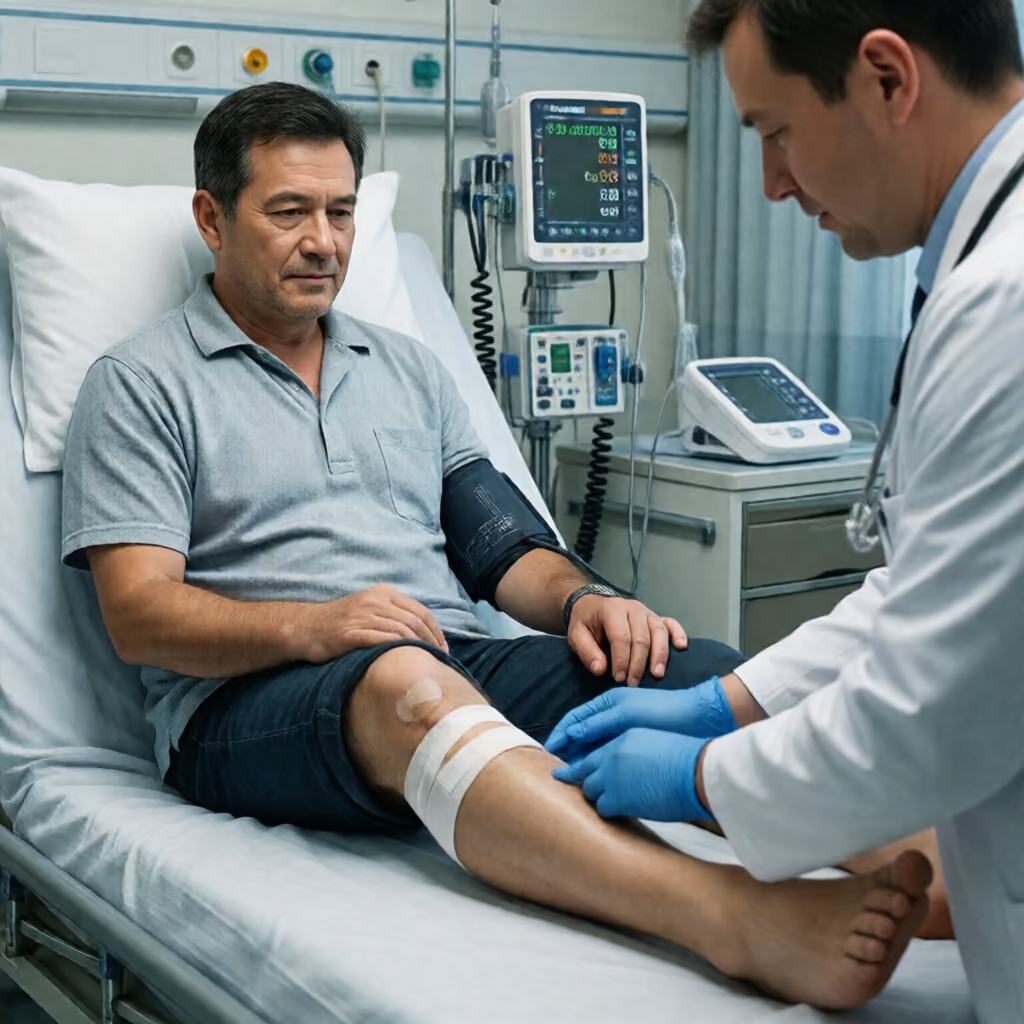
die Schusswunde
gunshot wound
An injury caused by a firearm and the penetration of a projectile into the body.
EXAMPLE
Der Arzt versorgte die Schusswunde am Bein sofort.
The doctor immediately treated the gunshot wound on his leg.
gunshot wound
die Schusswunde, die Schusswunden
Loading your saved state.
gunshot wound
An injury caused by a firearm and the penetration of a projectile into the body.
Der Arzt versorgte die Schusswunde am Bein sofort.
The doctor immediately treated the gunshot wound on his leg.
| gender | feminine die |
|---|---|
| plural | die Schusswunden |
| genitive | der Schusswunde |
| singular | plural | |
|---|---|---|
| nominative | die Schusswunde | die Schusswunden |
| accusative | die Schusswunde | die Schusswunden |
| dative | der Schusswunde | den Schusswunden |
| genitive | der Schusswunde | der Schusswunden |
The article changes with the case; it is shown in colour.
'Schusswunde' (gunshot wound) is made up of 'Schuss' (shot) and 'Wunde' (wound). The base word 'Wunde' (wound) refers to the injury, while 'Schuss' (shot) states its cause.
Die Schusswunde musste sofort operiert werden.
The gunshot wound had to be operated on immediately.
The verbs 'versorgen' (to treat), 'behandeln' (to treat), 'operieren' (to operate on), and 'erleiden' (to suffer) are particularly common with 'Schusswunde' (gunshot wound). These combinations occur mainly in medical and journalistic texts.
Das medizinische Team behandelte die Schusswunde mehrere Stunden lang.
The medical team treated the gunshot wound for several hours.
The affected part of the body is often specified with 'an' (on/at). After 'an' (on/at), the dative is used when indicating a fixed location.
Der Patient hatte eine Schusswunde an der Schulter.
The patient had a gunshot wound in his shoulder.