

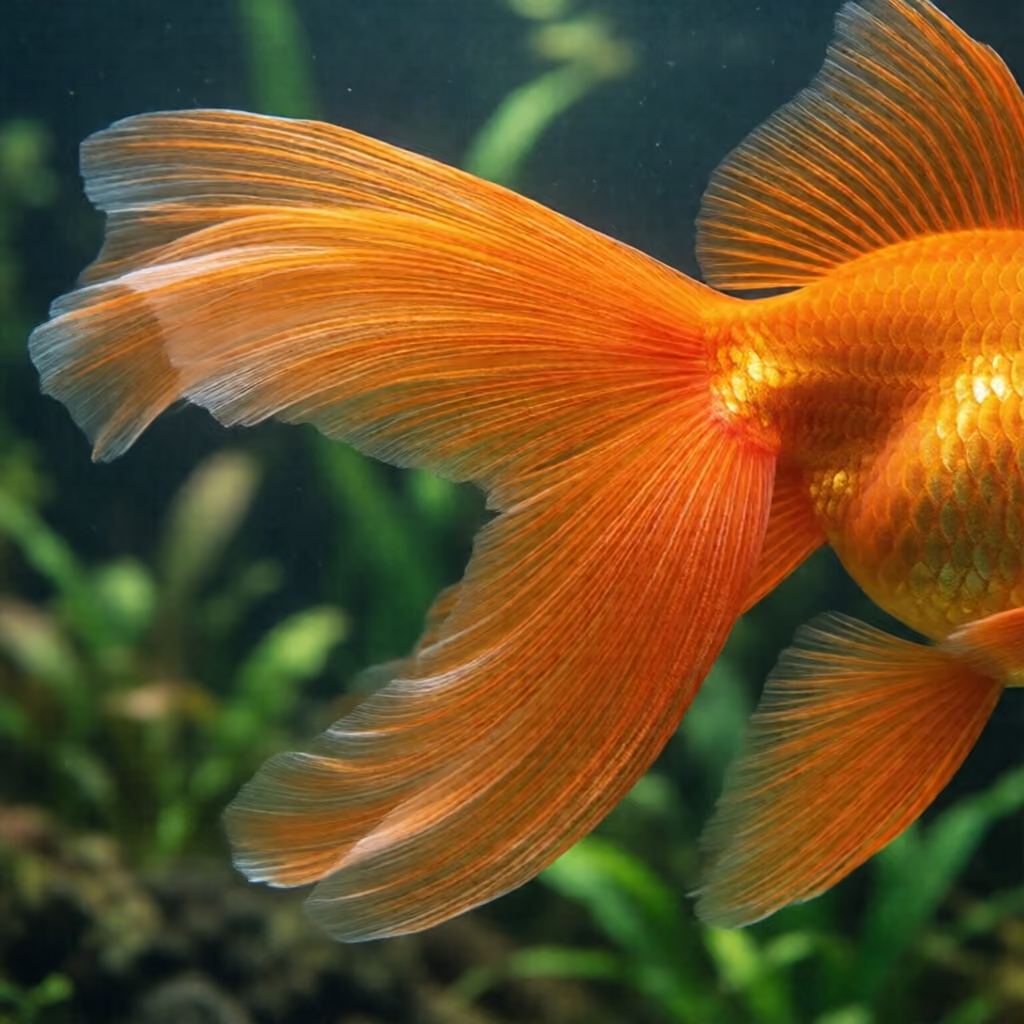
die Schwanzflosse
tail fin
The fin at the rear end of a fish or another aquatic animal, which is used for movement and steering.
EXAMPLE
Der Fisch bewegte seine Schwanzflosse und schwamm davon.
The fish moved its tail fin and swam away.
tail fin
die Schwanzflosse, die Schwanzflossen
Loading your saved state.
tail fin
The fin at the rear end of a fish or another aquatic animal, which is used for movement and steering.
Der Fisch bewegte seine Schwanzflosse und schwamm davon.
The fish moved its tail fin and swam away.
| gender | feminine die |
|---|---|
| plural | die Schwanzflossen |
| genitive | der Schwanzflosse |
| singular | plural | |
|---|---|---|
| nominative | die Schwanzflosse | die Schwanzflossen |
| accusative | die Schwanzflosse | die Schwanzflossen |
| dative | der Schwanzflosse | den Schwanzflossen |
| genitive | der Schwanzflosse | der Schwanzflossen |
The article changes with the case; it is shown in colour.
„Schwanzflosse“ (tail fin) is made up of „Schwanz“ (tail) and „Flosse“ (fin). It therefore refers to the fin at the rear end of an aquatic animal.
Die Schwanzflosse des Fisches war besonders groß.
The fish's tail fin was particularly large.
Verbs such as „bewegen“ (to move) and „schlagen“ (to beat or flap) are often used with „Schwanzflosse“ (tail fin). Typical combinations also include „mit der Schwanzflosse schlagen“ (to beat or flap with one's tail fin) and „die Schwanzflosse auf und ab bewegen“ (to move the tail fin up and down).
Der Delfin bewegte seine Schwanzflosse langsam auf und ab.
The dolphin slowly moved its tail fin up and down.
In descriptions of fish and other aquatic animals, „Schwanzflosse“ (tail fin) is often mentioned together with a direction or a type of movement. The preposition „mit“ (with) indicates which body part the animal uses for movement.
Der Hai steuerte mit seiner Schwanzflosse auf das Riff zu.
The shark steered toward the reef with its tail fin.