


schwarz
black
The darkest color, the color of coal or the night. The opposite of white.
EXAMPLE
Zum Interview trug er einen schwarzen Anzug.
He wore a black suit to the interview.
black
Loading your saved state.
black
The darkest color, the color of coal or the night. The opposite of white.
Zum Interview trug er einen schwarzen Anzug.
He wore a black suit to the interview.

illegal
Colloquial for illegal, without official permission or registration with the authorities.
Wer ohne Ticket fährt, fährt schwarz und riskiert eine Strafe.
Anyone who rides without a ticket is riding illegally and risks a fine.

dark / gloomy
Figuratively, dark, pessimistic, ominous, or evil.
Trotz der Probleme sollten wir nicht alles schwarz sehen.
Despite the problems, we shouldn't see everything so negatively.

in black and white
A fixed expression meaning that something is recorded in writing and is therefore binding or verifiable.
Ich glaube es erst, wenn ich es schwarz auf weiß habe.
I'll only believe it when I have it in black and white.

Black
Describes people who are identified as Black or identify themselves that way, often in relation to African heritage.
Martin Luther King war ein Anführer der Schwarzen Bürgerrechtsbewegung in den USA.
Martin Luther King was a leader of the Black civil rights movement in the USA.

conservative
In politics, the color associated in Germany and Austria with conservative, Christian democratic parties (CDU/CSU, ÖVP).
Bei der letzten Wahl hat der schwarze Kandidat das Direktmandat gewonnen.
In the last election, the conservative candidate won the direct mandate.
In colloquial language, 'schwarz' (black/illegal) often means 'illegal' or 'without official registration'. It is often combined with verbs such as 'arbeiten' (to work), 'fahren' (to ride/drive), or 'sehen' (to watch).
Er hat seine Wohnung schwarz untervermietet.
He illegally sublet his apartment.
Figuratively, 'schwarz' (black/dark) can stand for something negative, pessimistic, or ominous. This meaning appears in many fixed expressions.
Das war ein schwarzer Tag für den Verein.
That was a dark day for the club.
The idiom 'etwas schwarz auf weiß haben' (to have something in black and white) means that you have written, official proof of something. The form is always the same.
Ich möchte den Vertrag schwarz auf weiß sehen, bevor ich unterschreibe.
I want to see the contract in black and white before I sign.
The adjective 'schwarz' (black) can be used as a noun to refer to a person ('der/die Schwarze' — the Black man/woman). It is then declined like a noun and capitalized.
Die Ausstellung zeigt Werke von Schwarzen Künstlerinnen und Künstlern.
The exhibition shows works by Black artists.
In German and Austrian politics, the color 'schwarz' (black) traditionally stands for the conservative, Christian democratic parties (CDU/CSU and ÖVP).
Bei der Wahl hat die schwarze Partei die meisten Stimmen bekommen.
In the election, the conservative party received the most votes.
The verb 'schwärzen' is derived from 'schwarz' (black). It literally means 'to make something black' or, figuratively, 'to damage someone's reputation'.
Der Rauch des Feuers schwärzte die Hauswand.
The smoke from the fire blackened the wall of the house.
dark
Schwarz and dunkel can both refer to a very dark color. Schwarz names the color itself, while dunkel also describes other deep shades such as blue or green. Use schwarz for true black and dunkel when a color has little brightness or is approaching black.
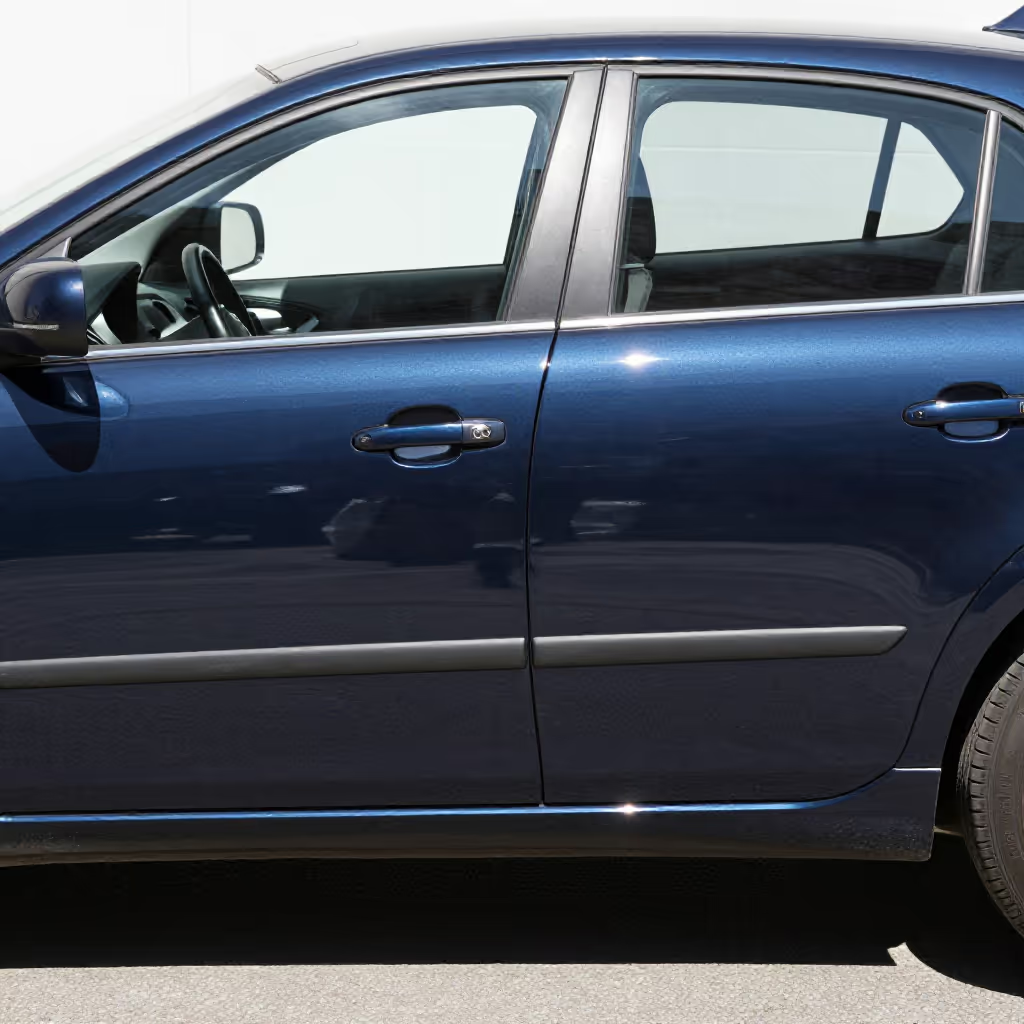
Die neue Jacke ist tiefschwarz.
The new jacket is jet black.
Für das Wohnzimmer wählte sie ein dunkles Grün.
She chose a dark green for the living room.