

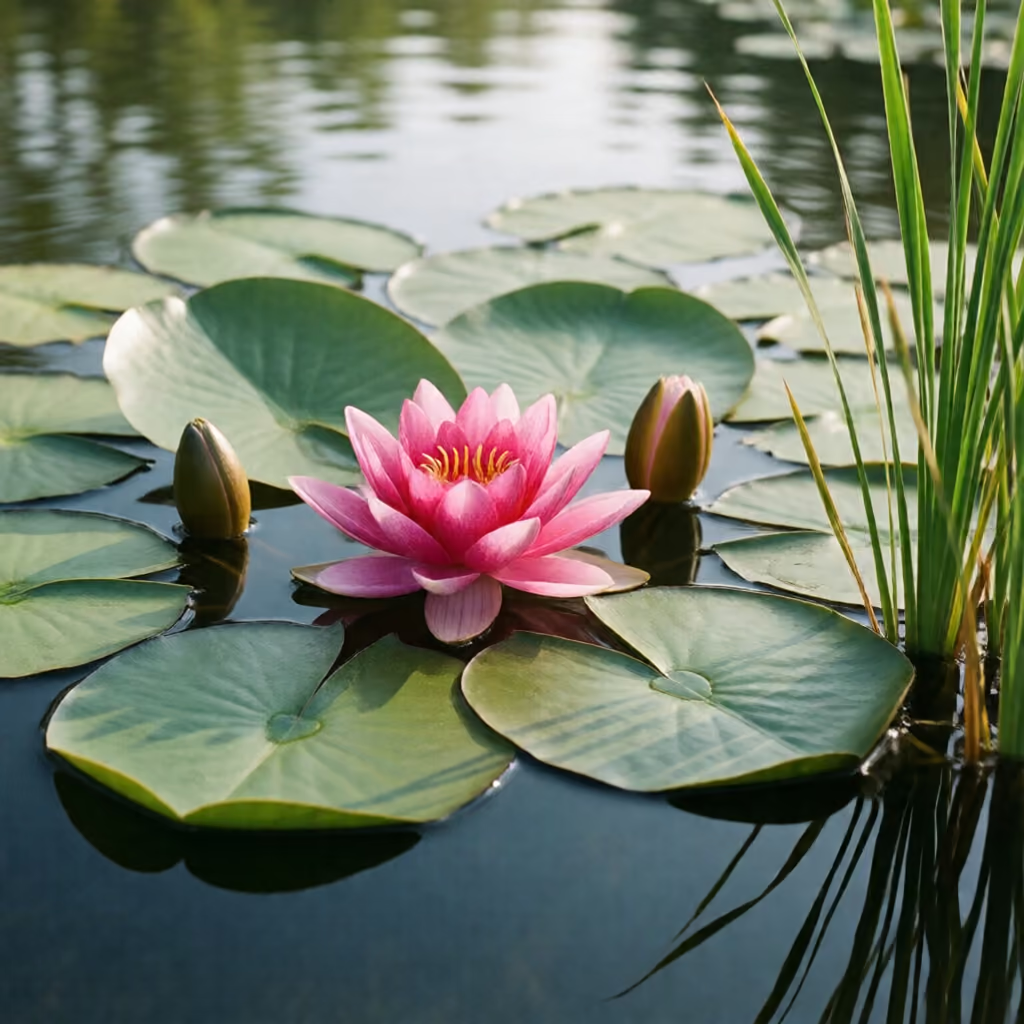
die Seerose
water lily
An aquatic plant with large, round leaves that float on the surface of the water and distinctive flowers.
EXAMPLE
Im Teich blüht eine weiße Seerose.
A white water lily is blooming in the pond.
water lily
die Seerose, die Seerosen
Loading your saved state.
water lily
An aquatic plant with large, round leaves that float on the surface of the water and distinctive flowers.
Im Teich blüht eine weiße Seerose.
A white water lily is blooming in the pond.
| gender | feminine die |
|---|---|
| plural | die Seerosen |
| genitive | der Seerose |
| singular | plural | |
|---|---|---|
| nominative | die Seerose | die Seerosen |
| accusative | die Seerose | die Seerosen |
| dative | der Seerose | den Seerosen |
| genitive | der Seerose | der Seerosen |
The article changes with the case; it is shown in colour.
'Seerose' is made up of 'See' (lake) and 'Rose' (rose). The word therefore describes a rose-like flower that grows on a lake or pond.
Auf dem kleinen See schwimmen mehrere Seerosen.
Several water lilies are floating on the small lake.
'Seerose' is often used with verbs such as 'blühen' (to bloom), 'wachsen' (to grow), and 'schwimmen' (to float). The combinations 'weiße Seerose' (white water lily) and 'Seerosenblatt' (water lily leaf) are also common.
Im Sommer blühen im Gartenteich viele Seerosen.
Many water lilies bloom in the garden pond in summer.
In the context of ponds, lakes, garden ponds, or water parks, 'Seerose' refers to the entire plant. If only the round leaf on the water is meant, the more precise term 'Seerosenblatt' (water lily leaf) is used.
Die Enten schwammen zwischen den Seerosen hindurch.
The ducks swam through the water lilies.