

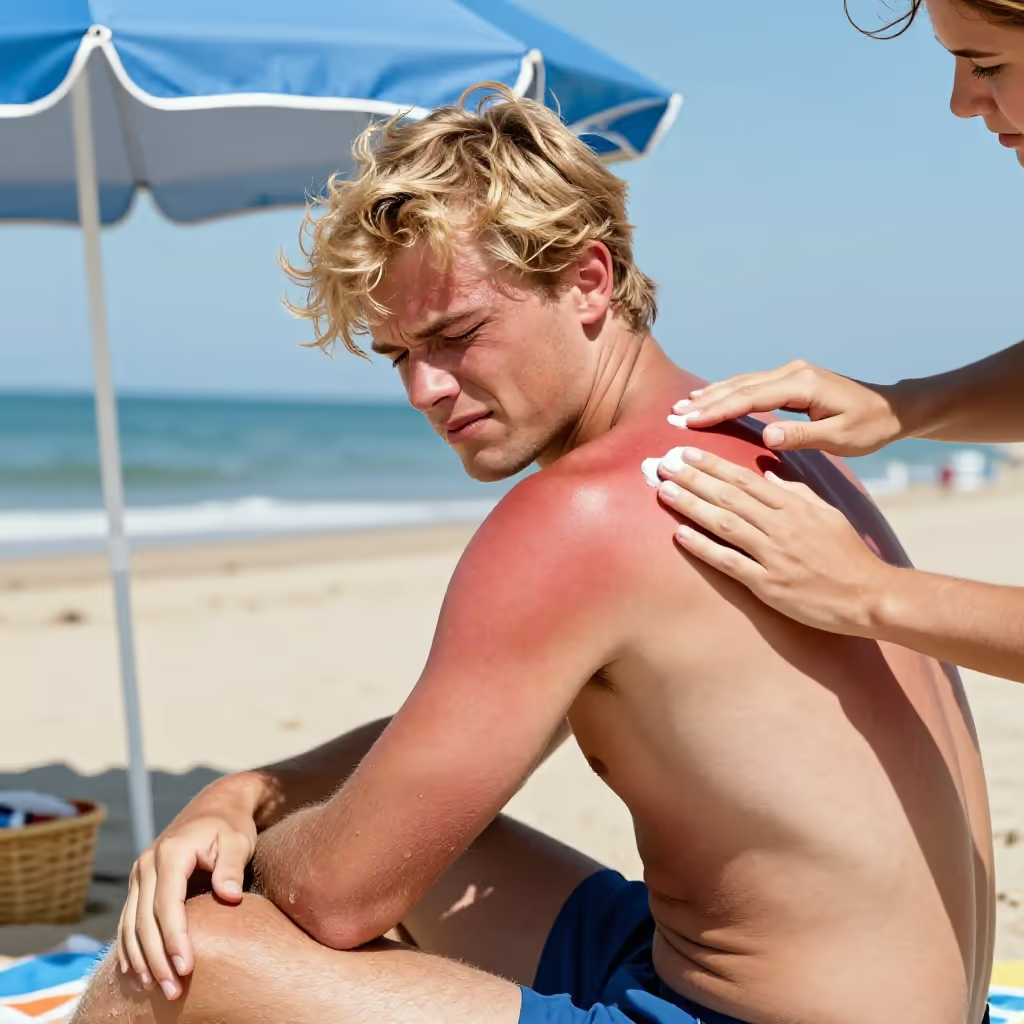
An acute inflammation of the skin caused by excessive UV radiation from the sun, showing itself through redness, pain, and sometimes blistering.
example
Nach dem Tag am Strand hatte ich einen schlimmen Sonnenbrand auf den Schultern.
After the day at the beach, I had a bad sunburn on my shoulders.
Usage tips
Compound word
The word is a compound of 'Sonne' (sun) and 'Brand' (burn/fire). A 'Brand' is a fire, so the word figuratively describes the skin as having been 'verbrannt' (burned) by the sun.
EXAMPLE
Ein Sonnenbrand ist im Grunde eine Verbrennung der Haut durch UV-Strahlen.
A sunburn is basically a burn of the skin caused by UV rays.
Typical verbs
The verbs 'haben' (to have) or 'bekommen' (to get) are usually used to talk about sunburn. With 'bekommen' you emphasize the process; with 'haben' you emphasize the state.
EXAMPLE
Pass auf, dass du in der Mittagssonne keinen Sonnenbrand bekommst.
Be careful that you don't get a sunburn in the midday sun.
Sentence structure and usage
To say where on the body the sunburn is, you use the preposition 'auf' (on) followed by the dative.
EXAMPLE
Er hat einen schmerzhaften Sonnenbrand auf dem Rücken.
He has a painful sunburn on his back.
Compare with
near_synonym · confusable
Sonnenbrand vs Verbrennung
combustion / burn
'die Verbrennung' and 'der Sonnenbrand' can both mean an injury to the skin. 'die Verbrennung' is the more general term: it can be caused by fire, hot water, chemicals, electricity, or radiation. 'der Sonnenbrand' is a specific type of skin damage caused by too much sun. Learners may confuse the words because in everyday life, a sunburn can sometimes seem like a mild burn. To be precise: every 'Sonnenbrand' is skin damage caused by the sun, but not every 'Verbrennung' is a 'Sonnenbrand'.
Sonnenbrand
Nach dem Tag am See hat Tom einen starken Sonnenbrand auf den Schultern.
After the day at the lake, Tom has a bad sunburn on his shoulders.
Verbrennung
Beim Kochen hat sich Anna eine kleine Verbrennung an der Hand zugezogen.