

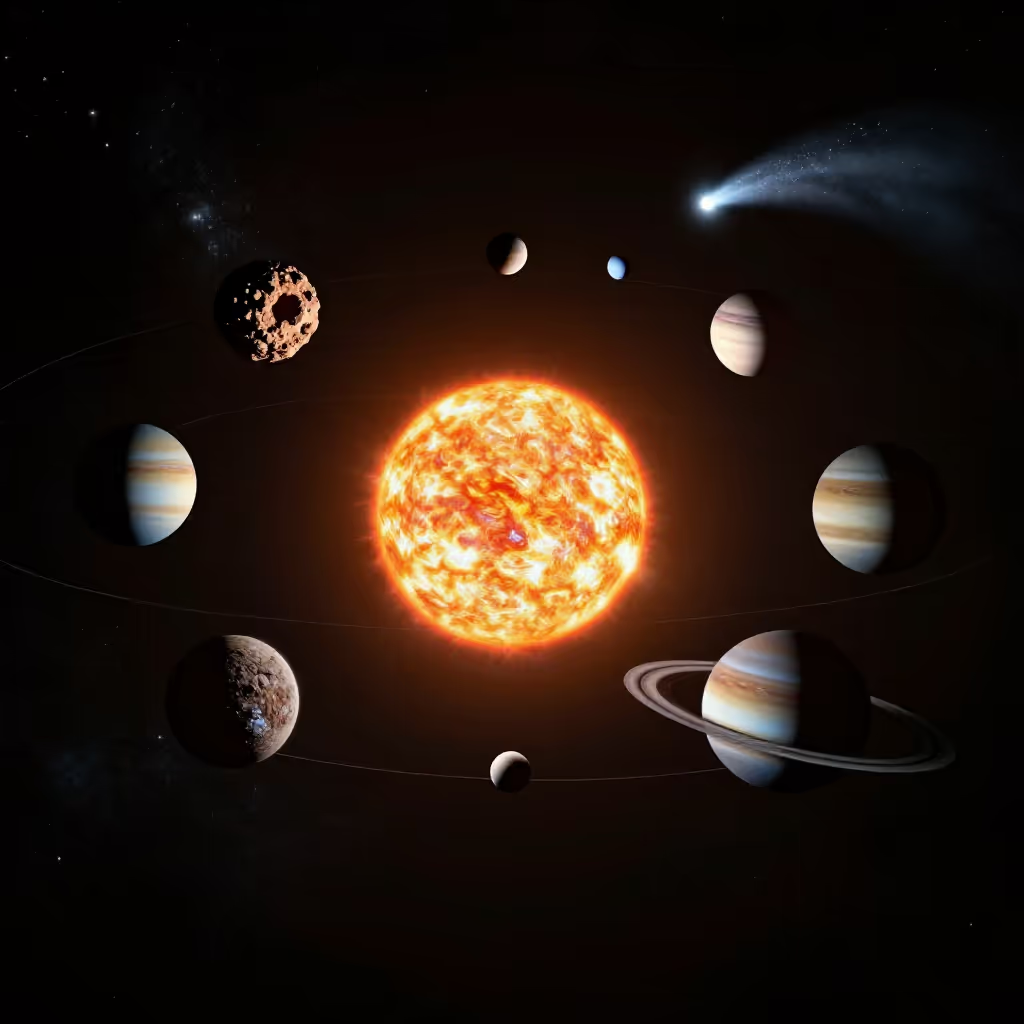
The planetary system consisting of the sun and the celestial bodies that orbit it, including planets, moons, asteroids, and comets.
example
Die Erde ist der dritte Planet in unserem Sonnensystem.
Earth is the third planet in our solar system.
Usage tips
Word composition
The word is made up of 'Sonne' (sun) and 'System' (system). The '-n-' is a linking element that connects the two parts. So it literally describes the system that belongs to the sun.
EXAMPLE
Astronomen entdecken ständig neue Planeten außerhalb unseres Sonnensystems.
Astronomers are constantly discovering new planets outside our solar system.
Use with article
Most of the time, the word refers to our own solar system. Therefore, it is almost always used with the definite article ('das Sonnensystem' — the solar system) or a possessive pronoun ('unser Sonnensystem' — our solar system).
EXAMPLE
Unser Sonnensystem hat acht Planeten.
Our solar system has eight planets.
Typical collocations
Common phrases are 'innerhalb des Sonnensystems' (within the solar system) and 'außerhalb des Sonnensystems' (outside the solar system). Typical verbs in this context are 'erforschen' (to explore), 'entstehen' (to form/arise), or 'durchqueren' (to cross/traverse).
EXAMPLE
Manche Kometen kommen von außerhalb des Sonnensystems.
Some comets come from outside the solar system.
Compare with
confusable
Sonnensystem vs Universum
universe
'das Universum' and 'das Sonnensystem' are easily confused because both have to do with planets, stars, and outer space. 'das Universum' means everything that exists: all of space with all galaxies, stars, and planets. 'das Sonnensystem' is much smaller. It consists of the sun and the celestial bodies that orbit it, for example the planets. Remember: Our solar system is located in the universe.
Sonnensystem
Für das Referat zeichnet Tom das Sonnensystem mit der Sonne in der Mitte.
For the presentation, Tom draws the solar system with the sun in the center.