

spanisch
Spanish
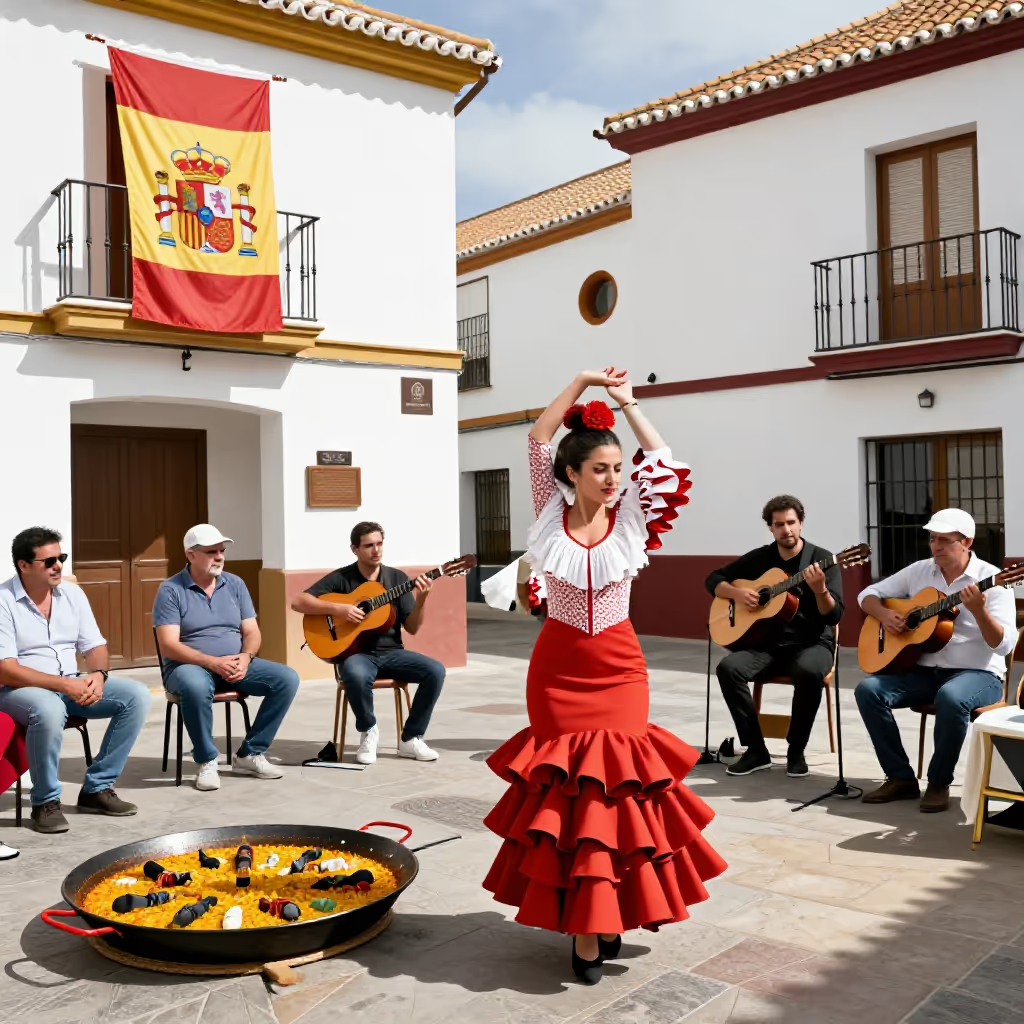
Relating to Spain, its inhabitants, its culture, or its language.
EXAMPLE
Wir haben gestern Abend leckere spanische Tapas gegessen.
We ate delicious Spanish tapas yesterday evening.
Spanish
Loading your saved state.
Spanish
Relating to Spain, its inhabitants, its culture, or its language.
Wir haben gestern Abend leckere spanische Tapas gegessen.
We ate delicious Spanish tapas yesterday evening.

that seems fishy to me
A fixed expression that indicates that something seems strange, incomprehensible, or suspicious to someone.
Er hat eine Ausrede nach der anderen – das kommt mir alles sehr spanisch vor.
He has one excuse after another—that all seems very fishy to me.
The adjective 'spanisch' (Spanish) is derived from the country name 'Spanien' (Spain). The ending '-isch' is a typical ending for adjectives that indicate origin or language.
Die italienische und die spanische Küche haben einige Ähnlichkeiten.
Italian and Spanish cuisine have some similarities.
As an adjective, 'spanisch' (Spanish) is written with a lowercase letter in German. But when referring to the language as a noun, it is capitalized: 'Spanisch' (Spanish).
Ich lerne gerade Spanisch.
I'm learning Spanish right now.
The idiom 'Das kommt mir spanisch vor' (That seems fishy to me) has a fixed structure. The person to whom something seems strange is always in the dative.
Er war plötzlich so freundlich. Das kam mir sofort spanisch vor.
He was suddenly so friendly. That immediately seemed fishy to me.
funny / strange
Komisch can generally mean that something seems strange or unusual. In the fixed expression “Das kommt mir spanisch vor,” spanisch also conveys this impression, but it often suggests stronger incomprehension or suspicion.

Dass der Verkäufer nur Bargeld ohne Quittung verlangt, kommt mir spanisch vor.
It seems fishy to me that the salesperson is asking for cash only, without a receipt.
Dass der Laden heute so früh schließt, kommt mir komisch vor.
It seems strange to me that the store is closing so early today.