

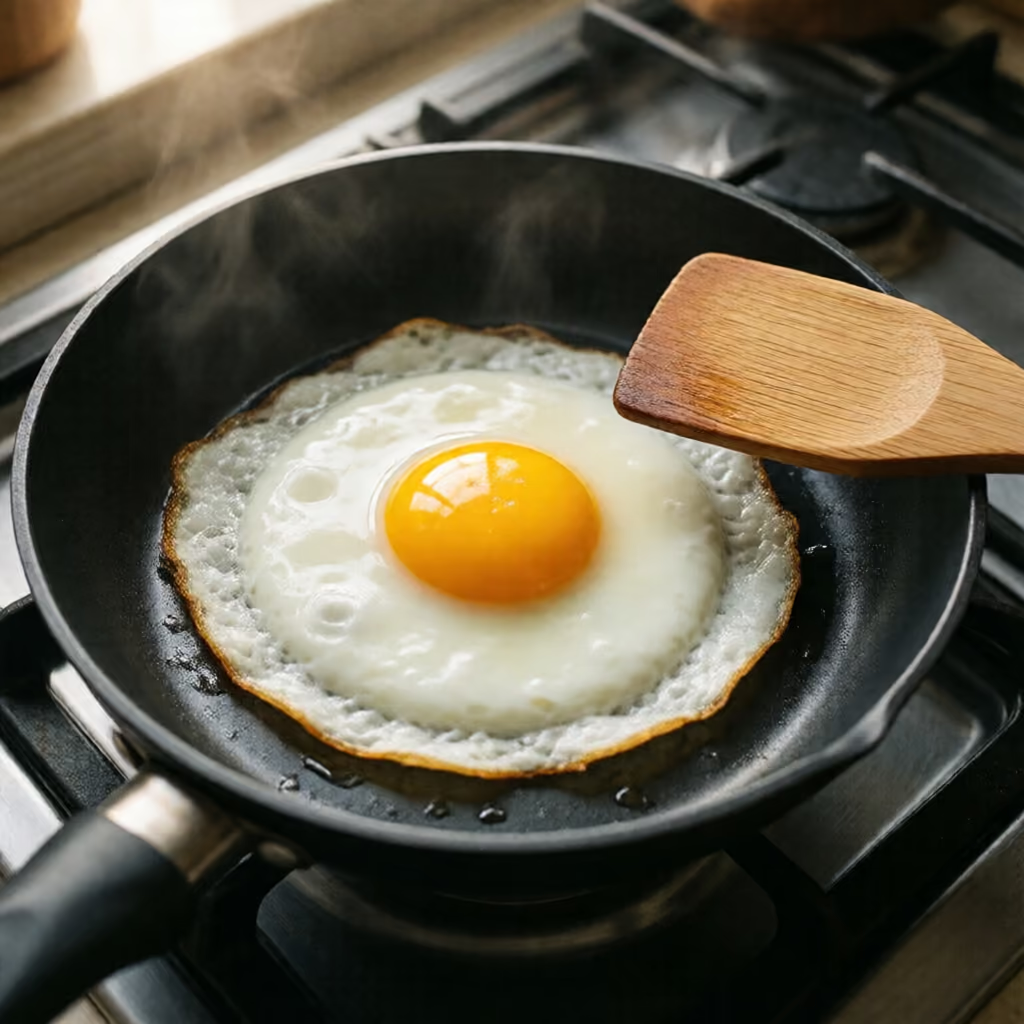
das Spiegelei
fried egg
An egg fried without its shell in a pan so that the white sets and the yolk stays intact.
EXAMPLE
Zum Frühstück esse ich gern ein Spiegelei.
I like to have a fried egg for breakfast.
fried egg
das Spiegelei, die Spiegeleier
Loading your saved state.
fried egg
An egg fried without its shell in a pan so that the white sets and the yolk stays intact.
Zum Frühstück esse ich gern ein Spiegelei.
I like to have a fried egg for breakfast.
| gender | neuter das |
|---|---|
| plural | die Spiegeleier |
| genitive | des Spiegeleis |
| singular | plural | |
|---|---|---|
| nominative | das Spiegelei | die Spiegeleier |
| accusative | das Spiegelei | die Spiegeleier |
| dative | dem Spiegelei | den Spiegeleiern |
| genitive | des Spiegeleis | der Spiegeleier |
The article changes with the case; it is shown in colour.
'Spiegelei' (fried egg) is made up of 'Spiegel' (mirror) and 'Ei' (egg). The name refers to the shiny, visible yolk, which resembles a small mirror.
Für das Abendessen brät mein Vater ein Spiegelei in der Pfanne.
My father is frying an egg in a pan for dinner.
'Spiegelei' (fried egg) is especially common with the verbs 'braten' (to fry) and 'bestellen' (to order). The phrase 'ein Spiegelei auf etwas legen' (to put a fried egg on something) is also often used when describing dishes.
Im Restaurant bestellte sie ein Spiegelei auf Bratkartoffeln.
At the restaurant, she ordered a fried egg on fried potatoes.
When talking about a 'Spiegelei' (fried egg), you often describe how well it is cooked using 'das Eiweiß ist fest' (the white is set) and 'das Eigelb ist noch flüssig' (the yolk is still runny). This lets you specify more precisely how you want the egg fried.
Ich mag mein Spiegelei, wenn das Eiweiß fest und das Eigelb noch flüssig ist.
I like my fried egg with the white set and the yolk still runny.