

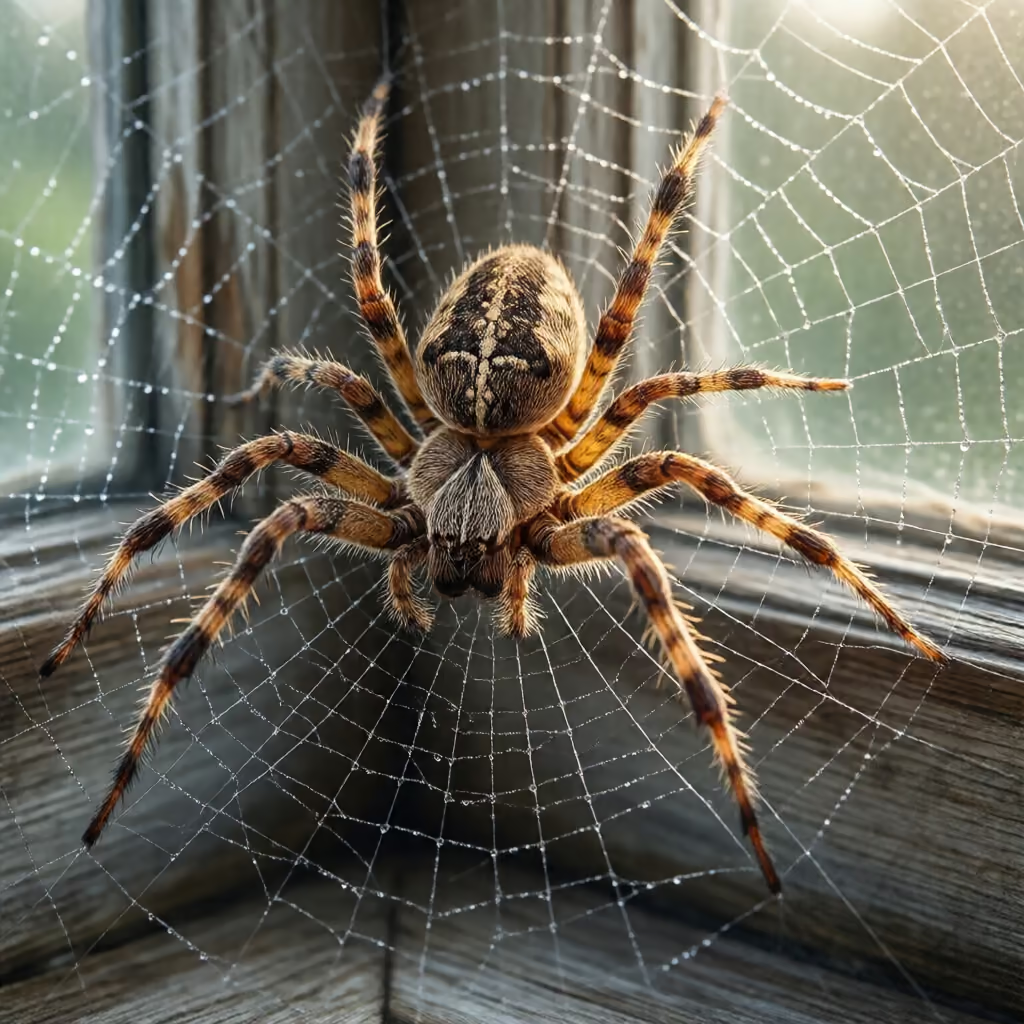
die Spinne
spider
A small animal with eight legs that usually builds a web to catch prey.
EXAMPLE
Eine Spinne sitzt in der Ecke neben dem Fenster.
A spider is sitting in the corner next to the window.
spider
die Spinne, die Spinnen
Loading your saved state.
spider
A small animal with eight legs that usually builds a web to catch prey.
Eine Spinne sitzt in der Ecke neben dem Fenster.
A spider is sitting in the corner next to the window.
| gender | feminine die |
|---|---|
| plural | die Spinnen |
| genitive | der Spinne |
| singular | plural | |
|---|---|---|
| nominative | die Spinne | die Spinnen |
| accusative | die Spinne | die Spinnen |
| dative | der Spinne | den Spinnen |
| genitive | der Spinne | der Spinnen |
The article changes with the case; it is shown in colour.
'Spinne' (spider) appears in many compound words. As the second part, it names types of spiders, such as 'Kreuzspinne' (cross spider) or 'Vogelspinne' (tarantula); as the first part, it usually appears as 'Spinnen-', for example in 'Spinnennetz' (spider web) or 'Spinnenbein' (spider leg).
Im Keller hängt ein großes Spinnennetz.
There is a large spider web hanging in the basement.
Im Zoo haben wir eine riesige Vogelspinne gesehen.
At the zoo, we saw a huge tarantula.
When referring to the animal, 'Spinne' (spider) often appears with verbs such as 'entdecken' (to discover), 'fangen' (to catch), and 'beobachten' (to observe). The phrase 'Angst vor Spinnen haben' (to be afraid of spiders) is also very common.
Wir haben eine große Spinne unter dem Schrank entdeckt.
We discovered a large spider under the cupboard.