

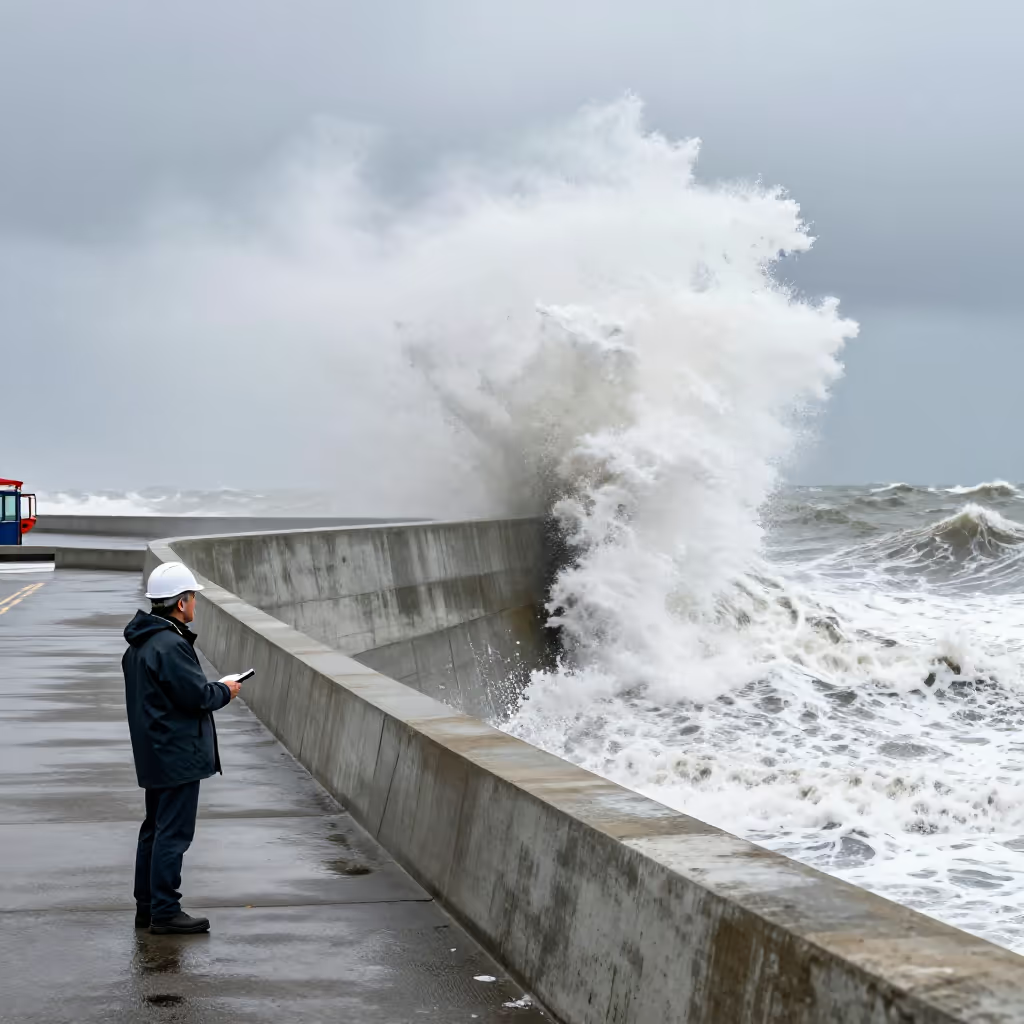
standhalten
to withstand
To resist pressure, an attack, or a strain without giving in or collapsing.
EXAMPLE
Die alte Brücke konnte dem Sturm nicht mehr standhalten.
The old bridge could no longer withstand the storm.
to withstand
Loading your saved state.
to withstand
To resist pressure, an attack, or a strain without giving in or collapsing.
Die alte Brücke konnte dem Sturm nicht mehr standhalten.
The old bridge could no longer withstand the storm.

to withstand
To withstand an abstract challenge such as a look, a test, or criticism without becoming insecure or avoiding it.
Er konnte ihrem prüfenden Blick nicht standhalten und schaute zu Boden.
He could not withstand her scrutinizing gaze and looked down at the floor.

to stand up to
To prove to be valid, correct, or equal to something when examined or compared.
Seine Argumentation wird einer genaueren Überprüfung nicht standhalten.
His argument will not stand up to closer examination.
'Standhalten' (to withstand) is a separable verb. In main clauses, the prefix 'stand' goes at the end; in subordinate clauses and in the infinitive with 'zu', the verb stays together.
Das kleine Zelt hielt dem starken Wind nicht stand.
The small tent did not withstand the strong wind.
This verb always requires an object in the dative. The person or thing that one resists is in the dative.
Die Verteidigung konnte dem Angriff des Gegners standhalten.
The defense was able to withstand the opponent's attack.
The verb is made up of 'stand' and 'halten' (to hold). The literal meaning is 'to hold one's ground' or 'to maintain one's position', which helps explain the figurative meaning.
Trotz des Drucks hielt sie an ihrer Meinung fest und hielt stand.
Despite the pressure, she stuck to her opinion and held her ground.
In this meaning, it is about physical resistance against a force. Typical dative objects are 'der Druck' (the pressure), 'ein Angriff' (an attack), 'eine Belastung' (a strain), or 'der Sturm' (the storm).
Die Staumauer wurde gebaut, um den Wassermassen standzuhalten.
The dam was built to withstand the masses of water.
This meaning describes resisting psychological or social pressure. Typical objects are 'einem Blick' (a gaze), 'der Kritik' (criticism), 'einer Versuchung' (a temptation), or 'einer Befragung' (an interrogation).
Es fiel ihm schwer, der Versuchung standzuhalten und kein Stück Kuchen zu essen.
He found it hard to withstand the temptation and not eat a piece of cake.
to pass / consist / exist
When something is being evaluated, both bestehen and standhalten can express success. Bestehen refers to meeting the specified requirements; standhalten emphasizes that something remains valid or convincing even under critical scrutiny. Use bestehen for a result that has been achieved, and standhalten for resistance that has been demonstrated.

Das neue Material hielt auch einer besonders kritischen Überprüfung stand.
The new material also stood up to particularly critical scrutiny.
Das neue Material hat den vorgeschriebenen Belastungstest bestanden.
The new material passed the prescribed stress test.