

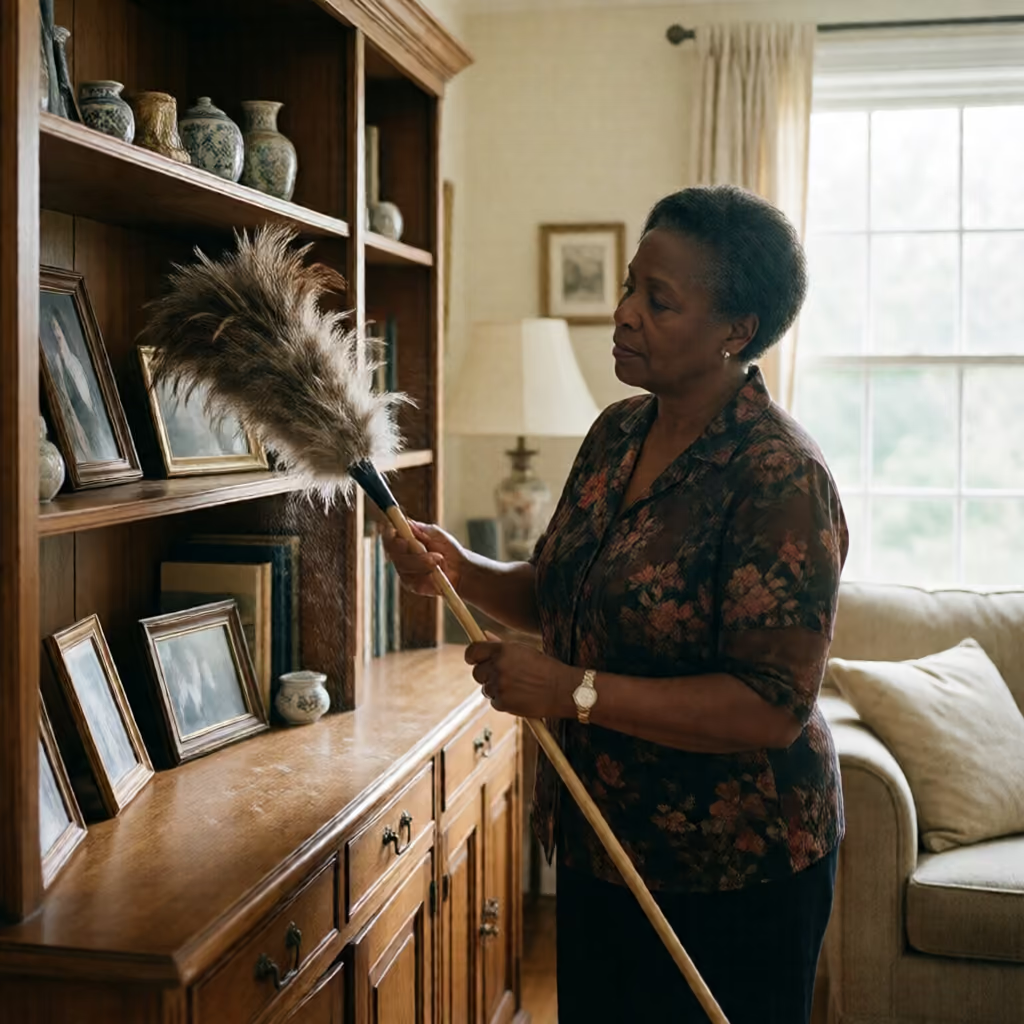
der Staubwedel
duster
A household tool with soft fibers or feathers used to remove dust from furniture and other surfaces.
EXAMPLE
Mit dem Staubwedel entfernte sie den Staub von den Regalen.
She used the duster to remove dust from the shelves.
duster
der Staubwedel, die Staubwedel
Loading your saved state.
duster
A household tool with soft fibers or feathers used to remove dust from furniture and other surfaces.
Mit dem Staubwedel entfernte sie den Staub von den Regalen.
She used the duster to remove dust from the shelves.
| gender | masculine der |
|---|---|
| plural | die Staubwedel |
| genitive | des Staubwedels |
| singular | plural | |
|---|---|---|
| nominative | der Staubwedel | die Staubwedel |
| accusative | den Staubwedel | die Staubwedel |
| dative | dem Staubwedel | den Staubwedeln |
| genitive | des Staubwedels | der Staubwedel |
The article changes with the case; it is shown in colour.
'Staubwedel' (duster) is made up of 'Staub' (dust) and 'Wedel' (a tuft or fan). Here, the second part refers to a tool with many soft, flexible fibers used for wiping.
Der Staubwedel liegt neben dem Schrank.
The duster is next to the cupboard.
'Staubwedel' (duster) is often used with verbs such as 'benutzen' (to use), 'nehmen' (to take), 'schwingen' (to swing), and 'schütteln' (to shake). Other typical combinations include 'mit dem Staubwedel wischen' (to wipe with a duster) and 'mit dem Staubwedel Staub entfernen' (to remove dust with a duster).
Vor dem Besuch nahm sie den Staubwedel und wischte die Bilderrahmen ab.
Before the visitors arrived, she took the duster and wiped down the picture frames.
The tool is usually introduced with 'mit' (with); the surface often follows 'von' (from) with the dative case. The pattern is: 'mit dem Staubwedel Staub von einer Oberfläche entfernen' (to remove dust from a surface with a duster).
Mit einem langen Staubwedel lässt sich Staub auch von hohen Deckenbalken entfernen.
A long duster can also be used to remove dust from high ceiling beams.