


die Strähne
lock
A group of hairs lying or hanging together and standing out from the rest of the hair.
EXAMPLE
Sie strich sich eine Strähne aus der Stirn.
She brushed a lock of hair away from her forehead.
lock / strand
die Strähne, die Strähnen
Loading your saved state.
lock
A group of hairs lying or hanging together and standing out from the rest of the hair.
Sie strich sich eine Strähne aus der Stirn.
She brushed a lock of hair away from her forehead.

to have a good / bad run
To experience repeated good luck or success, or repeated bad luck or failure, for a certain period of time.
Beim Kartenspielen habe ich gerade eine schlechte Strähne und verliere eine Runde nach der anderen.
I'm on a bad run at cards right now and am losing one hand after another.
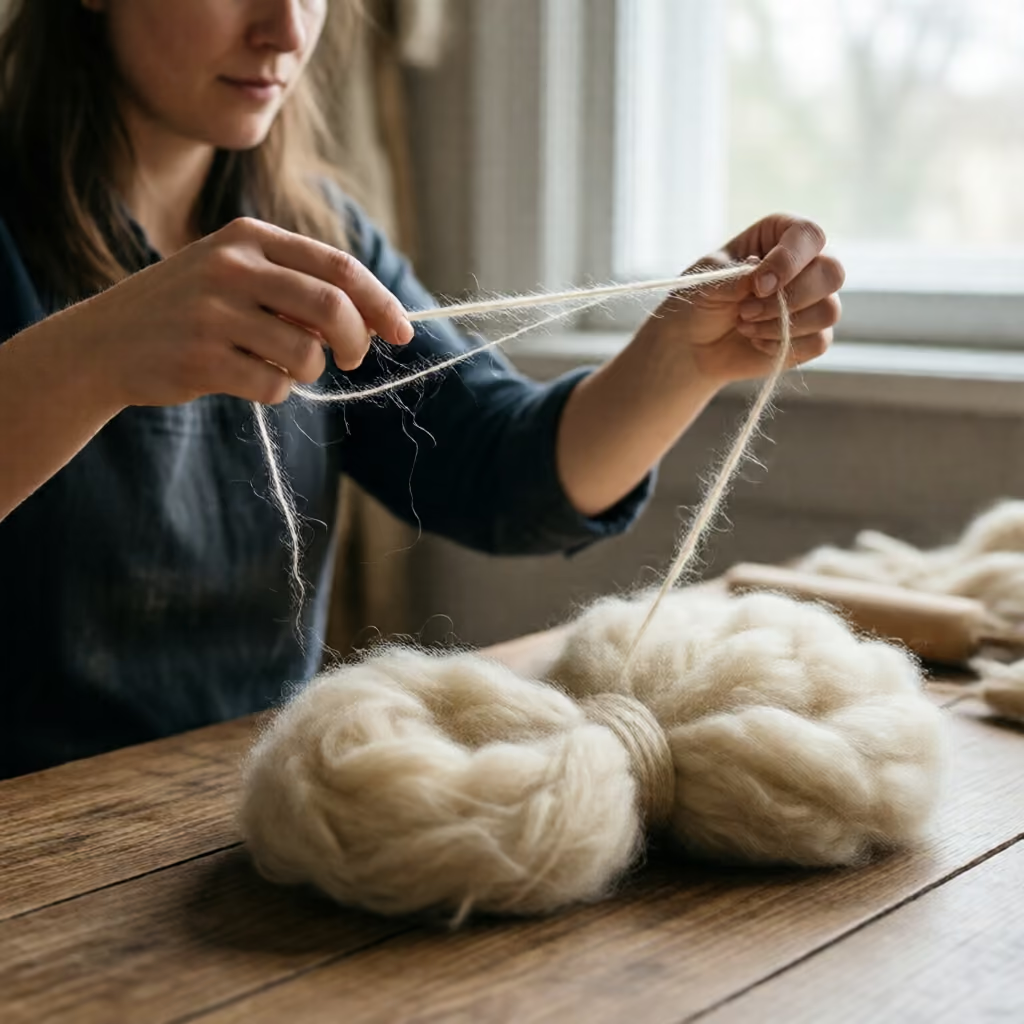
strand
An elongated bundle of fibers or threads lying together, such as wool or flax.
Sie zog eine dünne Strähne aus der ungesponnenen Wolle.
She pulled a thin strand from the unspun wool.
| gender | feminine die |
|---|---|
| plural | die Strähnen |
| genitive | der Strähne |
| singular | plural | |
|---|---|---|
| nominative | die Strähne | die Strähnen |
| accusative | die Strähne | die Strähnen |
| dative | der Strähne | den Strähnen |
| genitive | der Strähne | der Strähnen |
The article changes with the case; it is shown in colour.
With 'Strähne' (lock / strand), the accompanying words usually indicate the meaning: words like 'Haar' (hair), 'Stirn' (forehead), or 'Gesicht' (face) point to hair, while 'Wolle' (wool), 'Flachs' (flax), or 'Faser' (fiber) point to a bundle of fibers. The expression 'eine gute/schlechte Strähne haben' (to have a good/bad run) refers to repeated good luck or bad luck.
Eine lose Strähne fiel ihr ins Gesicht.
A loose lock of hair fell across her face.
Aus der Wolle hing eine lange Strähne heraus.
A long strand hung out of the wool.
Nach mehreren Siegen hat die Mannschaft eine gute Strähne.
After several victories, the team is on a good run.
When referring to hair, 'Strähne' (lock) is often used with verbs such as 'aus dem Gesicht streichen' (to brush away from one's face), 'hinters Ohr stecken' (to tuck behind one's ear), or 'zurückbinden' (to tie back). 'Lose Strähne' (loose lock) and 'lange Strähne' (long lock) are also typical combinations.
Sie steckte eine lose Strähne hinters Ohr.
She tucked a loose lock behind her ear.
In this meaning, 'Strähne' is especially often used with 'haben' (to have) and the adjectives 'gut' (good) or 'schlecht' (bad). The expression describes a phase in which successes or failures keep repeating.
Nach drei gewonnenen Spielen hatte unser Team eine gute Strähne.
After winning three games, our team was on a good run.
When referring to fibers, 'Strähne' (strand) is often used with a material, for example 'eine Strähne aus Wolle' (a strand of wool) or 'eine Strähne Flachs' (a strand of flax). It refers to an elongated bundle that has not yet been processed into finished yarn.
Die Spinnerin nahm eine Strähne aus Wolle und begann, sie zu verarbeiten.
The spinner took a strand of wool and began to process it.