A joking, malicious, or funny action with which you surprise, annoy, or fool someone. Such a joke is 'played' on someone.
example
Die Schüler spielten ihrem Lehrer einen Streich und versteckten die Kreide.
The students played a prank on their teacher and hid the chalk.

Usage tips
Word family
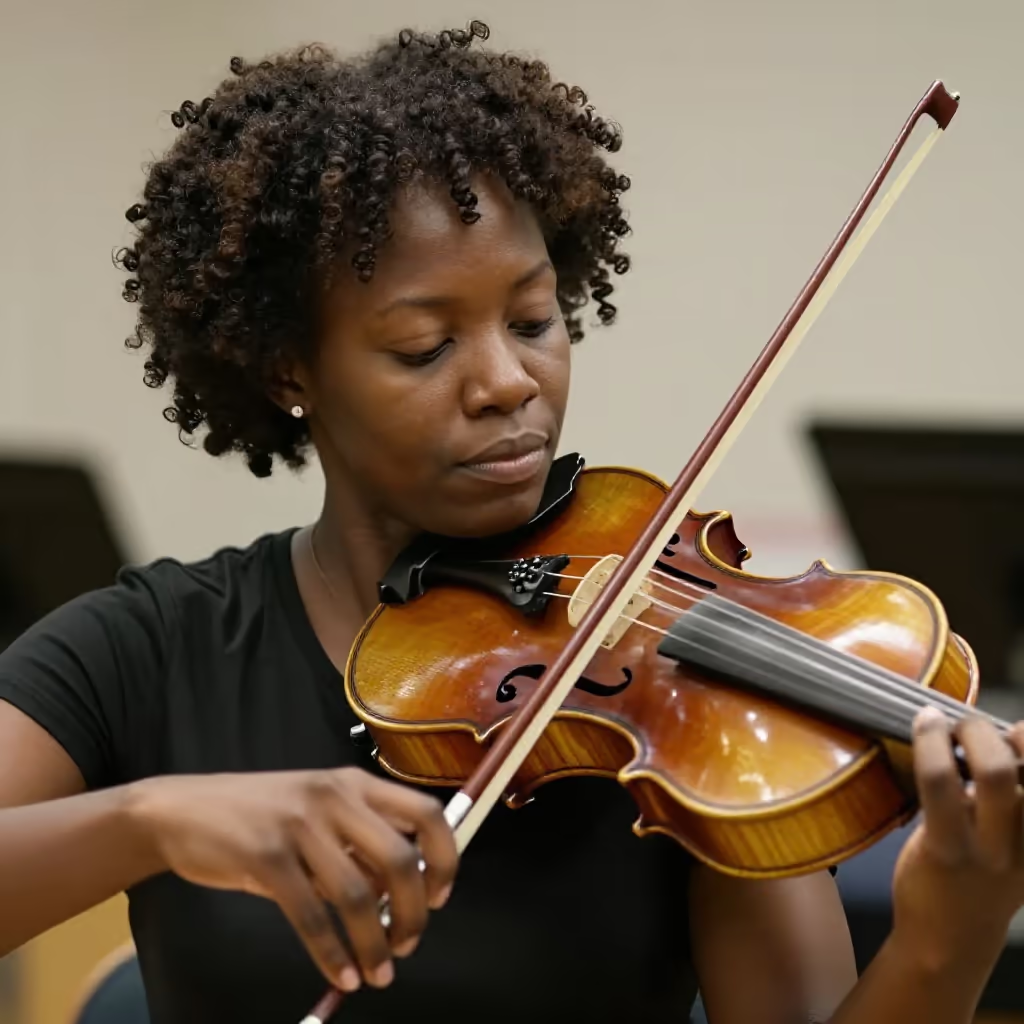
The noun 'der Streich' (prank/stroke/blow) is closely related to the verb 'streichen' (to stroke, to strike). This connection is still easy to recognize in meanings like the bow stroke on a violin or a blow with a sword.
EXAMPLE
Mit einem kräftigen Streich durchtrennte er das Seil.
With a powerful blow, he cut through the rope.
Context clue
You can recognize the meaning of 'Streich' from the context. In connection with musical instruments, it means a bow movement, while verbs like 'spielen' (to play) point to a joke or prank. The expression 'auf einen Streich' always means 'all at once'.
EXAMPLE
Die Kinder haben dem Hausmeister einen harmlosen Streich gespielt.
The children played a harmless prank on the caretaker.
Typical collocation
A 'Streich' (prank) is not 'made' or 'done', but always 'played'. The fixed expression is 'jemandem einen Streich spielen' (to play a prank on someone).
EXAMPLE
Meine Freunde haben mir zum Geburtstag einen lustigen Streich gespielt.
My friends played a funny prank on me for my birthday.
Fixed expression
The expression 'auf einen Streich' (in one go) is a fixed adverbial phrase. It means 'all at the same time' or 'in a single action' and can be placed flexibly in the sentence.
EXAMPLE
Er hat zwei Fliegen mit einer Klappe geschlagen und beide Probleme auf einen Streich gelöst.
He killed two birds with one stone and solved both problems in one go.
Register
The meaning 'blow with a weapon' is old-fashioned and is now used almost only in literary, historical, or fairy-tale-like texts.
EXAMPLE
Der Held parierte den tödlichen Streich des Drachen.
The hero parried the dragon's deadly blow.
Compare with
near_synonym · confusable
Streich vs Spaß
fun / joke
'der Spaß' and 'der Streich' can both refer to something joking. However, 'Spaß' is more general: it can simply be a joke or something not meant seriously. 'Streich' means a specific action used to surprise, trick, or slightly annoy someone. A prank can be funny, but it can also go too far. Learners may confuse the words because a prank is often meant as a joke. If it is only about the lighthearted intention, 'Spaß' fits. If someone actually does something to fool someone, 'Streich' fits.
Streich
Mia spielt ihrem Bruder vor der Reise einen kleinen Streich.
Mia plays a little prank on her brother before the trip.
Spaß
Im Restaurant sagt Daniel aus Spaß, dass er heute der Koch ist.
At the restaurant, Daniel says as a joke that he is the cook today.