

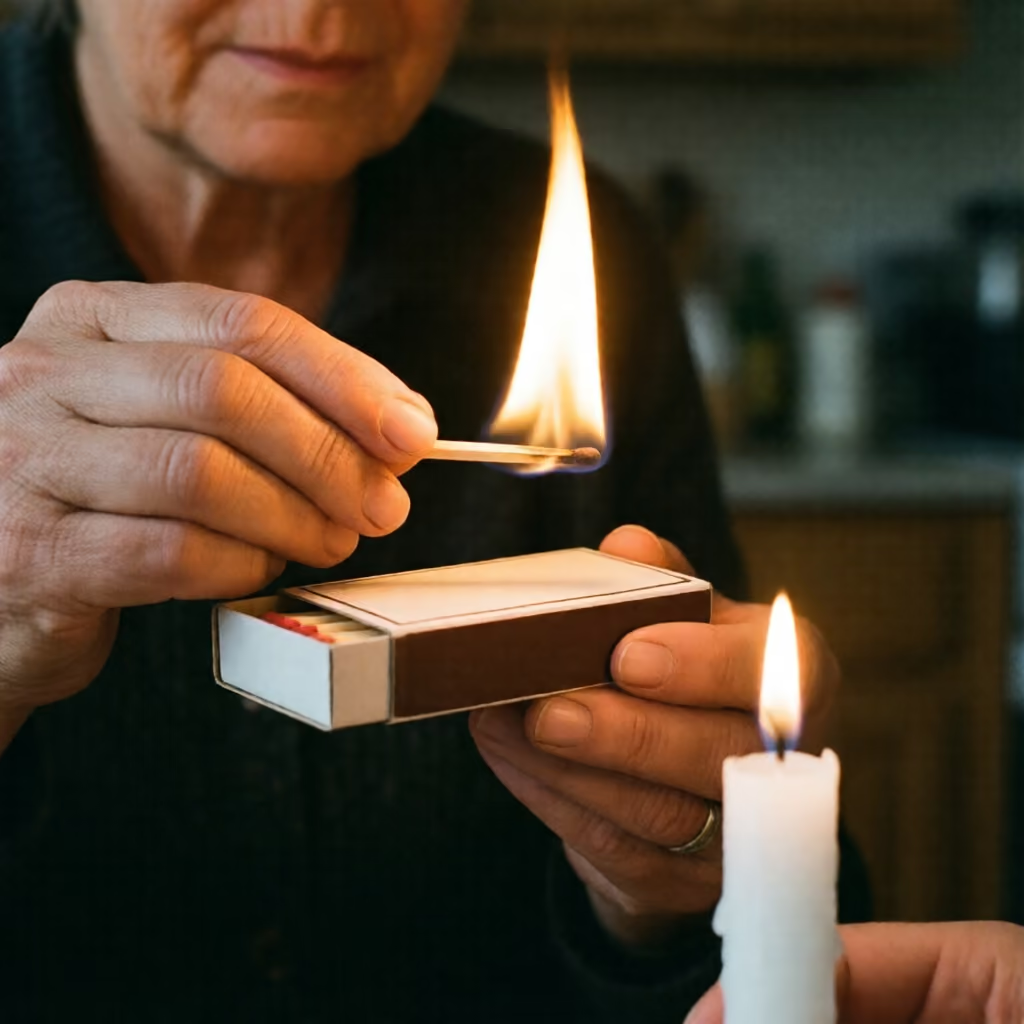
das Streichholz
match
A small wooden stick with a match head that catches fire when rubbed against a suitable surface.
EXAMPLE
Sie zündete die Kerze mit einem Streichholz an.
She lit the candle with a match.
match
das Streichholz, die Streichhölzer
Loading your saved state.
match
A small wooden stick with a match head that catches fire when rubbed against a suitable surface.
Sie zündete die Kerze mit einem Streichholz an.
She lit the candle with a match.
| gender | neuter das |
|---|---|
| plural | die Streichhölzer |
| genitive | des Streichholzes |
| singular | plural | |
|---|---|---|
| nominative | das Streichholz | die Streichhölzer |
| accusative | das Streichholz | die Streichhölzer |
| dative | dem Streichholz | den Streichhölzern |
| genitive | des Streichholzes | der Streichhölzer |
The article changes with the case; it is shown in colour.
„Streichholz“ (match) consists of „Streich-“ and „Holz“ (wood). „Streich-“ belongs to the verb „streichen“ (to rub) and recalls the movement across the striking surface.
Sie strich das Streichholz über die Reibfläche der Schachtel.
She rubbed the match across the striking surface of the box.
Typical collocations are „ein Streichholz anzünden“ (to light a match) and „ein Streichholz ausblasen“ (to blow out a match). You can use these to describe how the flame is created and how you extinguish it again.
Er zündete ein Streichholz an und blies es kurz darauf wieder aus.
He lit a match and blew it out again shortly afterward.
A typical quantity expression is „eine Schachtel Streichhölzer“ (a box of matches). There is no preposition between „Schachtel“ (box) and „Streichhölzer“ (matches).
Für den Campingurlaub kaufte sie eine Schachtel Streichhölzer.
She bought a box of matches for the camping trip.