


der Strich
line / stroke
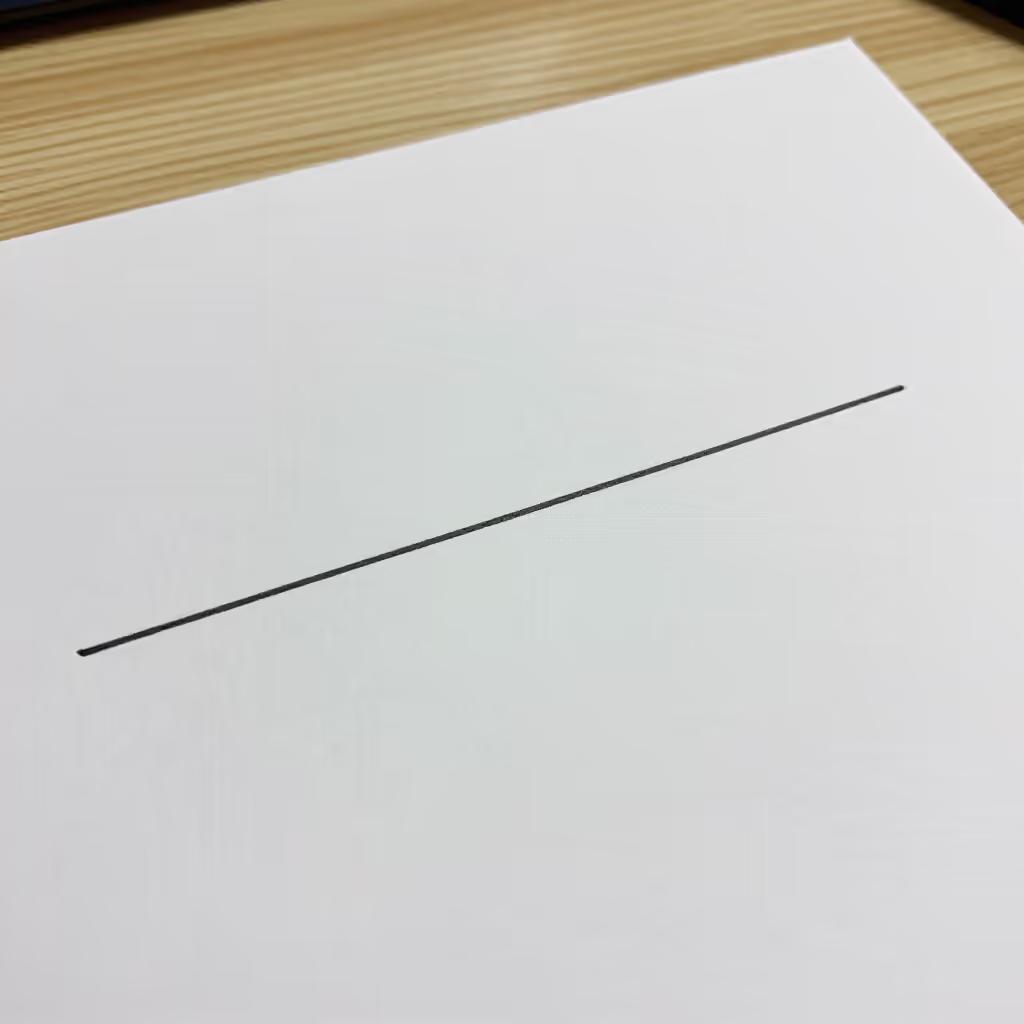
A usually thin and straight line drawn with a writing or drawing instrument.
EXAMPLE
Bitte ziehe einen Strich unter das Ergebnis der Rechnung.
Please draw a line under the result of the calculation.
line / stroke
Loading your saved state.
line / stroke
A usually thin and straight line drawn with a writing or drawing instrument.
Bitte ziehe einen Strich unter das Ergebnis der Rechnung.
Please draw a line under the result of the calculation.

to work the streets
In a fixed expression, the practice of prostitution, usually on the street.
In ihrer Verzweiflung sah sie keinen anderen Ausweg, als auf den Strich zu gehen.
In her desperation, she saw no other way out than to work the streets.

to draw a line under something
To consider a matter finished and no longer want to talk or think about it.
Nach dem langen Streit wollte er endlich einen Strich unter die Sache ziehen und neu anfangen.
After the long argument, he finally wanted to draw a line under the matter and start over.

to go against the grain
To be unpleasant to someone, or to contradict their principles or feelings.
Es geht mir gegen den Strich, wenn Versprechen nicht eingehalten werden.
It goes against the grain for me when promises are not kept.

a beanpole
A colloquial, figurative description of a very thin, frail person.
Er isst kaum etwas und ist nur noch ein Strich in der Landschaft.
He hardly eats anything and is nothing but a beanpole now.
'Der Strich' (the line/stroke) belongs to the word family of the verb 'streichen' (to stroke; to paint; to cross out). A 'Strich' is the result when you move a pen across a piece of paper.
Er strich den falschen Satz mit einem roten Strich durch.
He crossed out the wrong sentence with a red line.
In its basic meaning, 'Strich' (line/stroke) is often combined with the verbs 'ziehen' (to draw) or 'machen' (to make). A very common compound is also 'der Strichcode' (barcode) on products.
Kannst du mit dem Lineal einen geraden Strich ziehen?
Can you draw a straight line with the ruler?
The expression 'auf den Strich gehen' (to work the streets) is a fixed idiom and a colloquial expression for engaging in street prostitution. It is used only in this specific context.
Der Film handelt von jungen Menschen, die gezwungen werden, auf den Strich zu gehen.
The film is about young people who are forced to work the streets.
The idiom 'einen Strich unter etwas ziehen' (to draw a line under something) means to consider something finished. The thing being ended comes after the preposition 'unter' in the accusative.
Nach dem Streit zogen sie einen Strich unter die Vergangenheit und vertrugen sich wieder.
After the argument, they drew a line under the past and made up again.
The idiom 'jemandem gegen den Strich gehen' (to go against someone's grain) uses the dative. The person who finds something unpleasant is in the dative.
Es geht mir gegen den Strich, wenn Leute im Zug laut telefonieren.
It goes against the grain for me when people talk loudly on the phone on the train.
line
Linie and Strich can both refer to something drawn. Linie tends to emphasize a longer or continuous course, while Strich refers to a single, specific stroke made with a writing or drawing instrument. For a short, single mark, Strich is therefore usually more appropriate.
Mach neben dem ersten Punkt einen kurzen Strich.
Make a short stroke next to the first dot.
Zieh eine gerade Linie vom ersten Punkt bis zum letzten.
Draw a straight line from the first dot to the last.