

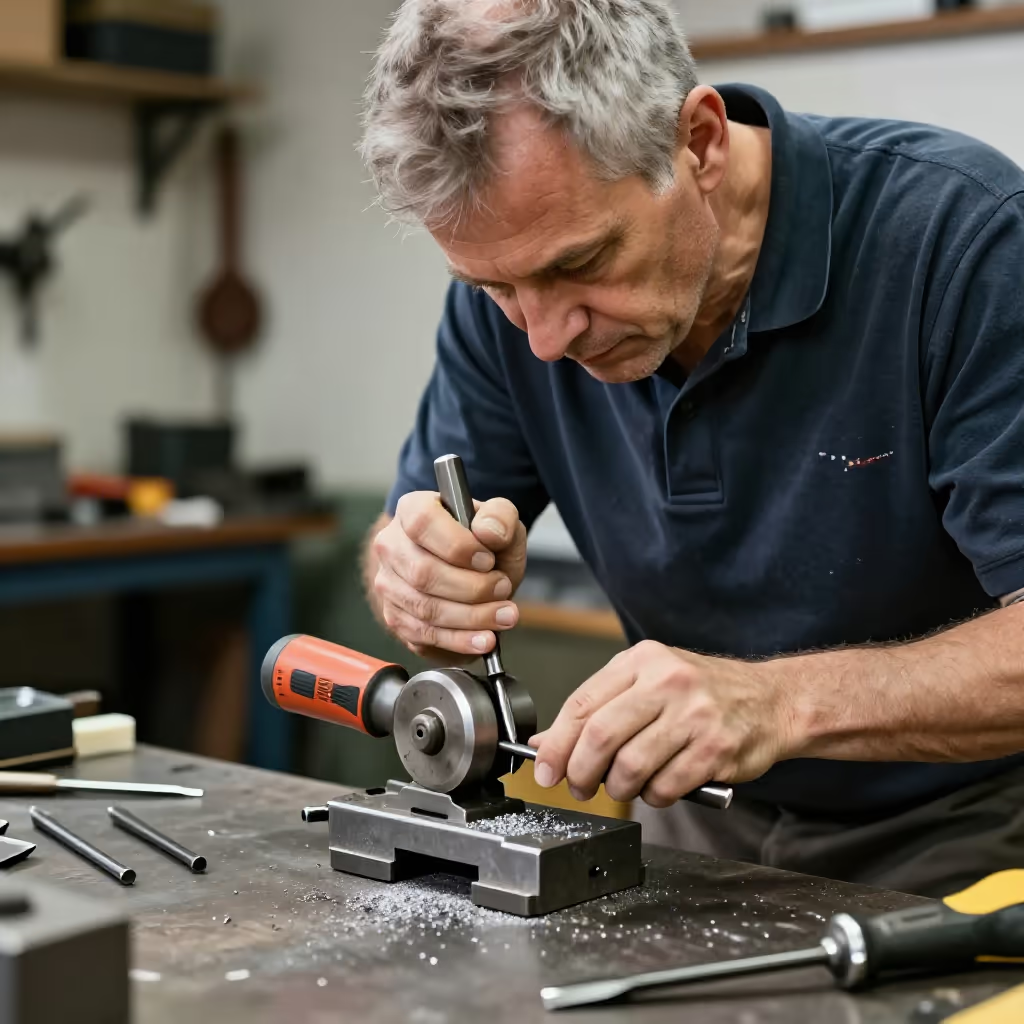
stumpfen
to blunt
To remove or reduce the sharpness or point of an object, usually a tool such as a knife. To make something less sharp or pointed.
EXAMPLE
Der harte Stein stumpfte die Klinge der Axt.
The hard stone blunted the blade of the axe.
to blunt
Loading your saved state.
to blunt
To remove or reduce the sharpness or point of an object, usually a tool such as a knife. To make something less sharp or pointed.
Der harte Stein stumpfte die Klinge der Axt.
The hard stone blunted the blade of the axe.
The verb 'stumpfen' (to blunt) is the action corresponding to the adjective 'stumpf' (blunt/dull). When you 'stumpfen' something, you make it blunt.
Pass auf, dass du das Messer nicht an dem harten Material stumpfst.
Be careful not to blunt the knife on the hard material.
'Stumpfen' (to blunt) is usually used transitively, meaning it requires an accusative object. Someone or something blunts something else.
Häufiger Gebrauch hat die Schere gestumpft.
Frequent use has blunted the scissors.
Typical objects that are blunted are sharp tools or objects. These include 'eine Klinge' (a blade), 'ein Messer' (a knife), 'eine Schere' (scissors), or 'eine Spitze' (a point/tip).
Der Koch muss seine Messer regelmäßig schärfen, da sie schnell stumpfen.
The cook has to sharpen his knives regularly because they become blunt quickly.
to defuse
Both verbs can express making a knife less dangerous. “Stumpfen” describes a change to the blade’s edge itself, while “entschärfen” focuses more on removing the danger it poses. Use “stumpfen” when the reduced sharpness matters, and “entschärfen” when safety is the main concern.

Der Hausmeister stumpfte das alte Messer, damit seine Klinge nicht mehr so scharf war.
The caretaker blunted the old knife so that its blade was no longer as sharp.
Der Hausmeister entschärfte das alte Messer, damit sich niemand an der scharfen Klinge verletzte.
The caretaker made the old knife safe so that no one would injure themselves on its sharp blade.