

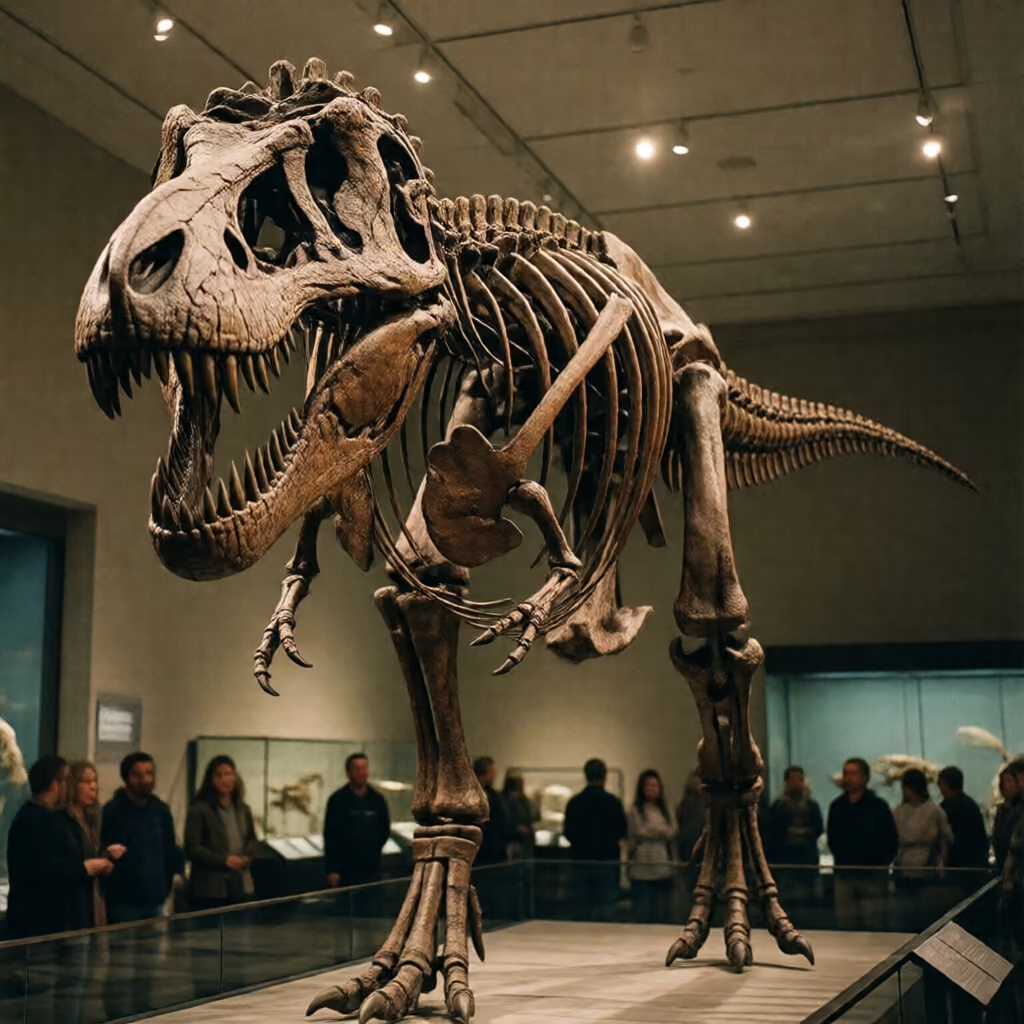
der T-Rex
T. rex
Short form for Tyrannosaurus rex, a large, bipedal predatory dinosaur species that lived about 66 million years ago.
EXAMPLE
Im Museum kann man das Skelett eines T-Rex sehen.
You can see the skeleton of a T. rex in the museum.
T. rex
der T-Rex, die T-Rex
Loading your saved state.
T. rex
Short form for Tyrannosaurus rex, a large, bipedal predatory dinosaur species that lived about 66 million years ago.
Im Museum kann man das Skelett eines T-Rex sehen.
You can see the skeleton of a T. rex in the museum.
| gender | masculine der |
|---|---|
| plural | die T-Rex |
| genitive | des T-Rex |
| singular | plural | |
|---|---|---|
| nominative | der T-Rex | die T-Rex |
| accusative | den T-Rex | die T-Rex |
| dative | dem T-Rex | den T-Rex |
| genitive | des T-Rex | der T-Rex |
The article changes with the case; it is shown in colour.
'T-Rex' can appear at the beginning of a compound, for example in 'T-Rex-Figur' (T. rex figure) or 'T-Rex-Kostüm' (T. rex costume). The last part names the object; 'T-Rex' shows which animal is depicted.
Zum Fasching trägt Mia ein T-Rex-Kostüm.
Mia is wearing a T. rex costume for Carnival.
The short form 'T-Rex' is especially common in children's books, films, and conversations about dinosaurs. You can also use it in a school presentation about dinosaurs.
In ihrem Referat erklärt Lea, wie ein T-Rex seine Beute jagte.
In her presentation, Lea explains how a T. rex hunted its prey.
When describing fossil finds, 'der Schädel eines T-Rex' (the skull of a T. rex), 'die Zähne eines T-Rex' (the teeth of a T. rex), and 'das Skelett eines T-Rex' (the skeleton of a T. rex) are typical collocations. 'Eines T-Rex' indicates which animal the body parts belong to.
Die Forscher untersuchen die Zähne eines T-Rex.
The researchers are examining the teeth of a T. rex.