

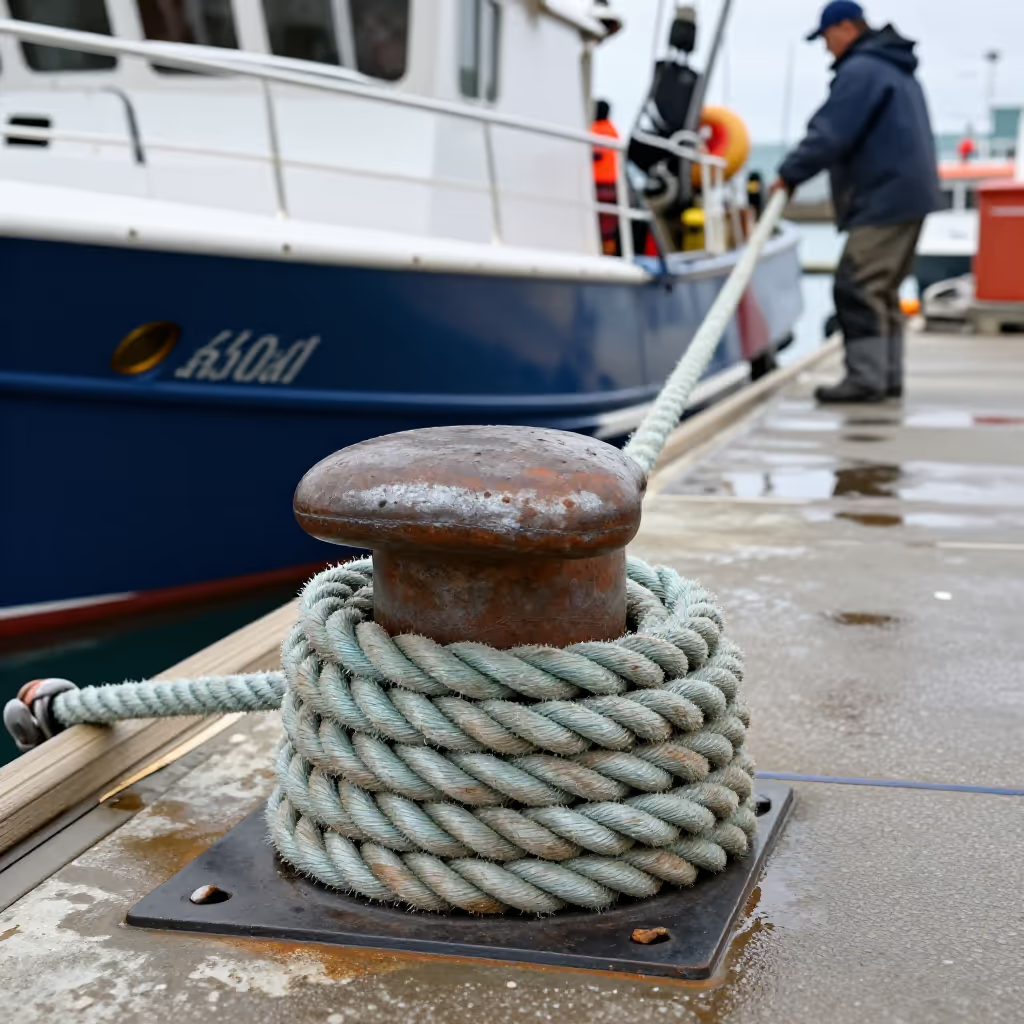
das Tau
rope
A very thick and strong rope used especially in shipping, climbing, or for securing heavy loads.
EXAMPLE
Das Schiff wurde mit einem dicken Tau am Pier festgemacht.
The ship was secured to the pier with a thick rope.
rope
Loading your saved state.
rope
A very thick and strong rope used especially in shipping, climbing, or for securing heavy loads.
Das Schiff wurde mit einem dicken Tau am Pier festgemacht.
The ship was secured to the pier with a thick rope.
The article is crucial with this word. 'Das Tau' (neuter) is the thick rope. There is also 'der Tau' (masculine), which means the moisture in the morning (dew).
Die Bergsteiger sicherten sich mit einem Tau.
The climbers secured themselves with a rope.
In the field of shipping, there are fixed expressions with 'Tau' (rope). You can 'die Taue loswerfen' (cast off the ropes, to depart) or 'mit Tauen festmachen' (secure with ropes, to dock) a ship.
Der Kapitän gab den Befehl, die Taue loszuwerfen.
The captain gave the order to cast off the ropes.
Since a rope has to be very sturdy, it is often described with adjectives such as 'dick' (thick), 'stark' (strong), or 'reißfest' (tear-resistant).
Für diese schwere Last brauchen wir ein besonders reißfestes Tau.
For this heavy load, we need an especially tear-resistant rope.
leash / line
Leine and Tau can both be used to hold a boat at the shore. In this context, Leine primarily describes the fastening material by its function. Tau emphasizes that it is especially thick and strong, so it is more suitable when high load-bearing capacity is important.

Vor dem Sturm befestigt Jana das kleine Boot mit einem starken Tau am Steg.
Before the storm, Jana ties the small boat to the dock with a strong rope.
Im ruhigen Hafen befestigt Jana das kleine Boot mit einer Leine am Steg.
In the calm harbor, Jana ties the small boat to the dock with a line.