

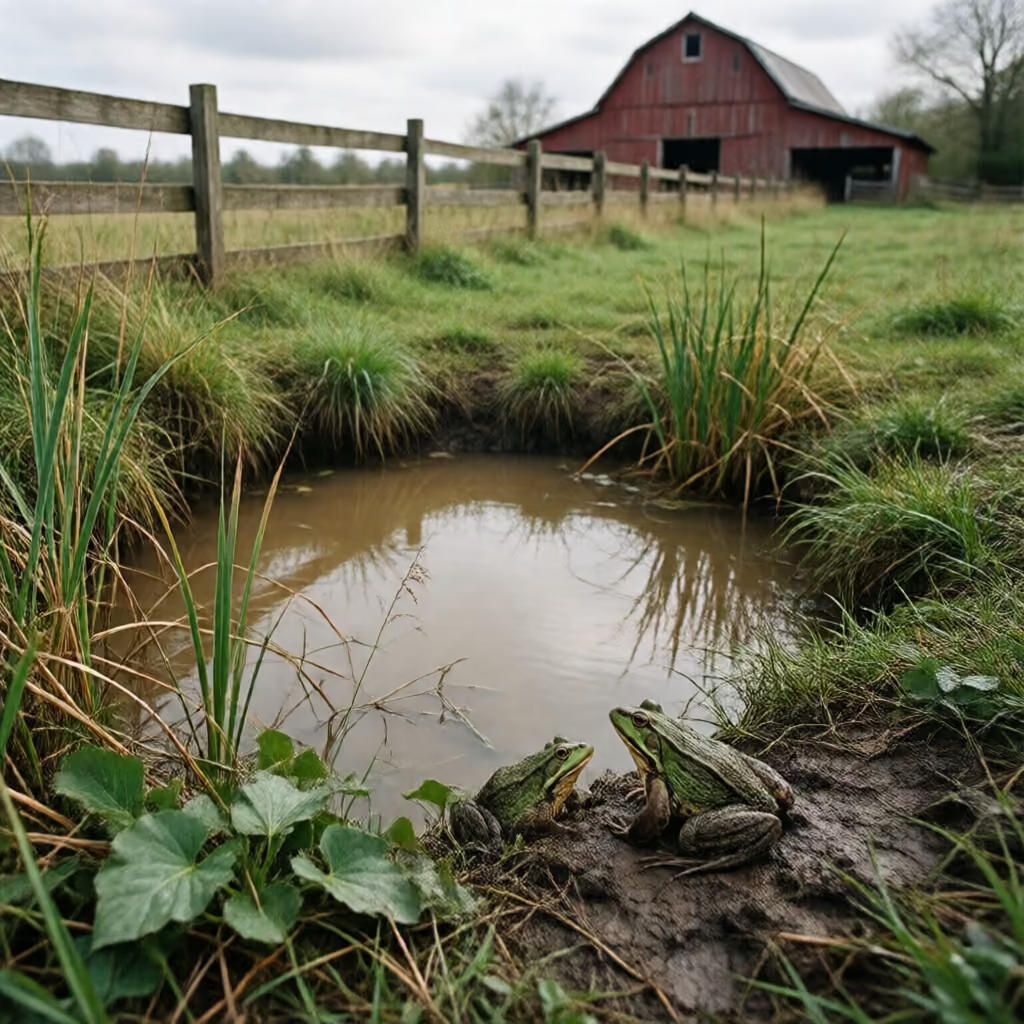
der Tümpel
pond
A small body of usually still water, often in a natural hollow and frequently containing murky or muddy water.
Hinter dem Bauernhof liegt ein kleiner Tümpel, in dem Frösche leben.
Behind the farm is a small pond where frogs live.
pond
der Tümpel, die Tümpel
Loading your saved state.

pond
A small body of usually still water, often in a natural hollow and frequently containing murky or muddy water.
Hinter dem Bauernhof liegt ein kleiner Tümpel, in dem Frösche leben.
Behind the farm is a small pond where frogs live.
| gender | masculine der |
|---|---|
| plural | die Tümpel |
| genitive | des Tümpels |
| singular | plural | |
|---|---|---|
| nominative | der Tümpel | die Tümpel |
| accusative | den Tümpel | die Tümpel |
| dative | dem Tümpel | den Tümpeln |
| genitive | des Tümpels | der Tümpel |
The article changes with the case; it is shown in colour.
'Tümpel' (pond) is often used with descriptive adjectives such as 'klein' (small), 'schlammig' (muddy), 'trüb' (murky), or 'stinkend' (smelly). References to animals are also typical, for example frogs or insects in a pond.
Neben dem Wald entdeckten die Kinder einen kleinen, schlammigen Tümpel.
Beside the forest, the children discovered a small, muddy pond.
Words such as 'Frösche' (frogs), 'Kaulquappen' (tadpoles), 'Schilf' (reeds), 'Schlamm' (mud), or 'stehendes Wasser' (still water) usually point to this meaning. 'Tümpel' (pond) generally refers to a natural body of water that is neither large nor deep.
Im Tümpel schwammen zahlreiche Kaulquappen zwischen den Wasserpflanzen.
Numerous tadpoles were swimming among the aquatic plants in the pond.
For animals or plants located there, 'in' is often used with the dative: 'in einem Tümpel' (in a pond). For movement into it, 'in' is used with the accusative.
In einem Tümpel am Waldrand leben mehrere Molche.
Several newts live in a pond at the edge of the forest.
Nach dem Regen lief das Wasser in den Tümpel.
After the rain, the water flowed into the pond.