

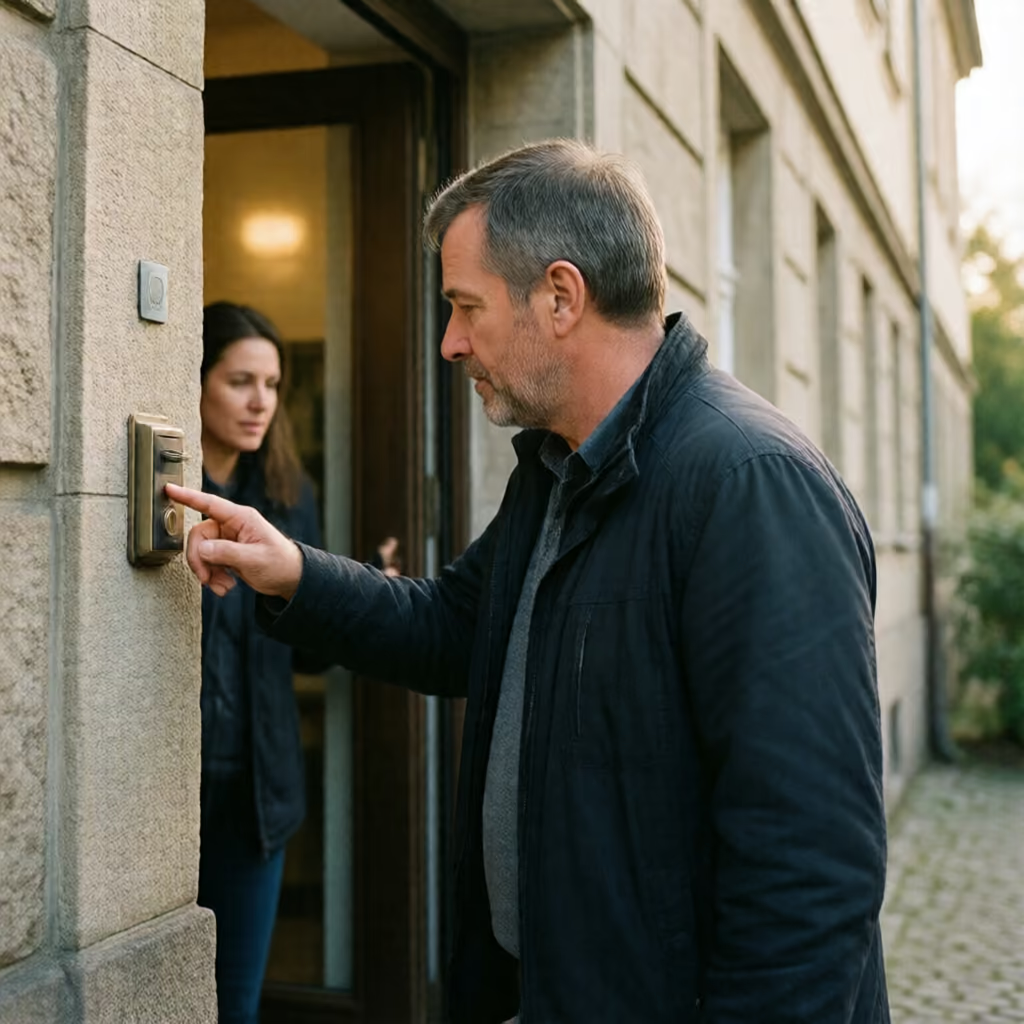
die Türglocke
doorbell
A bell or buzzer at a door that visitors use to produce an audible signal to attract attention.
EXAMPLE
Als die Türglocke läutete, ging sie zur Tür und öffnete.
When the doorbell rang, she went to the door and opened it.
doorbell
die Türglocke, die Türglocken
Loading your saved state.
doorbell
A bell or buzzer at a door that visitors use to produce an audible signal to attract attention.
Als die Türglocke läutete, ging sie zur Tür und öffnete.
When the doorbell rang, she went to the door and opened it.
| gender | feminine die |
|---|---|
| plural | die Türglocken |
| genitive | der Türglocke |
| singular | plural | |
|---|---|---|
| nominative | die Türglocke | die Türglocken |
| accusative | die Türglocke | die Türglocken |
| dative | der Türglocke | den Türglocken |
| genitive | der Türglocke | der Türglocken |
The article changes with the case; it is shown in colour.
'Türglocke' (doorbell) is made up of 'Tür' (door) and 'Glocke' (bell). The basic word 'Glocke' is specified more precisely by 'Tür': it refers to a bell at a door.
Die alte Türglocke hängt neben dem Eingang.
The old doorbell hangs next to the entrance.
The verbs 'läuten' (to ring), 'klingeln' (to ring) and 'ertönen' (to sound) are especially common with 'Türglocke' (doorbell). In these sentences, the doorbell is usually the subject.
Plötzlich klingelte die Türglocke, und der Hund begann zu bellen.
Suddenly, the doorbell rang, and the dog began to bark.
Sentences with 'Türglocke' (doorbell) are often followed by a reaction from the person inside, such as 'zur Tür gehen' (to go to the door), 'öffnen' (to open) or 'nachsehen' (to check). This describes what happens after the signal.
Die Türglocke ertönte, und er sah erst durch den Spion nach, wer draußen stand.
The doorbell sounded, and he first looked through the peephole to see who was outside.