

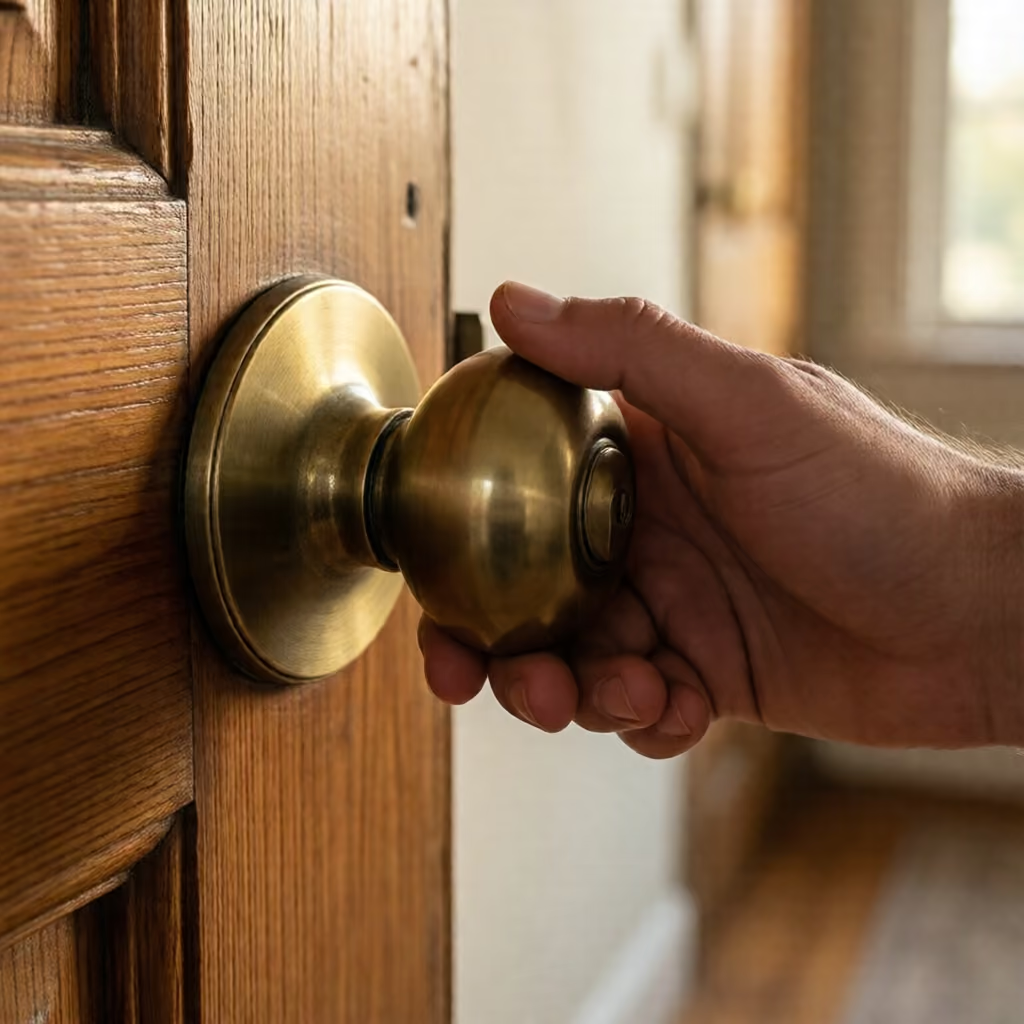
der Türknauf
doorknob
A usually round handle on a door, used to open or close it.
EXAMPLE
Der Türknauf an der Haustür ist locker.
The doorknob on the front door is loose.
doorknob
der Türknauf, die Türknäufe
Loading your saved state.
doorknob
A usually round handle on a door, used to open or close it.
Der Türknauf an der Haustür ist locker.
The doorknob on the front door is loose.
| gender | masculine der |
|---|---|
| plural | die Türknäufe |
| genitive | des Türknaufes |
| singular | plural | |
|---|---|---|
| nominative | der Türknauf | die Türknäufe |
| accusative | den Türknauf | die Türknäufe |
| dative | dem Türknauf | den Türknäufen |
| genitive | des Türknaufes des Türknaufs | der Türknäufe |
The article changes with the case; it is shown in colour.
'Türknauf' (doorknob) is made up of 'Tür' (door) and 'Knauf' (knob). The second part refers to a round handle, so together they mean a handle on a door.
Der Türknauf der alten Zimmertür ist aus Messing.
The doorknob on the old room door is made of brass.
'Türknauf' (doorknob) is often used with verbs such as 'drehen' (to turn), 'drücken' (to push), 'festhalten' (to hold on to), and 'reparieren' (to repair). The phrase 'am Türknauf drehen' (to turn the doorknob) is especially common.
Sie drehte am Türknauf, aber die Tür ließ sich nicht öffnen.
She turned the doorknob, but the door wouldn't open.
The preposition 'an' is usually used to describe location: something is 'an der Tür' (at or on the door) or 'am Türknauf' (at or on the doorknob). Movements or actions are also often described using 'am Türknauf' (at or on the doorknob).
Er hielt sich am Türknauf fest, als der Wind die Tür aufriss.
He held on to the doorknob as the wind flung the door open.