


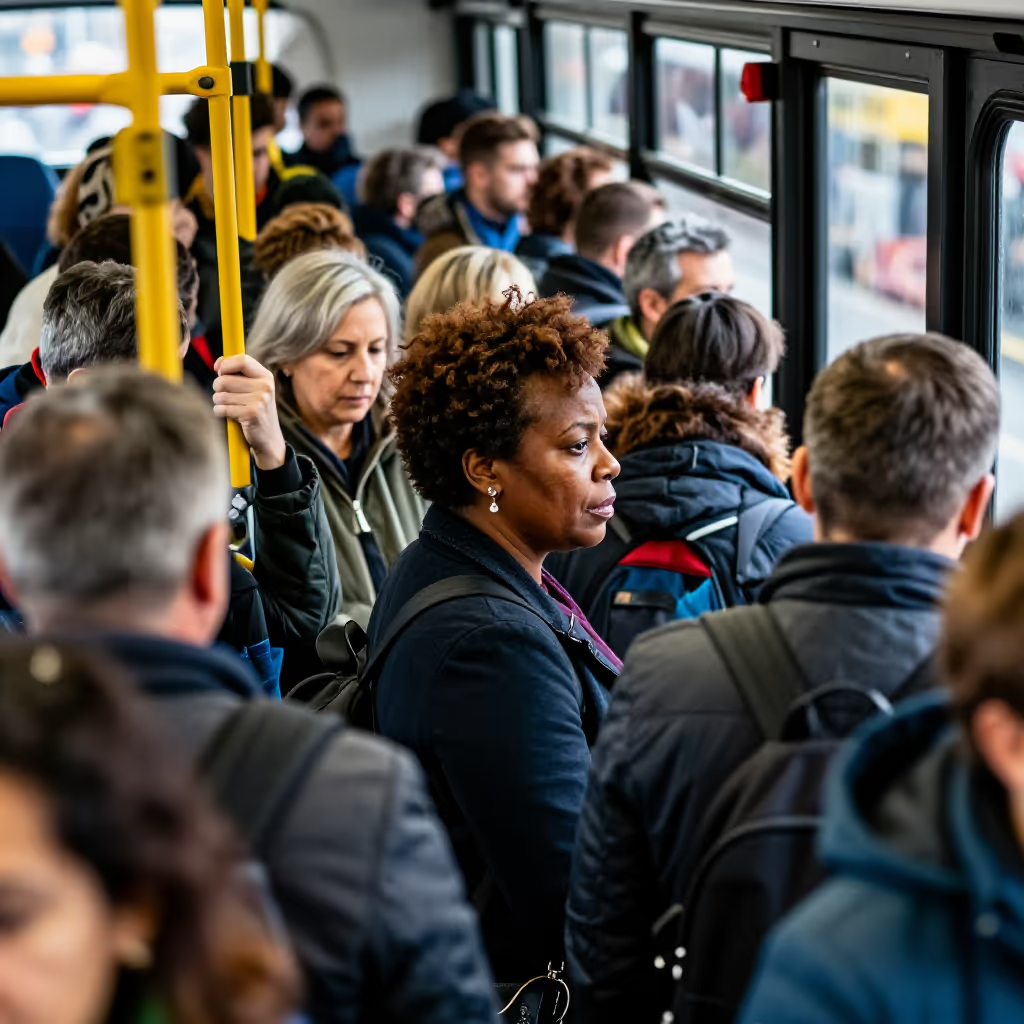
So full of people or things that it is uncomfortably cramped and hardly any space is left.
example
Am ersten Ferientag war der Zug nach Berlin komplett überfüllt.
On the first day of the school holidays, the train to Berlin was completely overcrowded.
Usage tips
Word structure
'Überfüllt' (overcrowded) is the past participle of the verb 'überfüllen' (to overfill). The prefix 'über-' here means 'too much,' so something is 'überfüllt' when it is 'filled too full.'
EXAMPLE
Der Papierkorb ist schon wieder überfüllt.
The wastepaper basket is already overflowing again.
Use with 'mit'
If you want to say exactly what something is overcrowded with, you use the preposition 'mit' followed by the dative.
EXAMPLE
Die Altstadt war mit Touristen überfüllt.
The old town was overcrowded with tourists.
Typical collocations
The adjective is very often used for places or means of transport. Typical combinations are 'ein überfüllter Bus' (an overcrowded bus), 'eine überfüllte U-Bahn' (an overcrowded subway), or 'ein überfüllter Raum' (an overcrowded room).
EXAMPLE
Ich nehme lieber den nächsten Bus, dieser ist mir zu überfüllt.
I'd rather take the next bus; this one is too overcrowded for me.
Compare with
near_synonym · confusable
überfüllt vs voll
full
'voll' and 'überfüllt' both describe that there is a lot in a room, vehicle, or container. 'voll' can be neutral: there is simply no space, or hardly any space, left. 'überfüllt' is stronger and sounds negative. It means that there are too many people or things there and it becomes uncomfortably cramped. The words can be confused because both express 'a lot of contents'. If you are only saying that there is no space left, 'voll' fits. If it is too cramped and uncomfortable, 'überfüllt' fits better.
überfüllt
Am Montagmorgen ist die U-Bahn oft überfüllt.
On Monday mornings, the subway is often overcrowded.
voll
Der Kühlschrank ist voll, weil wir am Wochenende eingekauft haben.
The refrigerator is full because we went shopping at the weekend.