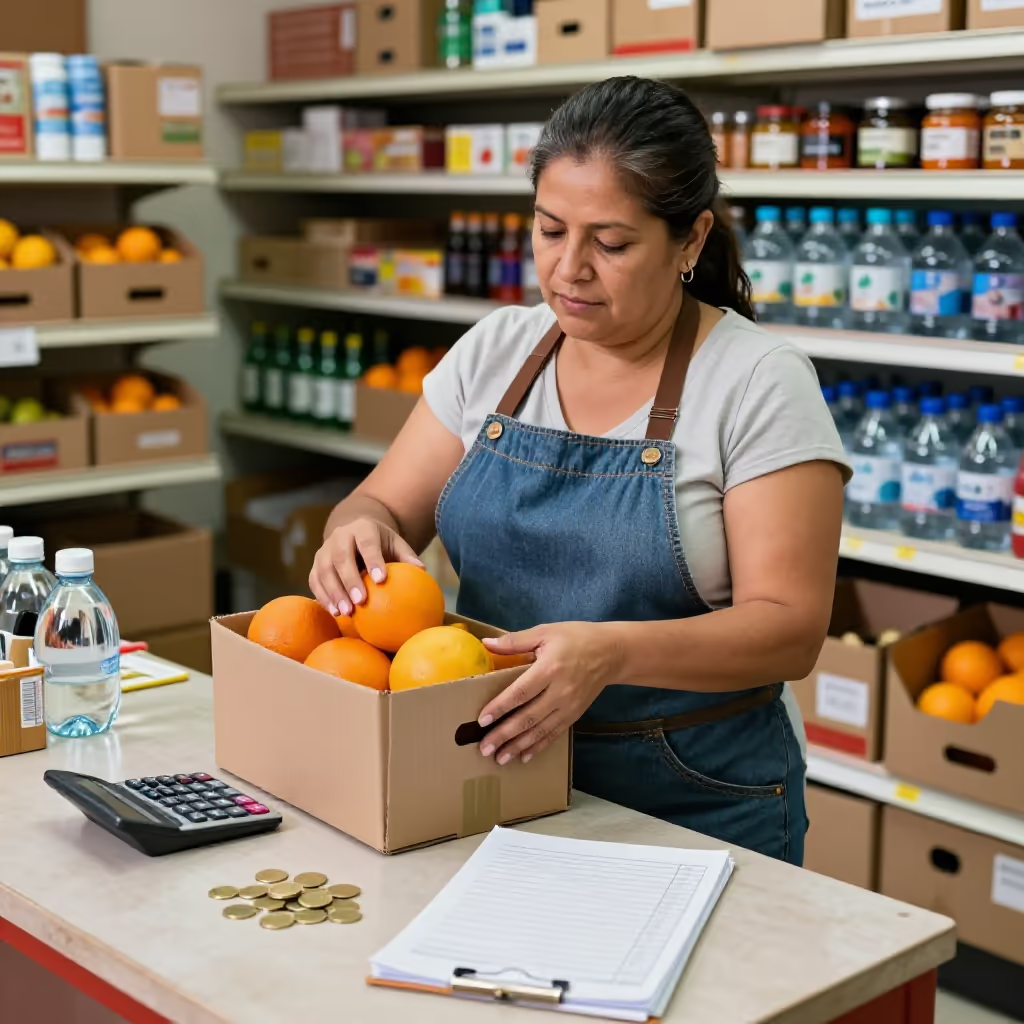
An amount that remains after all costs or consumption have been deducted; a surplus of money, goods, or resources.
example
Das Unternehmen hat im letzten Geschäftsjahr einen Überschuss von fünf Millionen Euro erwirtschaftet.
The company generated a surplus of five million euros in the last fiscal year.

Usage tips
Word composition
The word consists of 'über' (over) and 'Schuss' (shot). Figuratively, it describes something that 'shoots beyond' the normal measure or target and is therefore left over.
EXAMPLE
Durch gute Planung entstand ein Überschuss im Budget.
Good planning created a surplus in the budget.
Fixed preposition
'Überschuss' (surplus) is very often used with the preposition 'an' followed by a noun in the dative to say what there is too much of.
EXAMPLE
Wir haben einen Überschuss an Bewerbungen für die Stelle erhalten.
We received a surplus of applications for the position.
Typical collocations
In an economic context, 'Überschuss' (surplus) is often combined with verbs like 'erwirtschaften' (to generate), 'erzielen' (to achieve), or 'produzieren' (to produce).
EXAMPLE
Das Land hat dieses Jahr einen hohen Exportüberschuss erzielt.
The country achieved a high export surplus this year.
Context: immaterial things
Outside of economics, the word describes an excess of non-material things. Typical combinations are 'ein Überschuss an Energie' (an excess of energy), 'an Kreativität' (of creativity), or 'an Informationen' (of information).
EXAMPLE
Nach dem Kaffee hatte er einen Überschuss an Energie und konnte nicht still sitzen.
After the coffee, he had an excess of energy and couldn't sit still.
Compare with
near_synonym · confusable
Überschuss vs Rest
rest / remainder
'der Rest' and 'der Überschuss' can both mean something that remains after something has been used or after a calculation. 'der Rest' is neutral and general: it is simply the part that is still there. 'der Überschuss' is more about having more than you need, or a positive amount left after costs have been deducted. The word often fits with money, goods, energy, or resources. Learners may confuse the words because both have to do with 'being left over'. Remember: a 'Rest' can be small or accidental; an 'Überschuss' means that there is too much or something extra available.
Überschuss
Nach dem Verkauf spendet der Verein den Überschuss an die Schule.
After the sale, the association donates the surplus to the school.
Rest
Herr Müller benutzt den Rest des Holzes für ein kleines Regal.
Mr. Müller uses the rest of the wood for a small shelf.