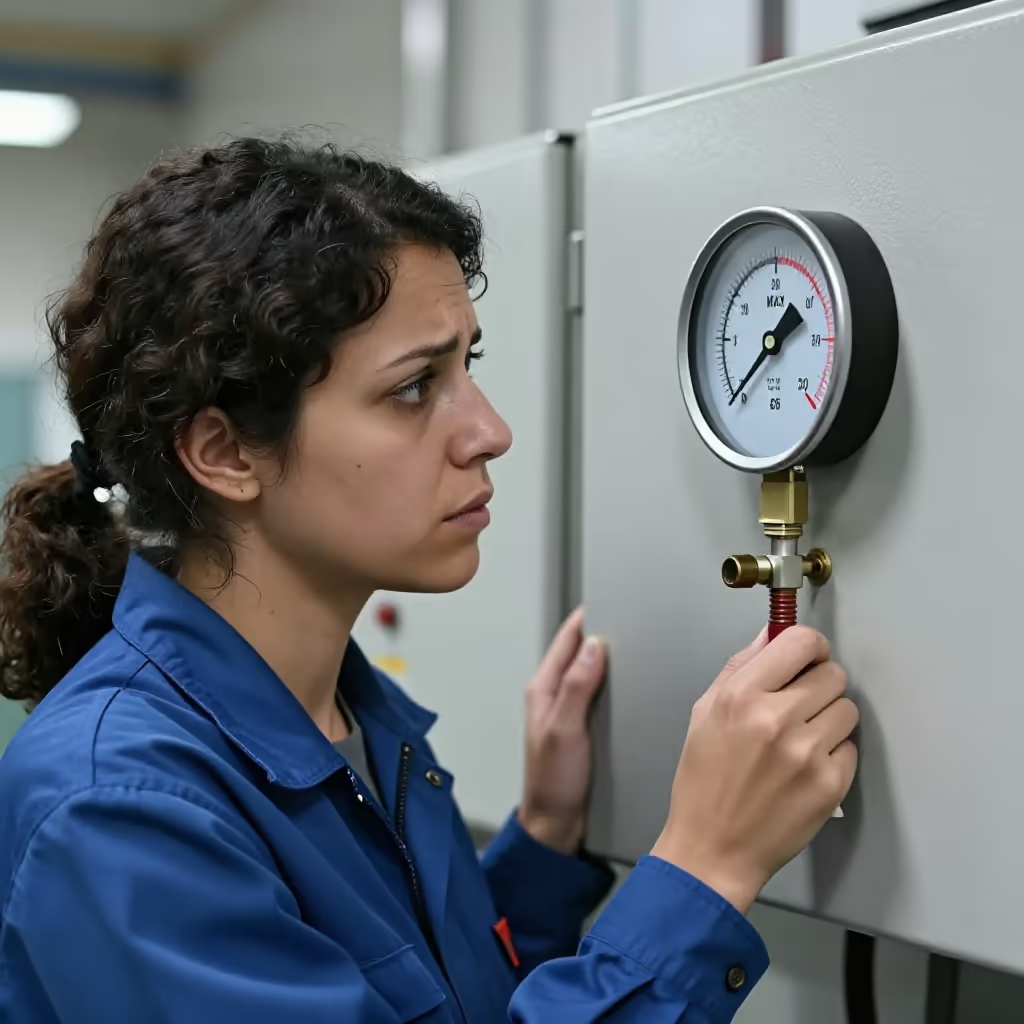
übersteigen
to exceed
To go beyond a certain amount, measure, or value; to be larger or more than something else.
Die Kosten für das Projekt überstiegen das geplante Budget bei Weitem.
The costs for the project far exceeded the planned budget.

to exceed / climb over
Loading your saved state.

to exceed
To go beyond a certain amount, measure, or value; to be larger or more than something else.
Die Kosten für das Projekt überstiegen das geplante Budget bei Weitem.
The costs for the project far exceeded the planned budget.


to climb over
To physically climb over an obstacle, for example over a wall or a fence.
Der Einbrecher hat den Zaun überstiegen, um auf das Grundstück zu gelangen.
The burglar climbed over the fence to get onto the property.

to be beyond
To be too complex, too abstract, or too unimaginable for someone to understand or imagine. Often used in the phrase 'jemandes Verstand/Vorstellungskraft übersteigen' (to be beyond someone's understanding/imagination).
Es übersteigt meinen Verstand, wie jemand so grausam sein kann.
It is beyond my understanding how someone can be so cruel.
'Übersteigen' (to exceed / climb over) is an inseparable verb. The prefix 'über-' remains firmly attached to the verb in all sentence forms and tenses and is not placed at the end of the sentence.
Die Nachfrage übersteigt bei Weitem das Angebot.
Demand far exceeds supply.
This verb always requires a direct object in the accusative. You ask: Whom or what does something exceed or climb over?
Die Reparaturkosten übersteigen den Wert des alten Autos.
The repair costs exceed the value of the old car.
In the abstract meaning 'mehr sein als' (to be more than), the verb is often combined with words such as 'Erwartungen' (expectations), 'Budget' (budget), 'Grenzen' (limits), or 'Kapazitäten' (capacities).
Deine Leistungen übersteigen alle unsere Erwartungen.
Your performance exceeds all our expectations.
When it refers to physical climbing, the object is always a concrete obstacle. Typical objects are 'einen Zaun' (a fence), 'eine Mauer' (a wall), or 'eine Absperrung' (a barrier).
Um in den Garten zu kommen, muss man die niedrige Mauer übersteigen.
To get into the garden, you have to climb over the low wall.
In the figurative meaning 'unverständlich sein' (to be incomprehensible), 'übersteigen' (to be beyond) is often used in fixed expressions. Common ones are 'jemandes Verstand übersteigen' (to be beyond someone's understanding), 'jemandes Vorstellungskraft übersteigen' (to be beyond someone's imagination), or 'jemandes Kräfte übersteigen' (to be beyond someone's strength/abilities).
Die Schönheit der Landschaft übersteigt jede Vorstellungskraft.
The beauty of the landscape is beyond all imagination.
to exceed / cross
Both verbs can express that a value is above a limit. „Überschreiten“ focuses more on passing or failing to observe a set threshold, while „übersteigen“ highlights the higher value in comparison. Use „überschreiten“ with a limit and „übersteigen“ for a comparison or additional amount.

Der neue Ticketpreis übersteigt den alten um zehn Euro.
The new ticket price exceeds the old one by ten euros.
Mit dem neuen Preis überschreitet das Ticket die für Studierende festgelegte Grenze von 50 Euro.
At the new price, the ticket exceeds the 50-euro limit set for students.