

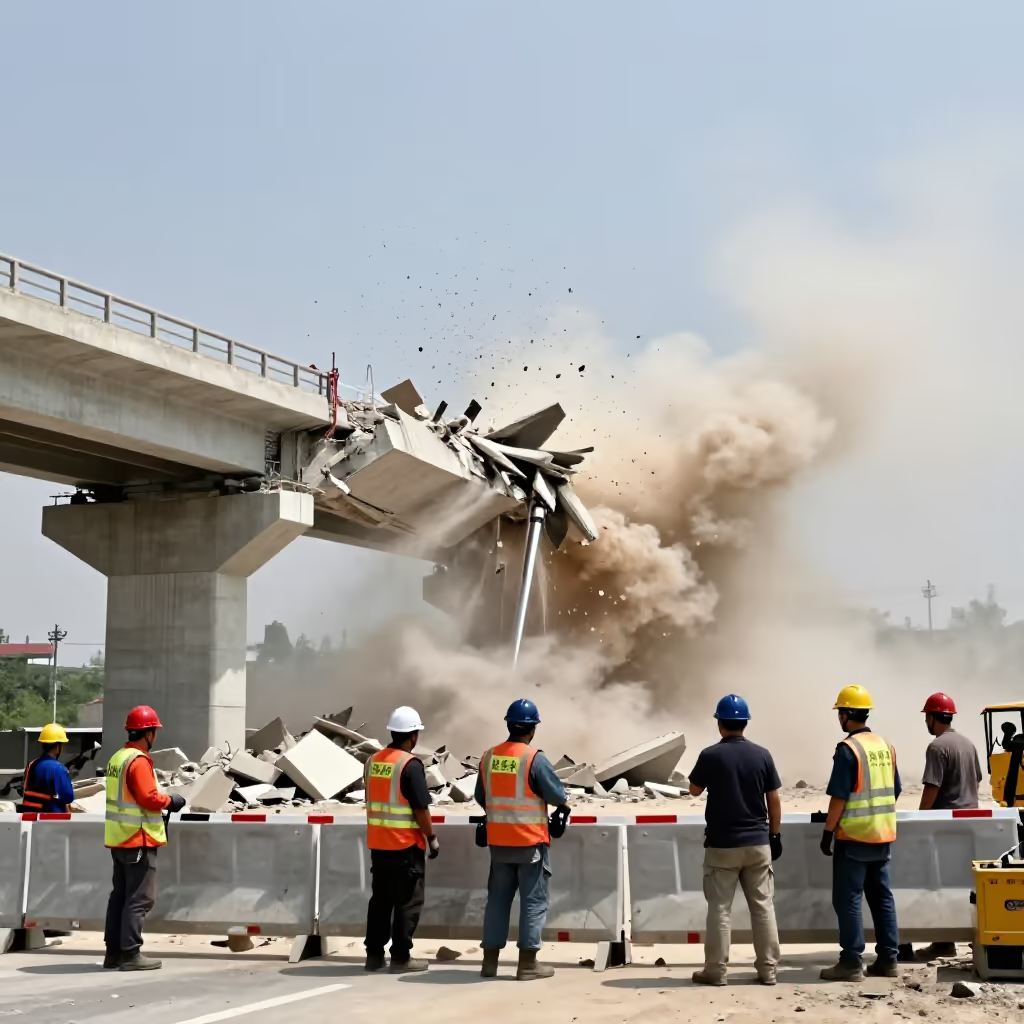
sprengen
to blast
To deliberately cause something to explode and be destroyed using explosives.
EXAMPLE
Das alte Fabrikgebäude wurde kontrolliert gesprengt.
The old factory building was blasted in a controlled demolition.
to blast / exceed
Loading your saved state.
to blast
To deliberately cause something to explode and be destroyed using explosives.
Das alte Fabrikgebäude wurde kontrolliert gesprengt.
The old factory building was blasted in a controlled demolition.

to exceed
To go far beyond a set framework, limit, or boundary.
Die unerwarteten Reparaturkosten sprengen unser gesamtes Budget.
The unexpected repair costs exceed our entire budget.

to burst
To cause something to burst or break open through internal pressure.
Der starke Frost hat die Wasserrohre gesprengt.
The severe frost burst the water pipes.

to water
To water an area, usually a garden or lawn, with water.
Im heißen Sommer muss man den Rasen jeden Abend sprengen.
In the hot summer, you have to water the lawn every evening.

to gallop
To make a horse go into a fast gallop or to ride at a gallop.
Der Reiter sprengte auf seinem Pferd über die weite Ebene.
The rider galloped across the wide plain on his horse.
'Sprengen' is a weak verb in most modern meanings. The past forms are 'sprengte' and 'hat gesprengt'.
Die Baufirma hat den alten Schornstein sicher gesprengt.
The construction company safely blasted the old chimney.
The verb 'sprengen' has a literal meaning (to make something explode) and a figurative one (to exceed a limit). The context makes clear what is meant: with buildings and rocks it is literal; with budgets and frameworks it is figurative.
Die Lawine wurde künstlich gesprengt, um die Gefahr zu bannen.
The avalanche was artificially blasted in order to eliminate the danger.
In the figurative meaning, 'sprengen' is often part of fixed expressions. Common combinations are 'den Rahmen sprengen' (to go beyond the scope), 'das Budget sprengen' (to exceed the budget), or 'alle Erwartungen sprengen' (to exceed all expectations).
Eine Feier mit so vielen Gästen würde den finanziellen Rahmen sprengen.
A party with that many guests would exceed the financial scope.
In the meaning 'bewässern' (to water), 'sprengen' is used almost exclusively for lawns and gardens. The related device is called 'der Rasensprenger' (lawn sprinkler).
Ich muss daran denken, heute Abend den Rasen zu sprengen.
I have to remember to water the lawn this evening.
The meaning 'im Galopp reiten' (to ride at a gallop) is outdated today and is used almost only in historical or literary language to describe a fast, dramatic movement.
Der König sprengte an der Spitze seiner Armee in die Schlacht.
The king galloped into battle at the head of his army.
to break
Brechen and sprengen can both refer to existing records. You use brechen for a specific record as soon as you surpass it. Sprengen, on the other hand, emphasizes that a performance exceeds the previous limit by far and is often used in the expression „alle Rekorde sprengen“.

Mit 9,5 Sekunden sprengt die Läuferin alle bisherigen Vereinsrekorde.
With a time of 9.5 seconds, the runner shatters all previous club records.
Mit 10,1 Sekunden bricht die Läuferin den bisherigen Vereinsrekord knapp.
With a time of 10.1 seconds, the runner narrowly breaks the previous club record.