


der Unterton
undertone
An implied, not directly stated meaning, intention, or emotional tone in an utterance or action.
EXAMPLE
In seiner Stimme war ein drohender Unterton zu hören.
There was a threatening undertone in his voice.
undertone
Loading your saved state.
undertone
An implied, not directly stated meaning, intention, or emotional tone in an utterance or action.
In seiner Stimme war ein drohender Unterton zu hören.
There was a threatening undertone in his voice.
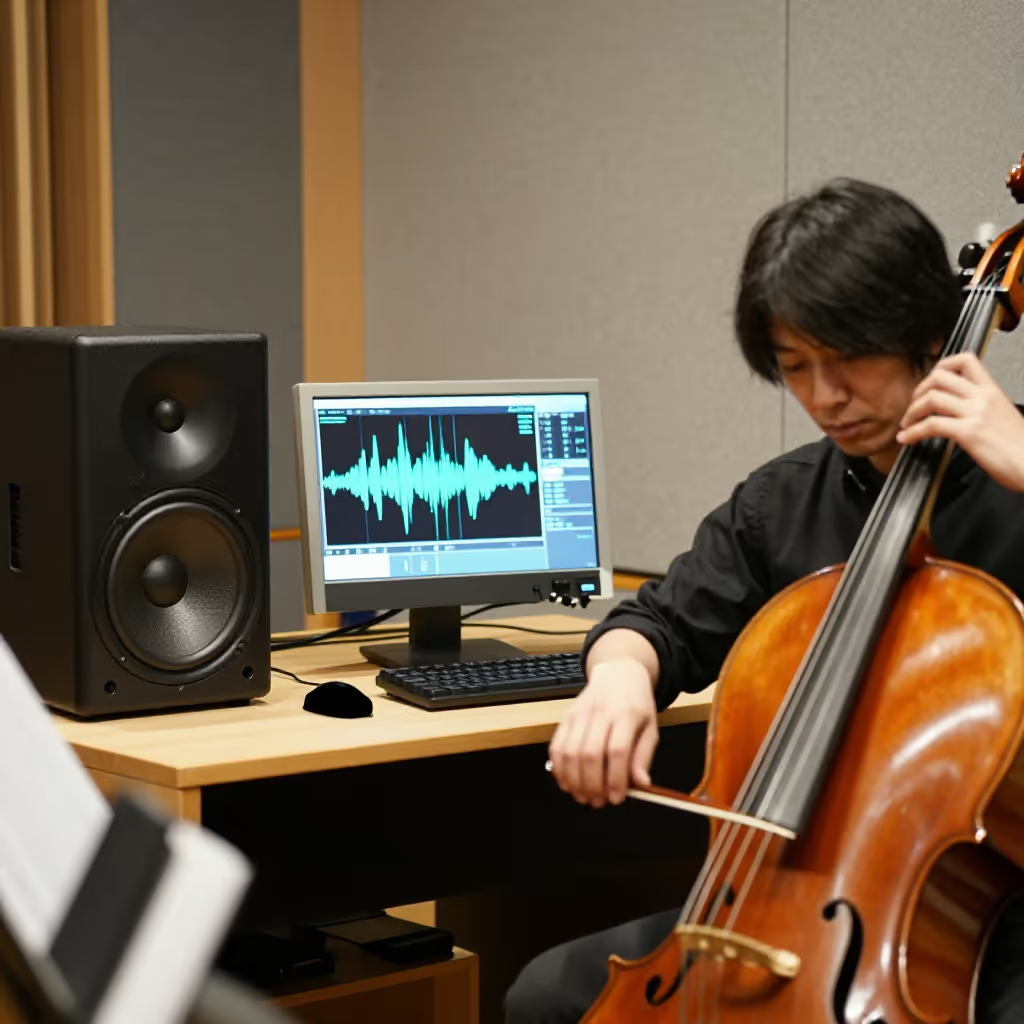
undertone
A tone in acoustics or music that lies below a fundamental tone and resonates together with it.
Bei der Analyse des Klangs wurden mehrere schwache Untertöne identifiziert.
During the analysis of the sound, several weak undertones were identified.
The word consists of 'unter' (under) and 'Ton' (tone). This compound helps with both meanings: it is either an emotional tone that lies 'under' the words, or an acoustic tone that resonates 'under' a main tone.
Obwohl er lächelte, spürte ich einen kalten Unterton in seiner Begrüßung.
Although he smiled, I sensed a cold undertone in his greeting.
You can recognize the figurative meaning from words that describe communication (voice, criticism, words). You can recognize the literal, acoustic meaning from technical terms from music or physics (sound, frequency, analysis).
Ihre Frage hatte einen neugierigen Unterton.
Her question had a curious undertone.
In the figurative meaning, 'Unterton' (undertone) is often combined with adjectives that describe the emotion being implied, e.g. an 'ironischer' (ironic), 'kritischer' (critical), 'sarkastischer' (sarcastic), or 'freundlicher' (friendly) undertone.
Er bemerkte den ironischen Unterton in ihrer Stimme nicht.
He did not notice the ironic undertone in her voice.
To express how something is said, German often uses the fixed expression 'mit einem ... Unterton' (with a ... undertone).
Sie erzählte die Geschichte mit einem amüsierten Unterton.
She told the story with an amused undertone.
The acoustic meaning of 'Unterton' (undertone) is a technical term and is used almost exclusively in contexts such as music theory, acoustics, or physics.
In der Akustik beschäftigt man sich mit Obertönen und Untertönen.
In acoustics, people study overtones and undertones.
implication
Both words refer to something that is not stated directly in an utterance. An Implikation is an inferable meaning or logical consequence, whereas an Unterton is an accompanying attitude, evaluation, or emotional state. So ask yourself whether you mean content or mood.

Der Unterton seiner Aussage klang trotz der höflichen Worte genervt.
Despite the polite words, the undertone of his statement sounded annoyed.
Die Implikation seiner Aussage war, dass wir den Plan ändern müssen.
The implication of his statement was that we had to change the plan.