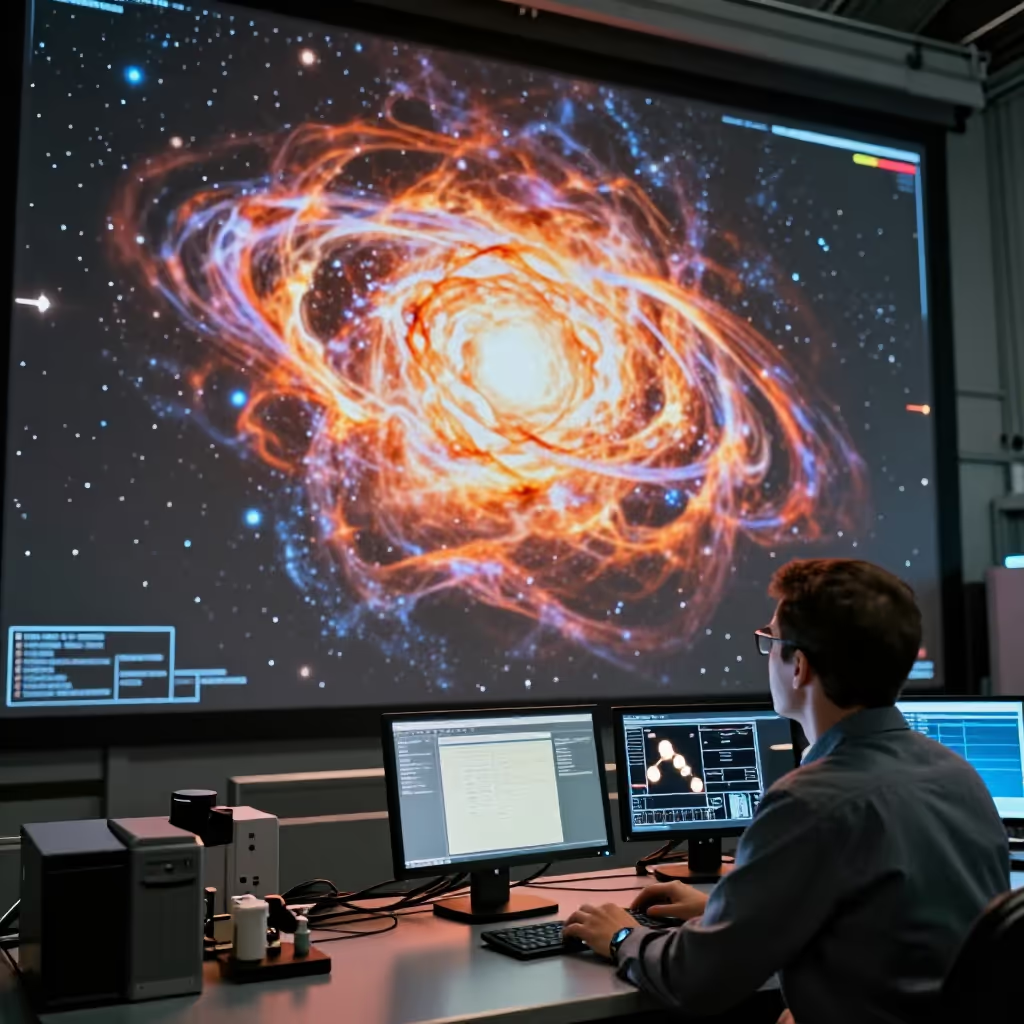
In cosmology, the scientific theory about the beginning of the universe from an extremely hot and dense state.
example
Die Theorie des Urknalls beschreibt die Entstehung von Raum, Zeit und Materie vor etwa 13,8 Milliarden Jahren.
The theory of the Big Bang describes the origin of space, time, and matter about 13.8 billion years ago.

Usage tips
Word composition
The word is made up of 'Ur-' and 'Knall' (bang). The prefix 'Ur-' means 'original' or 'very first'. So 'Urknall' (Big Bang) is literally the 'original bang' at the beginning of everything.
EXAMPLE
Die Physik versucht zu erklären, was genau beim Urknall passiert ist.
Physics tries to explain what exactly happened during the Big Bang.
The prefix Ur-
The prefix 'Ur-' is used in German to refer to the origin or oldest form of something. When you see it, it often points to something original or primordial, as in 'Urmensch' (early human), 'Urwald' (primeval forest), or 'Ursache' (cause).
EXAMPLE
Forscher haben im Urwald eine neue Pflanzenart entdeckt.
Researchers discovered a new plant species in the rainforest.
Context clue
The meaning can be recognized well from context. In scientific texts about the universe, astronomy, or physics, the cosmological meaning is intended. In texts about society, technology, or personal relationships, the figurative, metaphorical meaning is intended.
EXAMPLE
Die Entdeckung der kosmischen Hintergrundstrahlung war ein Beweis für die Urknall-Theorie.
The discovery of cosmic background radiation was evidence for the Big Bang theory.
Typical collocations
In the figurative meaning, 'Urknall' (Big Bang) is often used with the preposition 'für' (for). It then describes the starting point of a development, for example 'der Urknall für die Digitalisierung' (the Big Bang for digitalization).
EXAMPLE
Die Trennung von seiner Band war der Urknall für seine erfolgreiche Solokarriere.
The split from his band was the Big Bang for his successful solo career.
Compare with
near_synonym · confusable
Urknall vs Revolution
revolution
'die Revolution' and 'der Urknall' can both figuratively stand for a beginning that changes a great deal. 'Revolution' emphasizes a profound change in an area, for example in technology, culture, or society. 'Urknall' sounds more like a sudden, almost explosive starting point after which everything is different. The words can be confused when talking about major innovations. 'Revolution' is usually more factual and general, while 'Urknall' feels more figurative and dramatic.
Urknall
Für das kleine Unternehmen war der erste große Auftrag der Urknall für den späteren Erfolg.
For the small company, the first major order was the Big Bang for its later success.
Revolution
Die Erfindung des Smartphones war für viele Menschen eine Revolution.
For many people, the invention of the smartphone was a revolution.