

verhängen
to impose
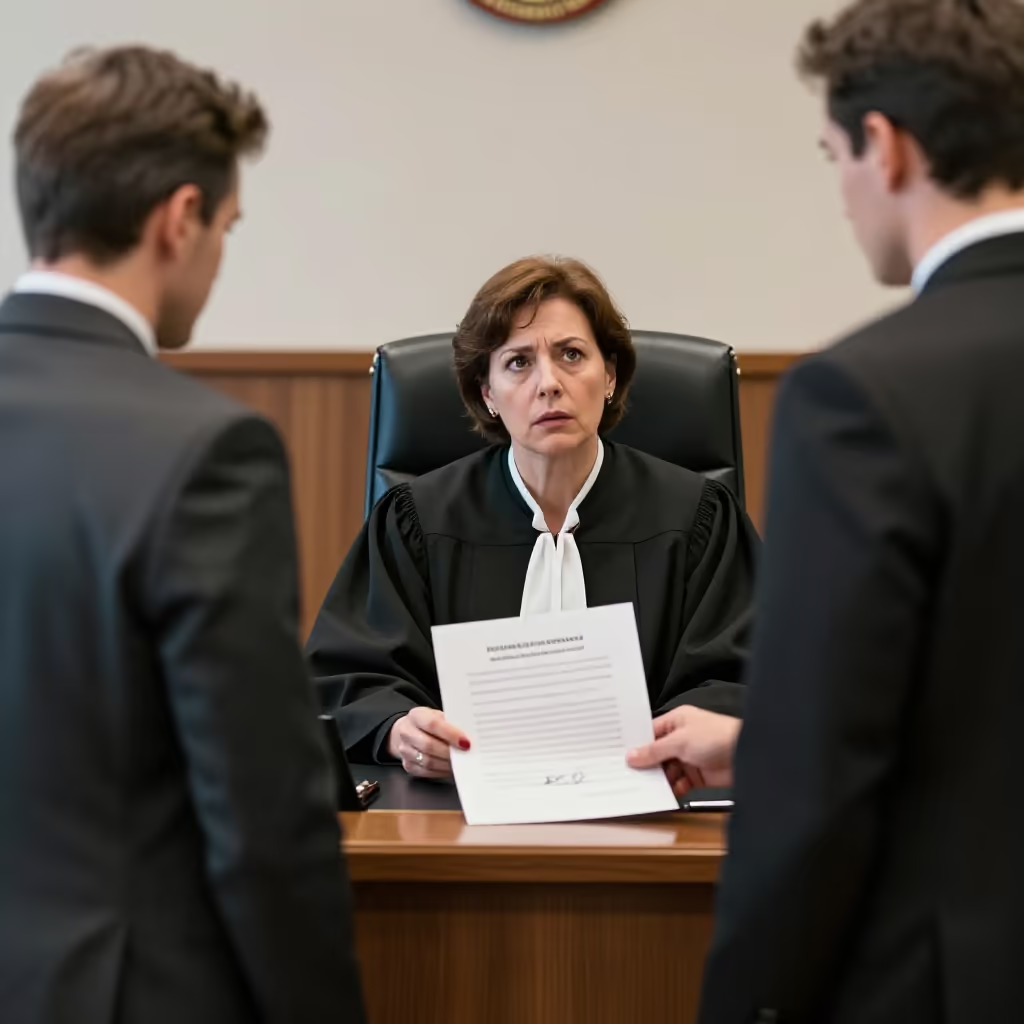
To order or enforce an official, usually negative measure, such as a penalty, a state of emergency, or a ban.
Das Gericht verhängte eine hohe Geldstrafe gegen das Unternehmen.
The court imposed a heavy fine on the company.


to impose / cover
Loading your saved state.
to impose
To order or enforce an official, usually negative measure, such as a penalty, a state of emergency, or a ban.
Das Gericht verhängte eine hohe Geldstrafe gegen das Unternehmen.
The court imposed a heavy fine on the company.

'Verhängen' (to impose / cover) is an inseparable verb. The prefix 'ver-' remains firmly attached to the verb stem 'hängen' (to hang) in all sentence forms and tenses.
Die Regierung hat eine Ausgangssperre verhängt.
The government imposed a curfew.
The direct object reveals the meaning. If it is an official measure (penalty, sanction, ban), meaning m01 is meant. If it is an object that can be covered (window, mirror), meaning m02 is meant.
Gegen den Fahrer wurde ein Fahrverbot verhängt.
A driving ban was imposed on the driver.
This meaning is used almost only for official, negative measures. Typical objects are: 'eine Strafe verhängen' (to impose a penalty), 'ein Bußgeld verhängen' (to impose a fine), 'Sanktionen verhängen' (to impose sanctions), 'ein Embargo verhängen' (to impose an embargo), or 'den Ausnahmezustand verhängen' (to impose a state of emergency).
Wegen der Dürre wurde über die Region der Notstand verhängt.
Because of the drought, a state of emergency was imposed over the region.
If you want to specify against whom a measure is directed, the preposition 'über' with the accusative is used. The subject is always an authority such as a court or a government.
Das Gericht verhängte eine Bewährungsstrafe über den Angeklagten.
The court imposed a suspended sentence on the defendant.
If you want to say what something is covered with, you use the preposition 'mit' (with). The structure is: [object] mit [material] verhängen.
Sie hat die Fenster mit dicken Decken verhängt, um die Kälte abzuhalten.
She covered the windows with thick blankets to keep out the cold.
to book / prove / top
'belegen' and 'verhängen' can both mean in formal situations that someone receives a penalty or measure. 'jemanden mit etwas belegen' sounds rather legal or very official and often needs the form 'mit einer Strafe belegen' (to impose a penalty on someone). 'verhängen' is used especially for official negative measures, for example a fine, a suspension, or a ban. Learners may confuse the words because both occur with penalties. In everyday language and in the news, 'eine Strafe verhängen' (to impose a penalty) is usually more natural than 'jemanden mit einer Strafe belegen'.

Nach dem Vorfall verhängt der Verein eine Sperre für drei Spiele.
After the incident, the club imposes a three-game suspension.
Die Behörde belegt den Laden wegen der Verstöße mit einer Geldstrafe.
The authority imposes a fine on the shop because of the violations.