

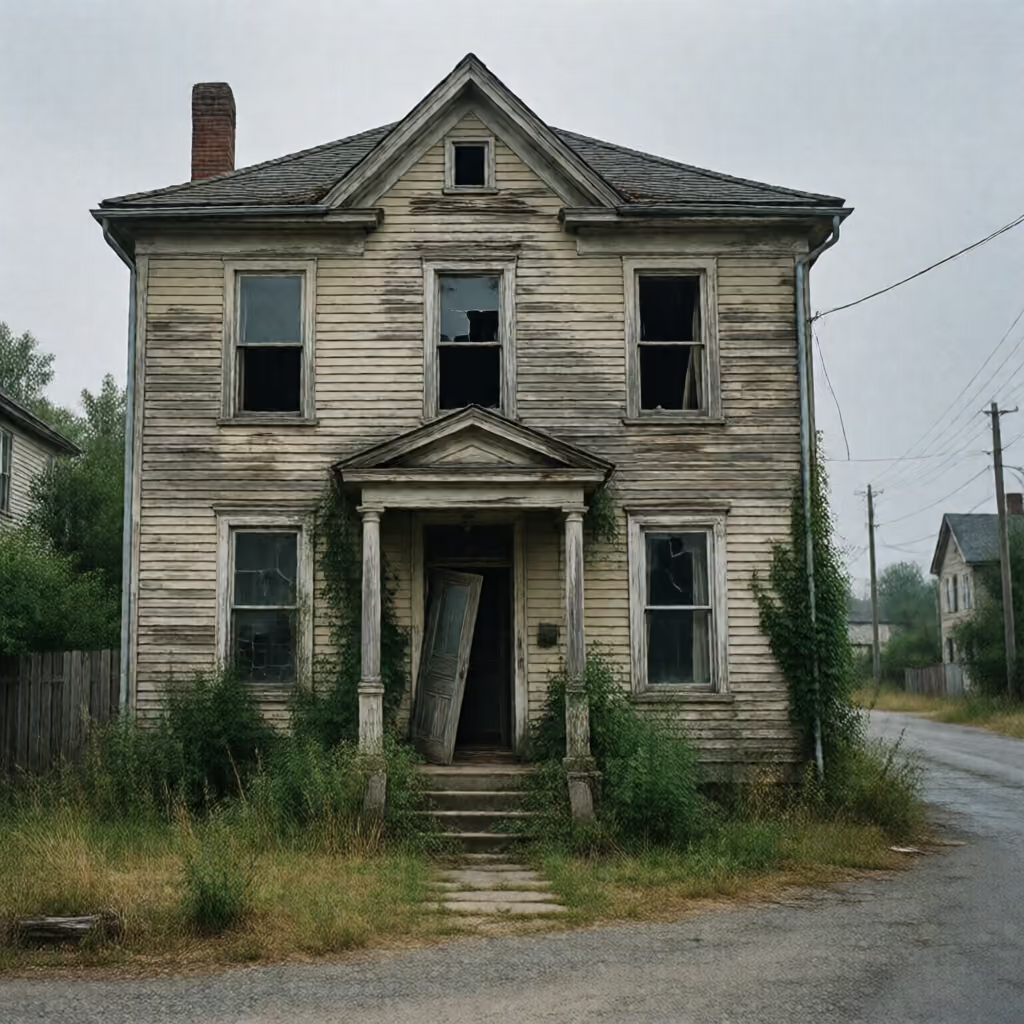
verlassen
abandoned
Without people; no longer inhabited or used.
EXAMPLE
Am Ende der Straße stand ein verlassenes Haus mit zerbrochenen Fenstern.
At the end of the street stood an abandoned house with broken windows.
abandoned / forsaken
verlassen – verlassener – am verlassensten
Loading your saved state.
abandoned
Without people; no longer inhabited or used.
Am Ende der Straße stand ein verlassenes Haus mit zerbrochenen Fenstern.
At the end of the street stood an abandoned house with broken windows.

forsaken
Alone and without the companionship or support of other people; lonely and left to fend for oneself.
Ohne ihre Freunde fühlte sie sich einsam und verlassen.
Without her friends, she felt lonely and forsaken.

out of one's mind
Colloquial: lacking all reason or good judgment. The expression 'von allen guten Geistern verlassen' (out of one's mind) usually conveys disbelief at very unreasonable behavior.
Bist du von allen guten Geistern verlassen, bei diesem Sturm aufs Meer hinauszufahren?
Are you out of your mind, going out to sea in this storm?
| basic form | verlassen |
|---|---|
| comparative | verlassener |
| superlative | am verlassensten |
| masc. | fem. | neut. | plural | |
|---|---|---|---|---|
| nom. | -e | -e | -e | -en |
| acc. | -en | -e | -e | -en |
| dat. | -en | -en | -en | -en |
| gen. | -en | -en | -en | -en |
Add the ending to verlassen.
| masc. | fem. | neut. | plural | |
|---|---|---|---|---|
| nom. | -er | -e | -es | -en |
| acc. | -en | -e | -es | -en |
| dat. | -en | -en | -en | -en |
| gen. | -en | -en | -en | -en |
Add the ending to verlassen.
| masc. | fem. | neut. | plural | |
|---|---|---|---|---|
| nom. | -er | -e | -es | -e |
| acc. | -en | -e | -es | -e |
| dat. | -em | -er | -em | -en |
| gen. | -en | -er | -en | -er |
Add the ending to verlassen.
'Verlassen' (abandoned / forsaken) comes from the past participle (Partizip II) of the verb 'verlassen' (to leave / abandon) and is also used as an adjective. It often follows 'sein' (to be) or 'bleiben' (to remain) and can also appear before a noun.
Nach dem Umzug der Firma blieb das Gebäude jahrelang verlassen.
After the company moved, the building remained abandoned for years.
Wir übernachteten in einer verlassenen Hütte im Wald.
We spent the night in an abandoned cabin in the woods.
For places and buildings, combinations such as 'ein verlassenes Haus' (an abandoned house), 'eine verlassene Fabrik' (an abandoned factory), 'ein verlassener Bahnhof' (an abandoned train station), and 'eine verlassene Straße' (a deserted street) are especially common.
Hinter dem Wald entdeckten wir eine verlassene Fabrik.
Beyond the woods, we discovered an abandoned factory.
When describing a person experiencing this feeling, 'verlassen' (forsaken) often appears in the fixed expression 'sich verlassen fühlen' (to feel forsaken). The reflexive pronoun changes to match the person.
Nach dem Streit fühlte sich Jonas völlig verlassen.
After the argument, Jonas felt completely forsaken.
'Von allen guten Geistern verlassen' (out of one's mind) is a colloquial idiom usually used as an exclamation or an incredulous question. The expression always includes the preposition 'von' and the dative plural form 'allen guten Geistern'.
Du bist wohl von allen guten Geistern verlassen, wenn du ohne Helm fahren willst.
You must be out of your mind if you want to ride without a helmet.