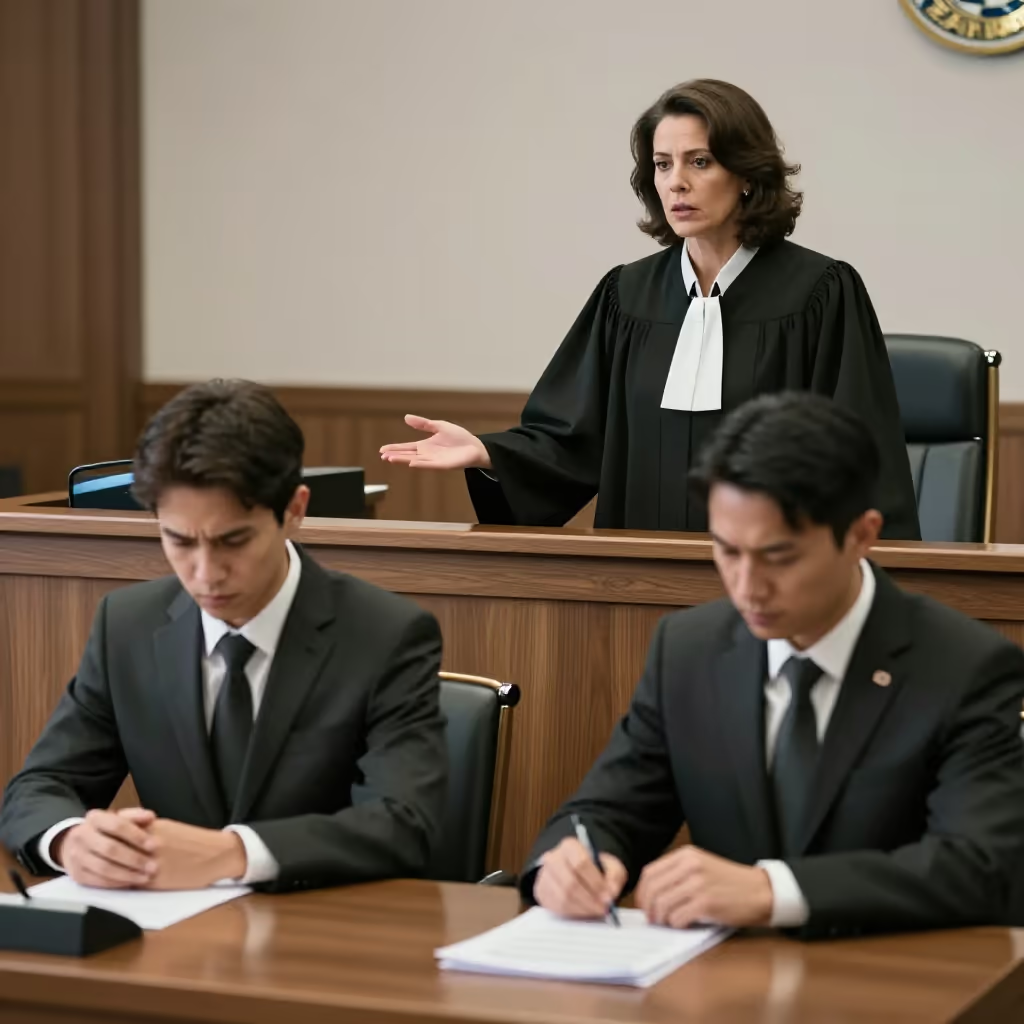
The formal judicial decision in a court case that a person is guilty of a criminal offense, usually combined with the setting of a sentence.
example
Die Verurteilung zu einer fünfjährigen Haftstrafe wurde vom Gericht bestätigt.
The conviction resulting in a five-year prison sentence was upheld by the court.

Usage tips
Word structure
The noun 'Verurteilung' (conviction / condemnation) is derived from the verb 'verurteilen' (to convict / to condemn). This consists of the prefix 'ver-' and the verb 'urteilen' (to judge). Here, the prefix emphasizes the final, definitive character of the judgment.
EXAMPLE
Das Gericht wird den Angeklagten morgen verurteilen.
The court will convict the defendant tomorrow.
Sentence structure in legal contexts
In the legal sense, the punishment is given with the preposition 'zu' and the dative. The reason for the conviction is often stated with 'wegen' and the genitive.
EXAMPLE
Die Verurteilung zu einer Geldstrafe war erwartet worden.
The conviction resulting in a fine had been expected.
Typical collocations
In the sense of moral rejection, 'Verurteilung' (condemnation) is often combined with adjectives such as 'scharf' (sharp), 'öffentlich' (public), or 'einhellig' (unanimous). A common expression is also 'auf Verurteilung stoßen' (to meet with condemnation).
EXAMPLE
Seine rassistischen Äußerungen stießen auf scharfe Verurteilung.
His racist remarks met with sharp condemnation.
Context clue
Words like 'Gericht' (court), 'Strafe' (punishment), or 'Haft' (imprisonment) signal the legal meaning (m01). Adjectives like 'moralisch' (moral), 'politisch' (political), or 'scharf' (sharp) point to general rejection (m02).
EXAMPLE
Nach dem Prozess erfolgte die Verurteilung des Angeklagten.
After the trial, the conviction of the defendant took place.
Compare with
near_synonym · confusable
Verurteilung vs Kritik
criticism / review
'die Kritik' and 'die Verurteilung' can both express rejection. However, 'Kritik' is often weaker and can remain objective: you point out mistakes or problems. 'Verurteilung' is much stronger and means clear moral condemnation, often publicly. Learners may confuse the words because both are negative. You say 'Kritik' when you are evaluating something or want to improve it. You say 'Verurteilung' when an action is presented as wrong or unacceptable.
Verurteilung
Die Verurteilung der Gewalt war in der Erklärung sehr deutlich.
The condemnation of the violence was very clear in the statement.
Kritik
Wir sprachen offen über die Kritik am neuen Stundenplan.
We spoke openly about the criticism of the new timetable.