

vordringen
to advance
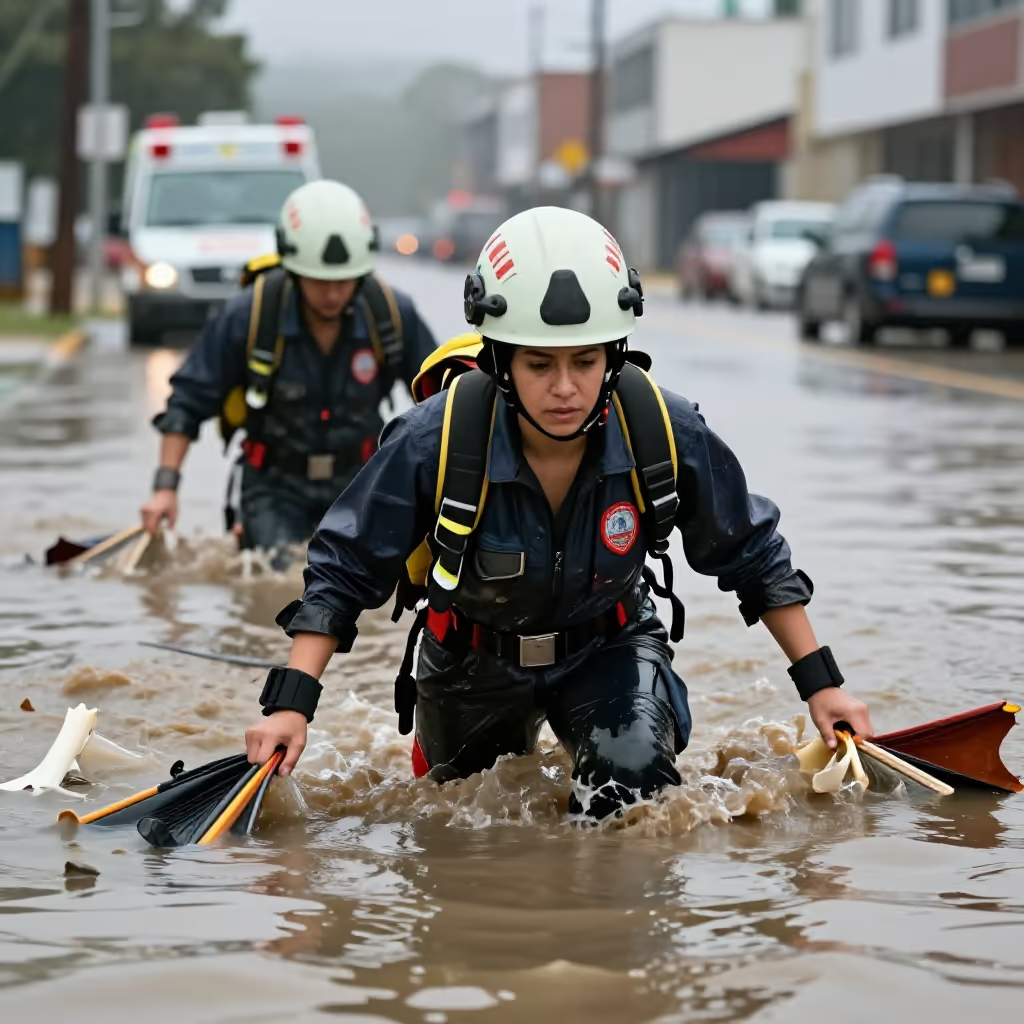
To move forward against resistance or through difficult terrain; to reach a particular point.
EXAMPLE
Die Forscher konnten bis tief in den Dschungel vordringen.
The researchers were able to advance deep into the jungle.
to advance
Loading your saved state.
to advance
To move forward against resistance or through difficult terrain; to reach a particular point.
Die Forscher konnten bis tief in den Dschungel vordringen.
The researchers were able to advance deep into the jungle.

to get through to someone
To manage to make contact with a person or be heard by them, even though it is difficult.
Mit meinen Argumenten konnte ich einfach nicht zu ihm vordringen.
I simply couldn't get through to him with my arguments.
'Vordringen' (to advance / to get through to someone) is a separable verb. The prefix 'vor-' comes at the end in a main clause. In subordinate clauses and in the infinitive, the verb stays together.
Die Feuerwehrleute drangen langsam zum Brandherd vor.
The firefighters slowly advanced toward the source of the fire.
Since 'vordringen' (to advance) describes directed movement, the perfect tense is always formed with the auxiliary verb 'sein' (to be).
Die Truppen sind bis an die Grenze vorgedrungen.
The troops advanced as far as the border.
To indicate the goal or direction of the movement, 'vordringen' (to advance) is often combined with prepositions such as 'in (+ Akkusativ)' (into + accusative), 'bis zu (+ Dativ)' (as far as + dative), or 'bis an (+ Akkusativ)' (up to + accusative).
Die Bergsteiger sind bis zum Basislager vorgedrungen.
The mountaineers advanced as far as the base camp.
In the figurative meaning 'Kontakt aufnehmen' (to make contact), 'vordringen' (to get through to someone) is used with the fixed preposition 'zu' (to). You say 'zu jemandem vordringen' (to get through to someone).
Trotz vieler Versuche ist er mit seiner Kritik nicht zum Chef vorgedrungen.
Despite many attempts, he didn't get through to the boss with his criticism.
to penetrate / intrude
Eindringen and vordringen can both describe movement into foreign or difficult-to-access territory. Eindringen emphasizes entering a defined area, often against resistance or without permission. Vordringen, by contrast, emphasizes moving forward to a particular point.

Die Wanderer drangen trotz des dichten Waldes bis zum Gipfel vor.
Despite the dense forest, the hikers advanced as far as the summit.
Die Wanderer drangen trotz des Zauns in das abgesperrte Gelände ein.
Despite the fence, the hikers entered the restricted area.