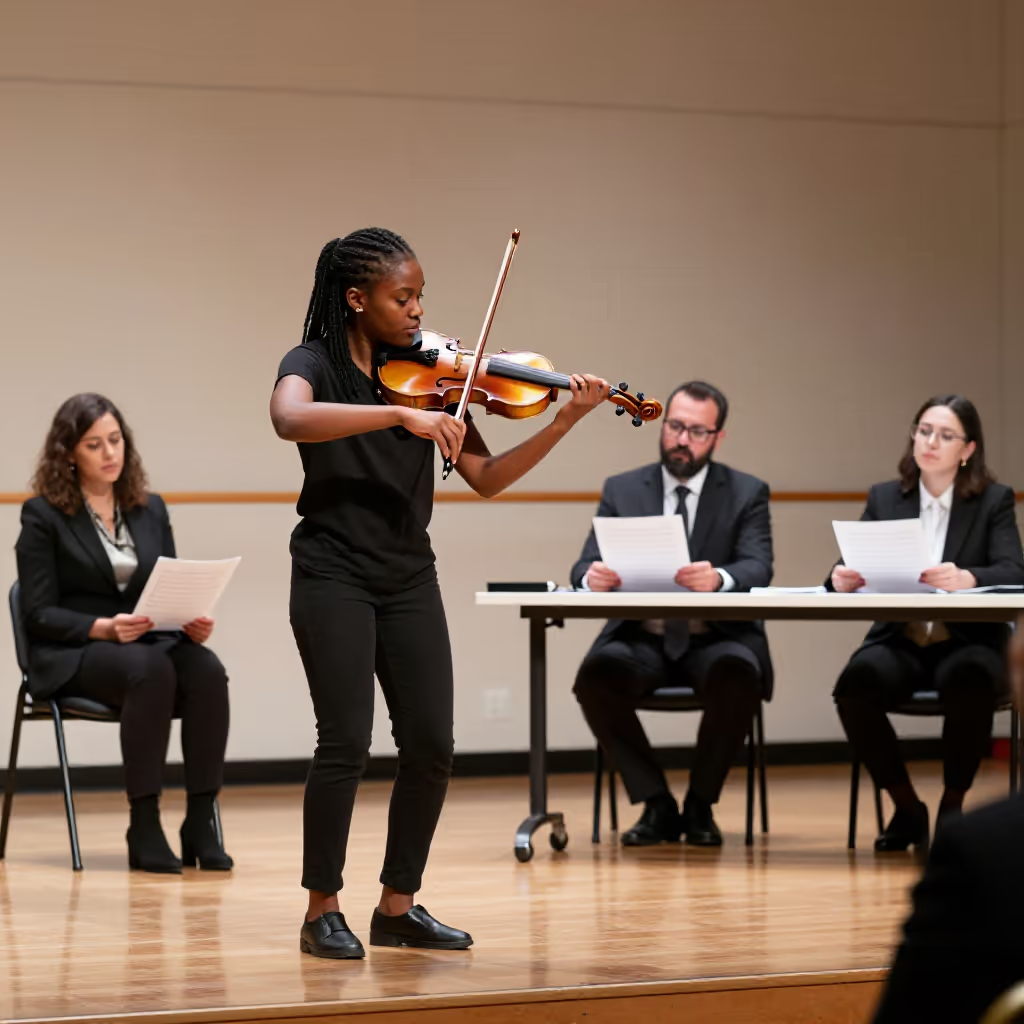
To perform a piece of music or an acting scene in front of someone, often to prove one's ability for a role or position (audition).
example
Die junge Pianistin musste bei dem berühmten Professor vorspielen, um in seine Klasse aufgenommen zu werden.
The young pianist had to perform for the famous professor in order to be accepted into his class.

Usage tips
Separable verb
'Vorspielen' is a separable verb with the prefix 'vor-'. In a main clause, the prefix comes at the end. In subordinate clauses and in the infinitive with 'zu', the verb stays together.
EXAMPLE
Er spielte seiner Familie das neue Lied vor.
He played the new song for his family.
Context clue
You can recognize the meaning of 'vorspielen' from the object: A piece of music or a role points to a performance (audition). A feeling (e.g., Liebe, love) points to deception. A recording (e.g., Sprachnachricht, voice message) points to playing something back.
EXAMPLE
Der Pianist spielte eine Sonate von Mozart vor. (Aufführung)
The pianist performed a sonata by Mozart. (performance)
Sentence structure: auditioning
When it is about an audition, the preposition 'bei' + dative is often used for the jury or person one performs for. The desired position is expressed with 'für' + accusative.
EXAMPLE
Sie musste bei einer internationalen Jury vorspielen.
She had to perform for an international jury.
Sentence structure: deceiving
In the meaning 'vortäuschen' (to fake/pretend), the verb follows a fixed pattern: The person who is deceived is in the dative, and what is being pretended is in the accusative.
EXAMPLE
Er spielte seiner Chefin Zufriedenheit vor, obwohl er unglücklich war.
He pretended to his boss that he was satisfied, even though he was unhappy.
Sentence structure: playing back
When playing a recording, a dative-accusative structure is also often used: The person for whom something is played is in the dative, and the recording itself is in the accusative.
EXAMPLE
Spiel mir die Nachricht bitte noch einmal vor.
Please play the message for me again.
Compare with
near_synonym
vorspielen vs aufführen
to perform / to list
'aufführen' and 'vorspielen' can both mean that someone presents music or a scene in front of others. 'aufführen' is more suitable for a finished performance in front of an audience, for example in the theater or at a concert. 'vorspielen' is often more personal and smaller in scale: someone performs something for a specific person or a jury, often to show what they can do. When applying for a role or a place at a music school, 'vorspielen' sounds more natural. For a public performance, 'aufführen' fits better.
vorspielen
Vor der Aufnahmeprüfung spielt Sofia der Jury ein Klavierstück vor.
Before the entrance exam, Sofia plays a piano piece for the jury.
aufführen
Der Chor führt das Lied beim Sommerfest auf.
The choir performs the song at the summer festival.