

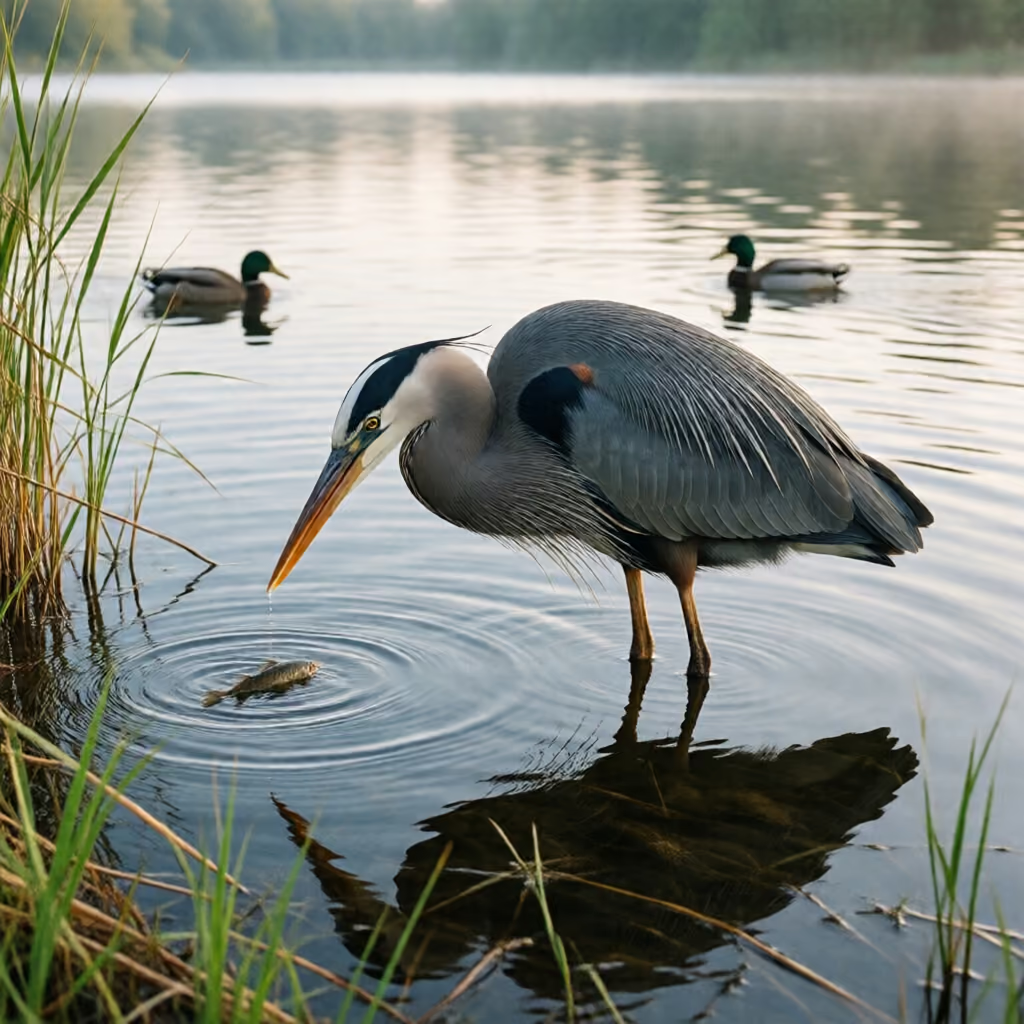
der Wasservogel
waterbird
A bird that lives in or near water and finds food there, such as a duck, swan, or heron.
EXAMPLE
Am See beobachteten wir viele Wasservögel.
We saw many waterbirds at the lake.
waterbird
der Wasservogel, die Wasservögel
Loading your saved state.
waterbird
A bird that lives in or near water and finds food there, such as a duck, swan, or heron.
Am See beobachteten wir viele Wasservögel.
We saw many waterbirds at the lake.
| gender | masculine der |
|---|---|
| plural | die Wasservögel |
| genitive | des Wasservogels |
| singular | plural | |
|---|---|---|
| nominative | der Wasservogel | die Wasservögel |
| accusative | den Wasservogel | die Wasservögel |
| dative | dem Wasservogel | den Wasservögeln |
| genitive | des Wasservogels | der Wasservögel |
The article changes with the case; it is shown in colour.
'Wasservogel' (waterbird) consists of 'Wasser' (water) and 'Vogel' (bird). The first part names the typical habitat, while the second names the animal group.
Dieser Wasservogel sucht seine Nahrung am Ufer.
This waterbird looks for food along the shore.
With the pattern 'zu den Wasservögeln gehören' (to belong to the waterbirds), you classify a bird species as part of this group. The dative follows 'zu'.
Schwäne gehören zu den Wasservögeln.
Swans belong to the waterbirds.
Common combinations include 'Wasservögel beobachten' (to watch waterbirds), 'Wasservögel zählen' (to count waterbirds), and 'Wasservögel füttern' (to feed waterbirds). Here, 'Wasservögel' is used as the object in the accusative.
Vom Ufer aus beobachten wir die Wasservögel mit einem Fernglas.
We watch the waterbirds from the shore with binoculars.