

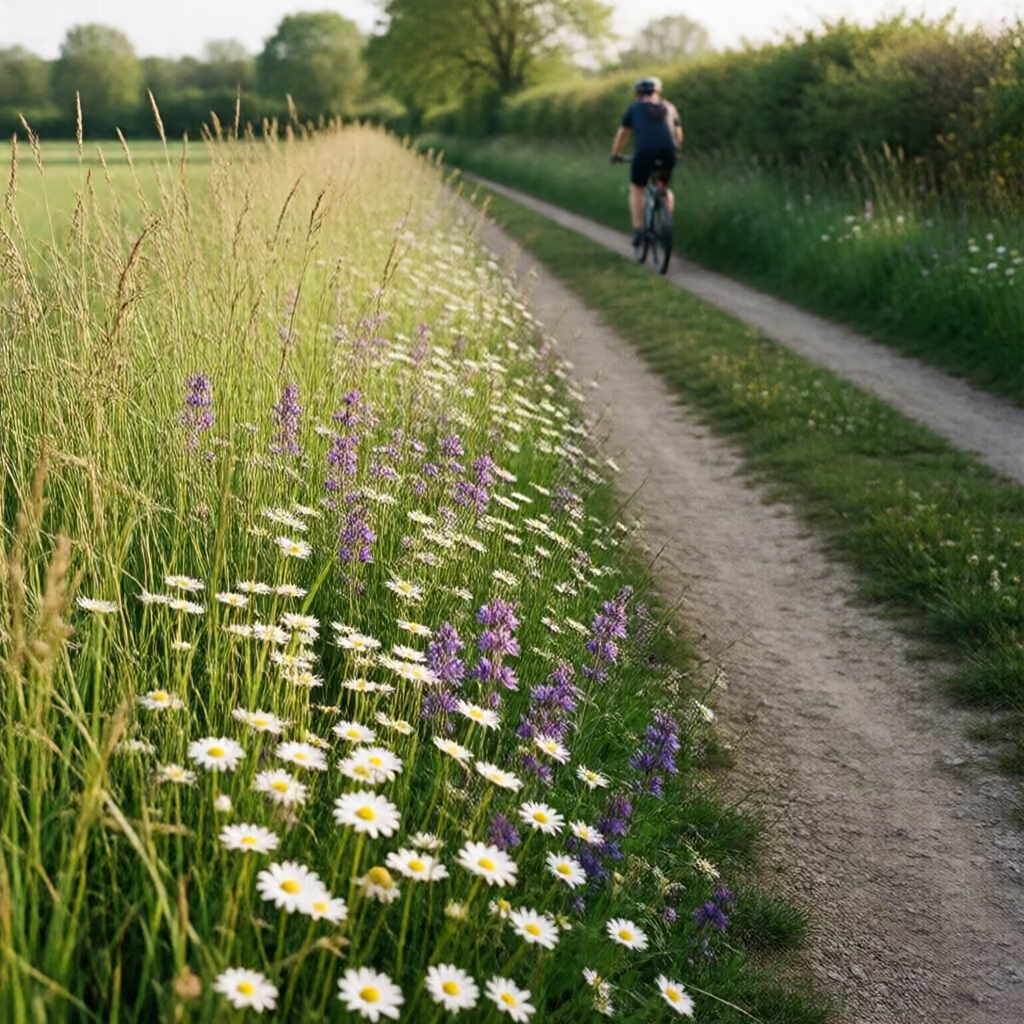
der Wegesrand
wayside
The area immediately beside a path or road.
EXAMPLE
Am Wegesrand blühen im Frühjahr viele wilde Blumen.
Many wildflowers bloom by the wayside in spring.
wayside
der Wegesrand, die Wegesränder
Loading your saved state.
wayside
The area immediately beside a path or road.
Am Wegesrand blühen im Frühjahr viele wilde Blumen.
Many wildflowers bloom by the wayside in spring.
| gender | masculine der |
|---|---|
| plural | die Wegesränder |
| genitive | des Wegesrandes |
| singular | plural | |
|---|---|---|
| nominative | der Wegesrand | die Wegesränder |
| accusative | den Wegesrand | die Wegesränder |
| dative | dem Wegesrand | den Wegesrändern |
| genitive | des Wegesrandes des Wegesrands | der Wegesränder |
The article changes with the case; it is shown in colour.
'Wegesrand' (wayside) is made up of 'Weg' (path) and 'Rand' (edge). The linking element 'es' connects the two parts; the word therefore means the edge of a path.
Am Wegesrand stand eine alte Bank.
An old bench stood by the wayside.
For a place at the edge of a path, German often uses 'am Wegesrand', the shortened form of 'an dem Wegesrand'. This expression describes something located directly beside the path.
Am Wegesrand entdeckten die Wanderer eine seltene Pflanze.
By the wayside, the hikers discovered a rare plant.
'Wegesrand' (wayside) often occurs with verbs such as 'blühen' (to bloom), 'wachsen' (to grow), 'liegen' (to lie), and 'stehen' (to stand). These sentences often describe plants, stones, benches, or other things in the landscape.
Am Wegesrand lag ein umgestürzter Baum.
A fallen tree lay by the wayside.