

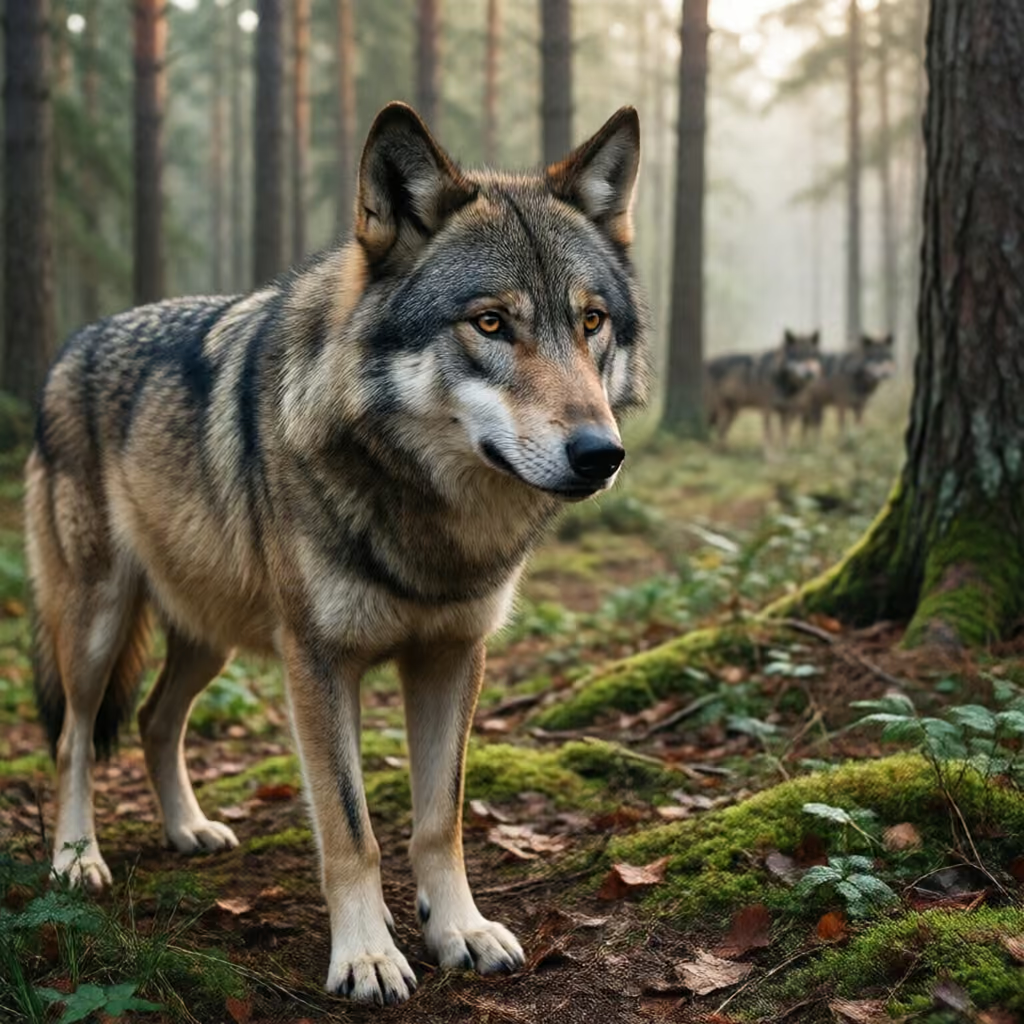
die Wölfin
she-wolf
A female wolf.
EXAMPLE
Die Wölfin führte ihr Rudel sicher durch den Wald.
The she-wolf led her pack safely through the forest.
she-wolf
die Wölfin, die Wölfinnen
Loading your saved state.
she-wolf
A female wolf.
Die Wölfin führte ihr Rudel sicher durch den Wald.
The she-wolf led her pack safely through the forest.
| gender | feminine die |
|---|---|
| plural | die Wölfinnen |
| genitive | der Wölfin |
| singular | plural | |
|---|---|---|
| nominative | die Wölfin | die Wölfinnen |
| accusative | die Wölfin | die Wölfinnen |
| dative | der Wölfin | den Wölfinnen |
| genitive | der Wölfin | der Wölfinnen |
The article changes with the case; it is shown in colour.
'Wölfin' (she-wolf) often occurs with verb phrases such as 'Junge aufziehen' (to raise young), 'ein Revier verteidigen' (to defend a territory), and 'Beute reißen' (to kill prey). These combinations are especially common in texts about wolf behavior.
Die Wölfin zog ihre Jungen in einer geschützten Höhle auf.
The she-wolf raised her young in a sheltered den.
'Wölfin' (she-wolf) is the feminine form of 'Wolf' (wolf). It is formed by adding the suffix '-in' and an umlaut; the plural is 'Wölfinnen' (she-wolves).
Im Gehege leben ein Wolf und zwei Wölfinnen.
One wolf and two she-wolves live in the enclosure.
'Wölfin' (she-wolf) is a neutral word in standard German and frequently appears in wildlife reports, nonfiction texts, and stories. It can also be used in texts with a scientific focus.
Laut dem Bericht wurde die Wölfin in der Nähe des Nationalparks fotografiert.
According to the report, the she-wolf was photographed near the national park.