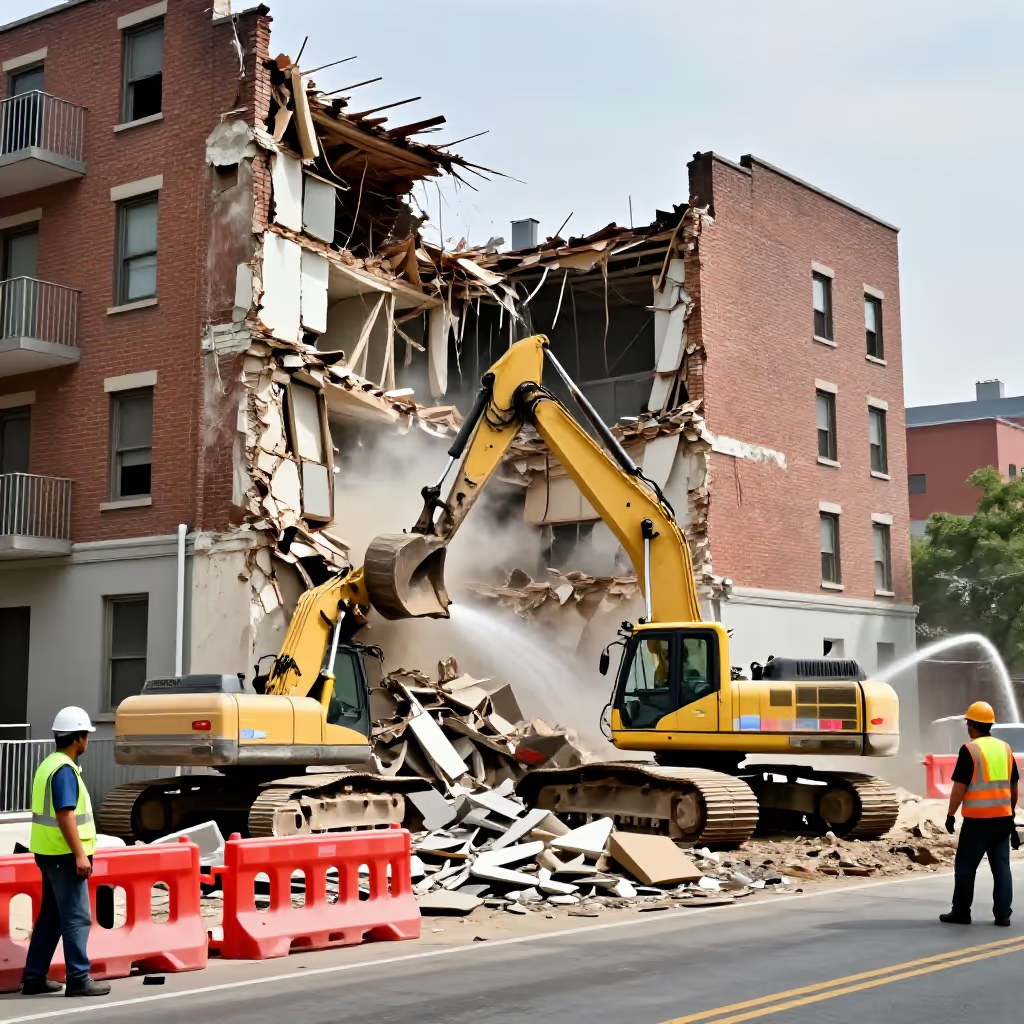
The planned destruction and removal of a structure; the demolition of a building.
example
Der Abbruch der alten Fabrikhalle schafft Platz für einen neuen Wohnkomplex.
The demolition of the old factory hall is creating space for a new residential complex.

Usage tips
Word family
The noun 'der Abbruch' (demolition/termination) comes from the separable verb 'abbrechen' (to break off/to cancel). The prefix 'ab-' means 'off/away,' and 'brechen' means 'to break.' The literal meaning is therefore 'the breaking away' or 'the breaking off.'
EXAMPLE
Wegen des starken Regens musste der Schiedsrichter das Fußballspiel abbrechen.
Because of the heavy rain, the referee had to call off the football match.
Context clue
Whether 'Abbruch' means the destruction of a building or the ending of an action can be recognized from context. If it is about structures like 'Haus' (house) or 'Brücke' (bridge), destruction is meant. If it is about processes like 'Gespräch' (conversation) or 'Beziehung' (relationship), ending is meant.
EXAMPLE
Der Abbruch der alten Brücke beginnt nächste Woche.
The demolition of the old bridge begins next week.
Typical collocations
In the meaning 'Beendigung' (ending/termination), 'Abbruch' is often used for abstract processes. Common combinations are 'der Abbruch der Verhandlungen' (the termination of negotiations), 'der Abbruch des Kontakts' (the breaking off of contact), or 'der Abbruch eines Experiments' (the termination of an experiment).
EXAMPLE
Nach stundenlangen Diskussionen kam es zum Abbruch der Verhandlungen.
After hours of discussion, the negotiations were terminated.
Fixed expression with dative
The idiom 'jemandem/etwas Abbruch tun' means 'to harm' or 'to diminish.' The person or thing that is harmed is always in the dative. The expression is usually negated: 'keinen Abbruch tun' (not to detract from).
EXAMPLE
Die eine schlechte Note wird deinem guten Zeugnis keinen Abbruch tun.
The one bad grade will not detract from your good report card.
Compare with
near_synonym
Abbruch vs Ende
end
'das Ende' and 'der Abbruch' can both describe that something stops. 'das Ende' is neutral and can be planned, normal, or natural. 'der Abbruch', on the other hand, usually means that something is ended early or suddenly, even though it was actually supposed to continue. This fits, for example, a conversation, an experiment, a trip, or a treatment. If something is simply finished, you are more likely to say 'Ende'. If something is stopped before it is completed, 'Abbruch' is more precise.
Abbruch
Wegen starker Schmerzen entschied die Ärztin den Abbruch der Behandlung.
Because of severe pain, the doctor decided to stop the treatment.
Ende
Er schreibt das Ende des Berichts noch heute fertig.