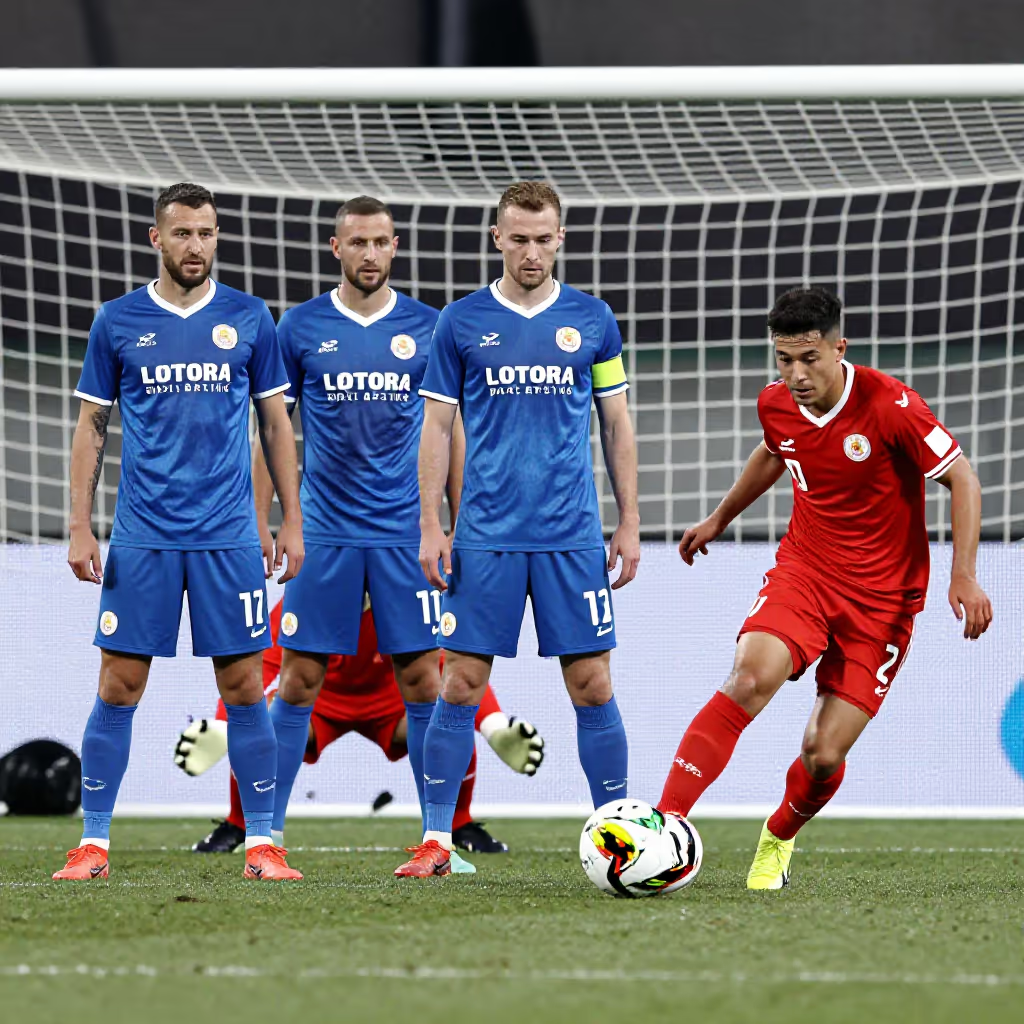
die Abwehr
defense
In sports, the part of a team whose main task is to prevent the opponent’s attacks and defend its own goal.
Die Abwehr unserer Fußballmannschaft hat heute sehr gut gespielt.
The defense of our soccer team played very well today.


defense
Loading your saved state.
defense
In sports, the part of a team whose main task is to prevent the opponent’s attacks and defend its own goal.
Die Abwehr unserer Fußballmannschaft hat heute sehr gut gespielt.
The defense of our soccer team played very well today.

'Die Abwehr' (defense) belongs to the verb 'abwehren' (to fend off/repel). This verb means to actively push back an attack or a danger. The basic meaning of protecting and defending is present in all uses of the noun.
Die Burg wurde gebaut, um Feinde abwehren zu können.
The castle was built so that enemies could be fended off.
The context makes the meaning of 'Abwehr' (defense) clear. Words like 'Mannschaft' (team) or 'Tor' (goal) point to sports. Terms like 'Körper' (body), 'Viren' (viruses), or 'stärken' (to strengthen) point to the medical meaning (immune system).
Die Abwehr des Teams war heute unüberwindbar.
The team’s defense was unbeatable today.
In a sports context, 'Abwehr' (defense) is often combined with certain verbs and adjectives. Common phrases are 'in der Abwehr spielen' (to play in defense), 'eine starke/schwache Abwehr haben' (to have a strong/weak defense), or 'die Abwehr durchbrechen' (to break through the defense).
Der Stürmer konnte die gegnerische Abwehr leicht überwinden.
The striker was able to get past the opposing defense easily.
In the medical sense, people often speak of the 'körpereigene Abwehr' (the body’s own immune defense) or the 'Abwehrkräfte' (immune defenses). Typical verbs are 'stärken' (to strengthen) or 'schwächen' (to weaken).
Stress kann die Abwehrkräfte des Körpers schwächen.
Stress can weaken the body’s immune defenses.
The psychological meaning of 'Abwehr' (defense) as a protective mechanism is technical language. In everyday life, this term is usually only used when people are specifically talking about psychological topics.
In der Therapie lernte er, seine psychologischen Abwehrmechanismen zu verstehen.
In therapy, he learned to understand his psychological defense mechanisms.
protection
'der Schutz' and 'die Abwehr' both have to do with safety from danger or harm. 'Schutz' is more general and can mean a safe state, a measure, or something protective. 'Abwehr' sounds more active: you fend off an attack, a disease, or a harmful influence. Learners may confuse the words because both protect against something negative. As a guide: 'Schutz' fits when safety is the focus; 'Abwehr' fits when something is actively fought or held back.

Viel Schlaf stärkt die Abwehr gegen Erkältungen.
Plenty of sleep strengthens the immune defense against colds.
In der Schule sorgt ein Plan für den Schutz der Kinder bei einem Feueralarm.
At school, a plan ensures the protection of the children during a fire alarm.