


abbrechen
to cancel
To end an action, event, or process early, before the planned end has been reached.
EXAMPLE
Wir mussten das Meeting abbrechen, weil der Feueralarm losging.
We had to cancel the meeting because the fire alarm went off.
to cancel / break off
Loading your saved state.
to cancel
To end an action, event, or process early, before the planned end has been reached.
Wir mussten das Meeting abbrechen, weil der Feueralarm losging.
We had to cancel the meeting because the fire alarm went off.

to break off
To remove or detach a part of something by breaking it.
Vorsicht, der Ast könnte abbrechen, wenn du dich darauf setzt.
Careful, the branch could break off if you sit on it.
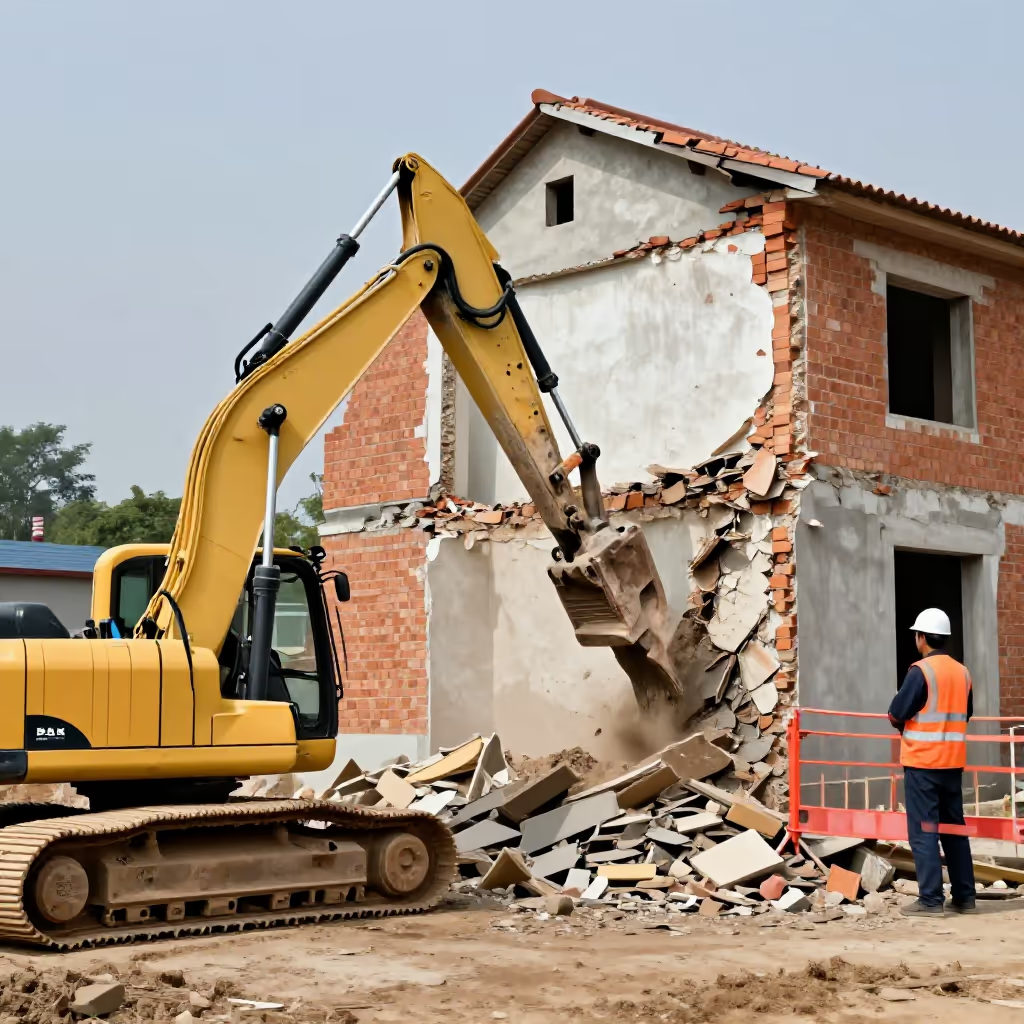
to demolish
To systematically destroy and remove a building or another structure.
Das alte Rathaus wird nächstes Jahr abgebrochen, um Platz für einen Neubau zu schaffen.
The old town hall will be demolished next year to make room for a new building.

to abort / cancel
In information technology, to stop an ongoing process such as a download, installation, or connection.
Der Download wurde bei 95 Prozent abgebrochen.
The download was aborted at 95 percent.
'Abbrechen' (to cancel/break off) is a separable verb. In main clauses, the prefix 'ab' stands at the end of the sentence. In subordinate clauses and in the infinitive with 'zu', the verb stays together.
Er bricht sein Studium ab.
He drops out of his degree program.
The perfect tense is formed with 'haben' when there is an object (transitive). It is formed with 'sein' when something breaks off by itself (intransitive).
Sie hat den Kontakt zu ihm abgebrochen.
She broke off contact with him.
In the meaning 'to end early', 'abbrechen' is often used with projects, training programs, or social contacts. Typical phrases are: 'ein Studium abbrechen' (to drop out of a degree program), 'eine Ausbildung abbrechen' (to discontinue vocational training), 'den Kontakt abbrechen' (to break off contact), or 'eine Beziehung abbrechen' (to end a relationship).
Leider musste sie ihre Ausbildung aus gesundheitlichen Gründen abbrechen.
Unfortunately, she had to discontinue her training for health reasons.
When referring to buildings or other large structures, 'abbrechen' always means 'abreißen' (to tear down) or 'demolieren' (to demolish). In this context, the meaning is clear.
Die alte Fabrik wurde letztes Jahr abgebrochen.
The old factory was demolished last year.
In IT, 'abbrechen' is used to stop a digital process. Typical combinations are: 'einen Download abbrechen' (to cancel a download), 'eine Installation abbrechen' (to cancel an installation), or 'einen Kopiervorgang abbrechen' (to cancel a copying process).
Klicken Sie hier, um die Installation abzubrechen.
Click here to cancel the installation.
to end
Beenden neutrally describes bringing an action or process to an end. Abbrechen makes it clear that the end comes before the planned conclusion. Use “beenden” for a regular conclusion as well, and “abbrechen” when the process is not continued because it ends prematurely.

Sie brach den Kurs wegen gesundheitlicher Probleme vorzeitig ab.
She dropped out of the course early because of health problems.
Sie beendete den Kurs nach der letzten Unterrichtsstunde.
She finished the course after the last lesson.