

der Schutz
protection
The act or state of keeping someone or something safe from danger, harm, or negative influences.
Die Impfung bietet einen wirksamen Schutz vor der Krankheit.
The vaccination offers effective protection against the disease.


protection
Loading your saved state.
protection
The act or state of keeping someone or something safe from danger, harm, or negative influences.
Die Impfung bietet einen wirksamen Schutz vor der Krankheit.
The vaccination offers effective protection against the disease.

'Der Schutz' (protection) is the noun form of the verb 'schützen' (to protect). If you know the verb, you can easily derive the meaning of the noun: 'schützen' is the action, and 'Schutz' is the result or the action itself.
Diese Creme schützt die Haut vor der Sonne.
This cream protects the skin from the sun.
To express what something or someone is protected from, you always use the preposition 'vor' (from/against) with the dative. The structure is: Schutz vor + [danger in the dative].
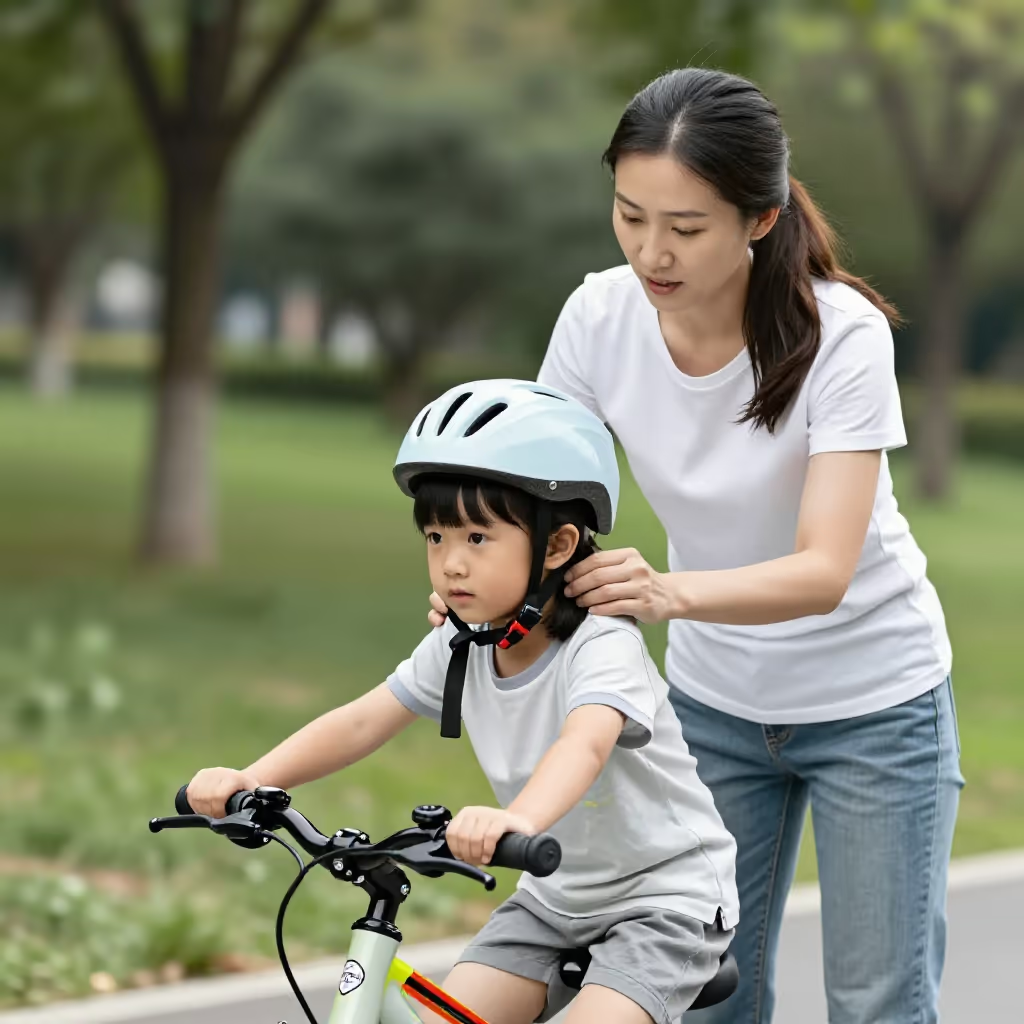
Ein Helm bietet Schutz vor Kopfverletzungen.
A helmet offers protection from head injuries.
'Schutz' (protection) is a very productive word and forms the second part of many important nouns. Examples include 'Umweltschutz' (environmental protection), 'Datenschutz' (data protection), 'Sonnenschutz' (sun protection), or 'Tierschutz' (animal protection).
In Deutschland ist der Datenschutz gesetzlich streng geregelt.
In Germany, data protection is strictly regulated by law.
The expression 'unter Schutz stehen' (to be protected) is a fixed structure. The word in the middle describes the type of protection, e.g. 'unter Denkmalschutz stehen' (to be a protected monument) or 'unter Naturschutz stehen' (to be under nature protection).
Seltene Pflanzenarten stehen oft unter Naturschutz.
Rare plant species are often protected by nature conservation laws.
safety / certainty / security
'die Sicherheit' and 'der Schutz' are closely related because both have to do with avoiding danger. 'Sicherheit' describes more the state: you are protected and do not feel threatened. 'Schutz' emphasizes more the action, measure, or thing that makes this safety possible, for example a helmet, a password, or a law. Learners may confuse the words because protection often leads to safety. A natural way to think of it is: 'der Schutz' provides 'Sicherheit'.

Beim Radfahren trägt Emma einen Helm zum Schutz vor Verletzungen.
When cycling, Emma wears a helmet to protect herself from injuries.
Im Büro ist die Sicherheit der Daten besonders wichtig.
In the office, data security is especially important.