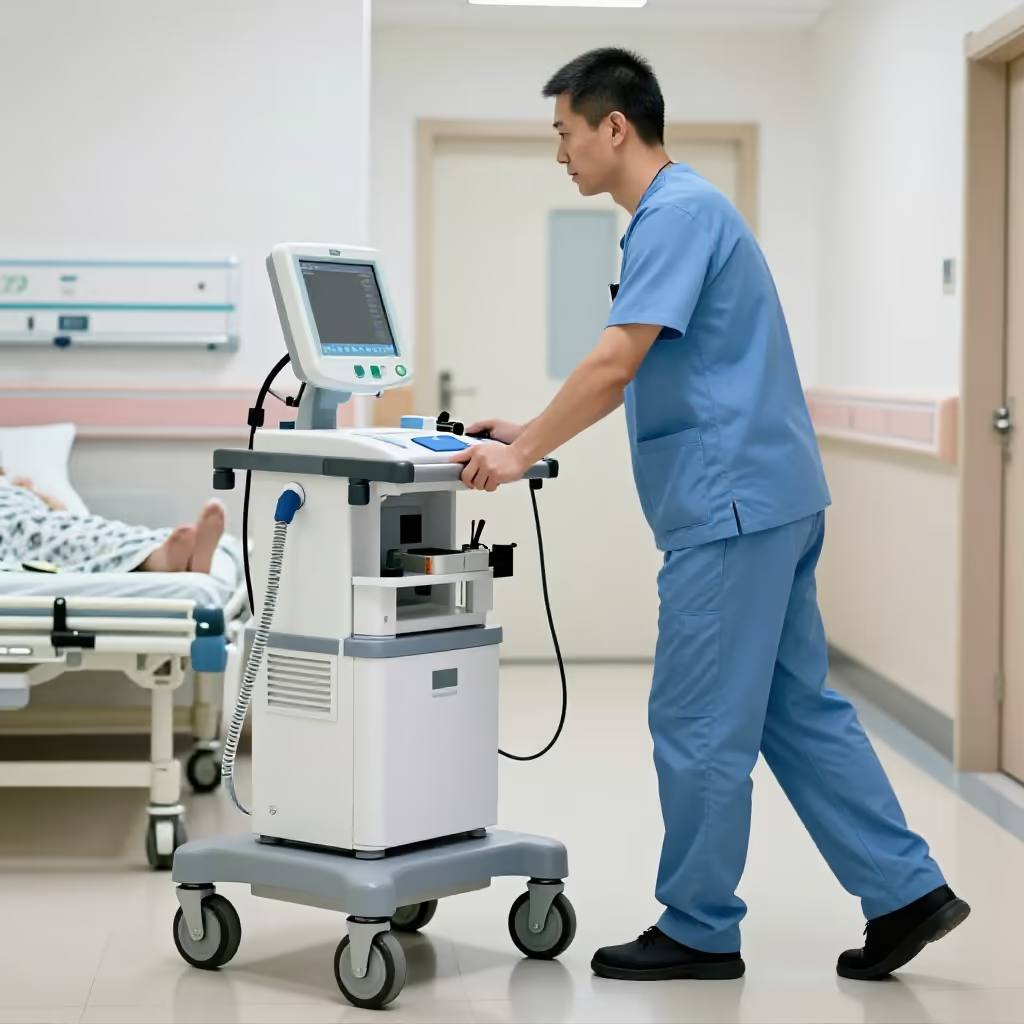
Refers to medical treatment in which the patient does not have to stay overnight in the hospital or at the practice.
example
Die Operation kann ambulant durchgeführt werden, Sie dürfen am selben Tag wieder nach Hause.
The operation can be performed on an outpatient basis; you may go home again the same day.

Usage tips
Word structure
The word comes from the Latin verb 'ambulare' (to walk, to wander around). This origin explains both meanings: a patient 'goes' home again after treatment, and a merchant 'wanders' with their business from place to place.
EXAMPLE
Die meisten kleineren Eingriffe werden heute ambulant durchgeführt.
Most minor procedures are now performed on an outpatient basis.
Context clue
The context usually makes the meaning very clear. In connection with medicine, doctors, or hospitals, it always means treatment without an overnight stay. If the topic is trade, business, or services, it refers to mobile operation.
EXAMPLE
Mein Vater bekommt zweimal pro Woche Besuch von einem ambulanten Pflegedienst.
My father gets visits twice a week from a mobile nursing service.
Typical collocations
In the medical context, 'ambulant' (outpatient) is often combined with certain nouns. Common combinations are 'ambulante Behandlung' (outpatient treatment), 'ambulante Pflege' (outpatient care/home care), or 'ambulante Operation' (outpatient operation).
EXAMPLE
Nach einer ambulanten Operation können die Patienten sich zu Hause erholen.
After an outpatient operation, patients can recover at home.
Typical collocations
When it comes to mobile activities, 'ambulant' (mobile) often appears with words like 'Handel' (trade), 'Gewerbe' (business), or 'Händler' (trader). An 'ambulanter Pflegedienst' is a mobile care service that visits patients at home.
EXAMPLE
Der ambulante Handel versorgt die Dörfer mit frischen Lebensmitteln.
Mobile trade supplies the villages with fresh food.
Compare with
near_synonym · confusable
ambulant vs mobil
mobile
'mobil' and 'ambulant' can both mean that something is not tied to a fixed place. But 'mobil' is much more general: a person, a device, or a service can be movable or used in different places. For people, 'mobil' can also mean that they can still move around well. 'ambulant' is used especially in medicine when someone is treated but does not stay overnight in the hospital. It can also describe work done in changing locations. The words are easy to confuse because both have to do with movement or changes of location. In medicine, 'ambulant' is often more precise; for general mobility, 'mobil' fits better.
ambulant
Die Behandlung ist ambulant, deshalb darf Maria am selben Tag nach Hause.
The treatment is outpatient, so Maria is allowed to go home the same day.
mobil
Nach der Operation ist Herr Kaya wieder mobil und kann kurze Wege allein gehen.
After the operation, Mr. Kaya is mobile again and can walk short distances by himself.