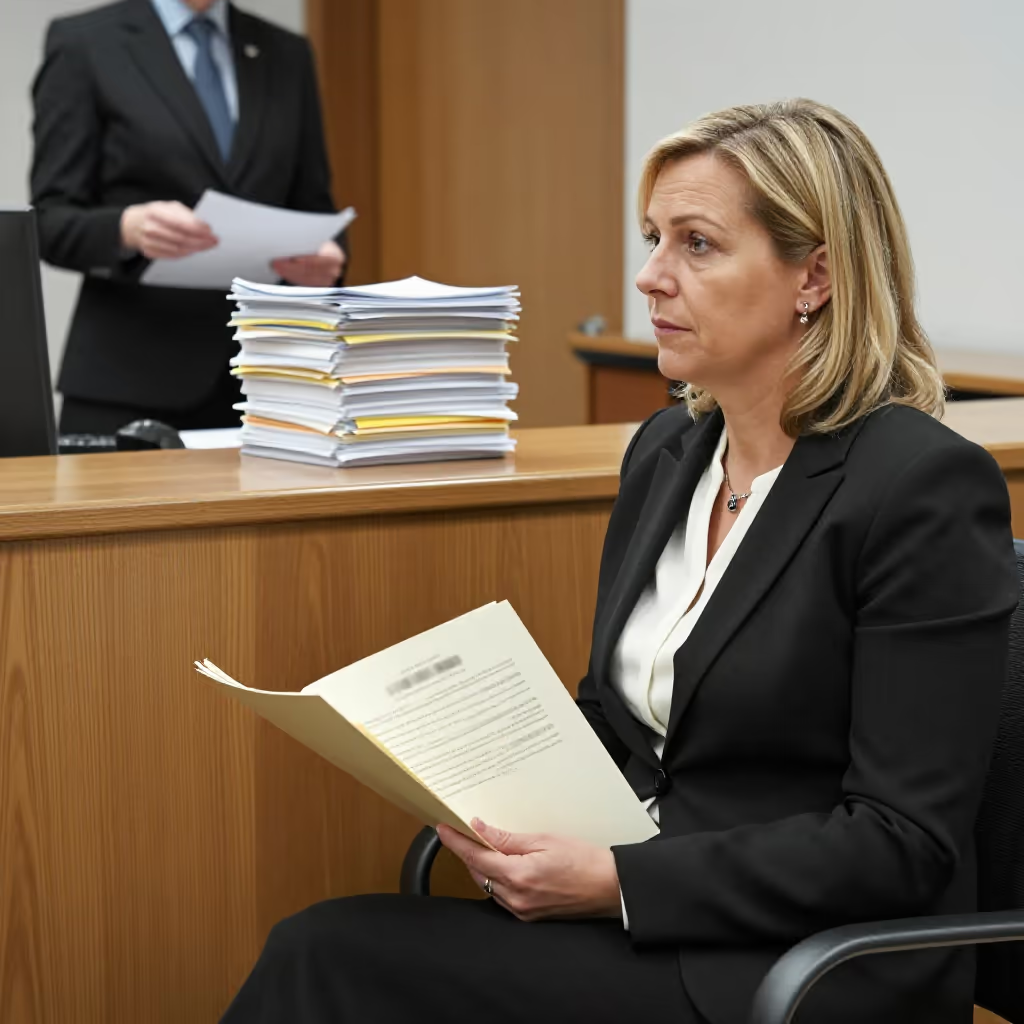
Describes a legal or administrative case that has been filed with a court or authority but has not yet been decided.
example
Das Scheidungsverfahren ist bereits seit über einem Jahr bei Gericht anhängig.
The divorce proceedings have already been pending in court for over a year.

Usage tips
Sentence structure
The adjective 'anhängig' (pending/dependent) is used almost exclusively predicatively, meaning after a verb such as 'sein' (to be) or 'machen' (to make). Use directly before a noun (attributively) is very rare.
EXAMPLE
Die Klage ist seit Monaten bei Gericht anhängig.
The lawsuit has been pending in court for months.
Register and context
This meaning belongs to the technical language of law and administration. You typically find it in connection with words such as 'Verfahren' (proceedings), 'Klage' (lawsuit), 'Antrag' (application/motion), 'Gericht' (court), or 'Behörde' (authority).
EXAMPLE
Solange das Verfahren anhängig ist, können wir keine weiteren Schritte unternehmen.
As long as the proceedings are pending, we cannot take any further steps.
Fixed preposition
In the legal meaning, 'anhängig' (pending) is almost always used with the preposition 'bei' to name the place (the court, the authority) where the case is being processed.
EXAMPLE
Der Antrag ist noch beim Bundesverwaltungsgericht anhängig.
The application is still pending before the Federal Administrative Court.
Outdated meaning
The meaning 'to be dependent on someone' is outdated and is no longer used in modern German. It is found mainly in historical or literary texts.
EXAMPLE
Im 19. Jahrhundert war eine Witwe ohne Vermögen oft ihren Verwandten anhängig.
In the 19th century, a widow without assets was often dependent on her relatives.
Compare with
near_synonym
anhängig vs offen
open
'offen' and 'anhängig' can both mean that a matter has not yet been decided. 'offen' is a normal everyday word and fits many situations: questions, tasks, decisions, or bills can be 'offen'. 'anhängig' is much more specific and is used mainly with courts or authorities. It means that a case has already been filed there, but no decision has been made yet. In everyday language, people usually say 'offen'; 'anhängig' fits only in legal or administrative contexts.
anhängig
Der Antrag ist bei der Behörde anhängig und wird noch geprüft.
The application is pending with the authority and is still being reviewed.
offen
In seiner E-Mail schreibt er, dass noch zwei Punkte offen sind.
In his email, he writes that two points are still open.