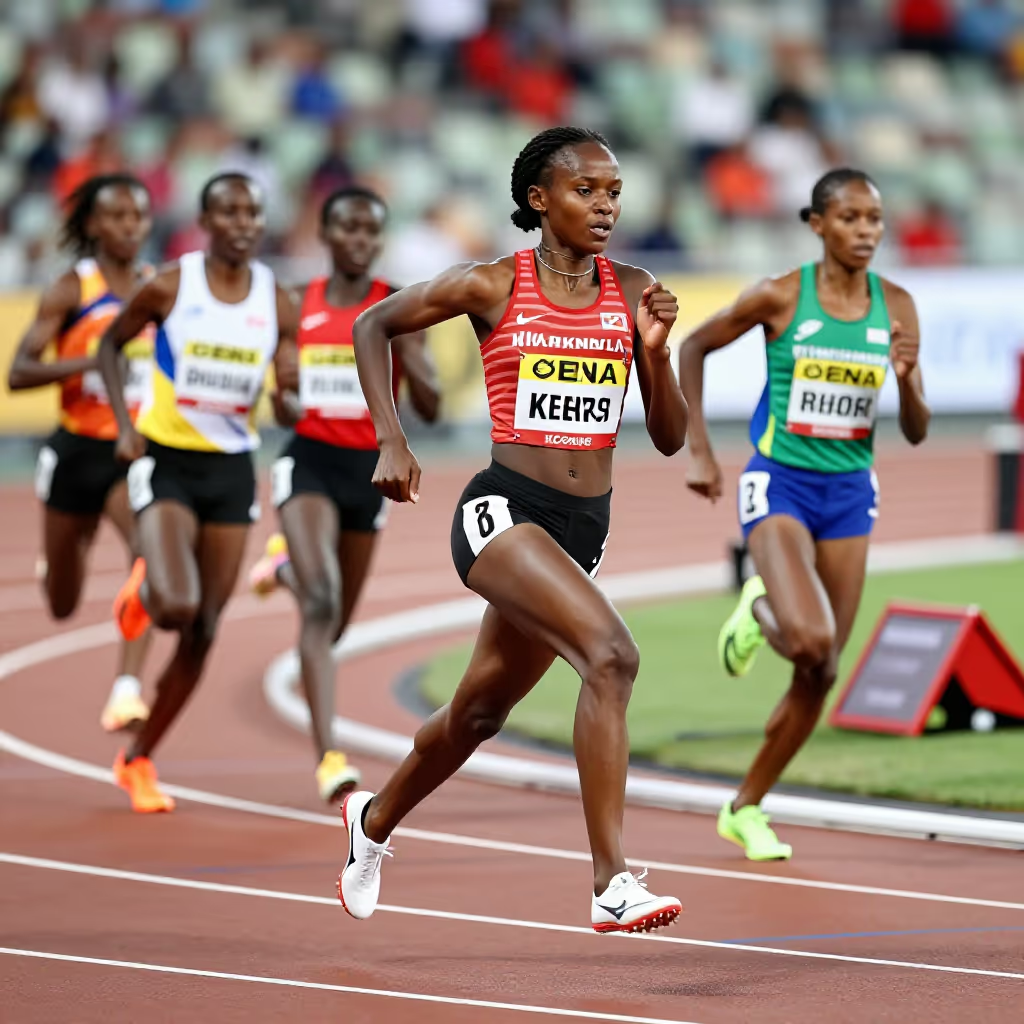
To reduce or completely make up a deficit, for example in a competition, in learning, or on a journey. You reach the same level as someone or something that previously had a lead.
example
Obwohl sie später gestartet ist, konnte sie die anderen Läufer schnell aufholen.
Although she started later, she was able to catch up with the other runners quickly.

Usage tips
Separable verb
'Aufholen' (to catch up) is a separable verb. The prefix 'auf-' goes at the end in a main clause. In subordinate clauses and in the infinitive with 'zu', the verb stays together.
EXAMPLE
Der Läufer holt den Führenden langsam auf.
The runner is slowly catching up with the leader.
Verb structure
The verb consists of the prefix 'auf-' and the base verb 'holen' (to fetch/get). While 'holen' means to bring something to oneself, 'aufholen' (to catch up) expresses the idea of closing a gap or distance.
EXAMPLE
Nach seiner Krankheit muss er viel Arbeit im Büro aufholen.
After his illness, he has to catch up on a lot of work at the office.
Use with an object
In the meaning of 'reducing a lead', 'aufholen' (to catch up) can be used with or without an object. With an object, you name the person or thing you are catching up with. Without an object, it simply means 'to reduce the distance.'
EXAMPLE
Sie muss ihre Konkurrentin noch aufholen.
She still has to catch up with her competitor.
Typical collocations
When making up for something missed, 'aufholen' (to catch up on) is often combined with abstract nouns. Typical phrases are 'Schlaf aufholen' (to catch up on sleep), 'Arbeit aufholen' (to catch up on work), or 'Lernstoff aufholen' (to catch up on study material).
EXAMPLE
Am Wochenende will ich endlich den Schlaf der letzten Nächte aufholen.
At the weekend I finally want to catch up on the sleep I missed over the last few nights.
Compare with
confusable
aufholen vs überholen
to overtake / overhaul
'überholen' and 'aufholen' can both have to do with a lead or a gap. 'aufholen' means that you reduce a gap or make it up completely. Afterward, you may be level with the other person. 'überholen' means that you pass someone or become better than someone else. In traffic, the difference is clear: first you catch up with a car, then you can overtake it. In a figurative sense, it is similar: someone who catches up ('aufholen') gets closer; someone who overtakes ('überholen') is ahead afterward. That is why the words are easy to confuse.
aufholen
Nach zwei Wochen Krankheit muss ich viel Stoff für den Kurs aufholen.
After two weeks of illness, I have to catch up on a lot of material for the course.
überholen
Auf der Landstraße überholt Frau Hoffmann einen langsamen Lkw.
On the country road, Ms. Hoffmann overtakes a slow truck.