To deal with a stressful or difficult experience from the past in order to process it emotionally.
example
Nach der Trennung brauchte er Zeit, um die Beziehung aufzuarbeiten.
After the breakup, he needed time to work through the relationship.

Usage tips
Separable verb
'Aufarbeiten' is a separable verb. In a main clause, the prefix 'auf' goes at the end; in a subordinate clause, the verb stays together; and in the infinitive with 'zu', 'zu' goes in the middle.
EXAMPLE
Er arbeitet seine Vergangenheit auf.
He works through his past.
Context clues
The context reveals the meaning: Is it about feelings or the past (emotional)? About furniture (renewing)? Or about emails and files (unfinished work)?
EXAMPLE
Er muss den Tod seines Vaters noch aufarbeiten.
He still has to work through his father's death.
Typical collocations
In the emotional sense, 'aufarbeiten' (to work through) is often combined with abstract nouns such as 'die Vergangenheit' (the past), 'ein Trauma' (a trauma), 'Erlebnisse' (experiences), or 'eine Beziehung' (a relationship).
EXAMPLE
In der Therapie konnte sie viele Kindheitserlebnisse aufarbeiten.
In therapy, she was able to work through many childhood experiences.
Typical collocations
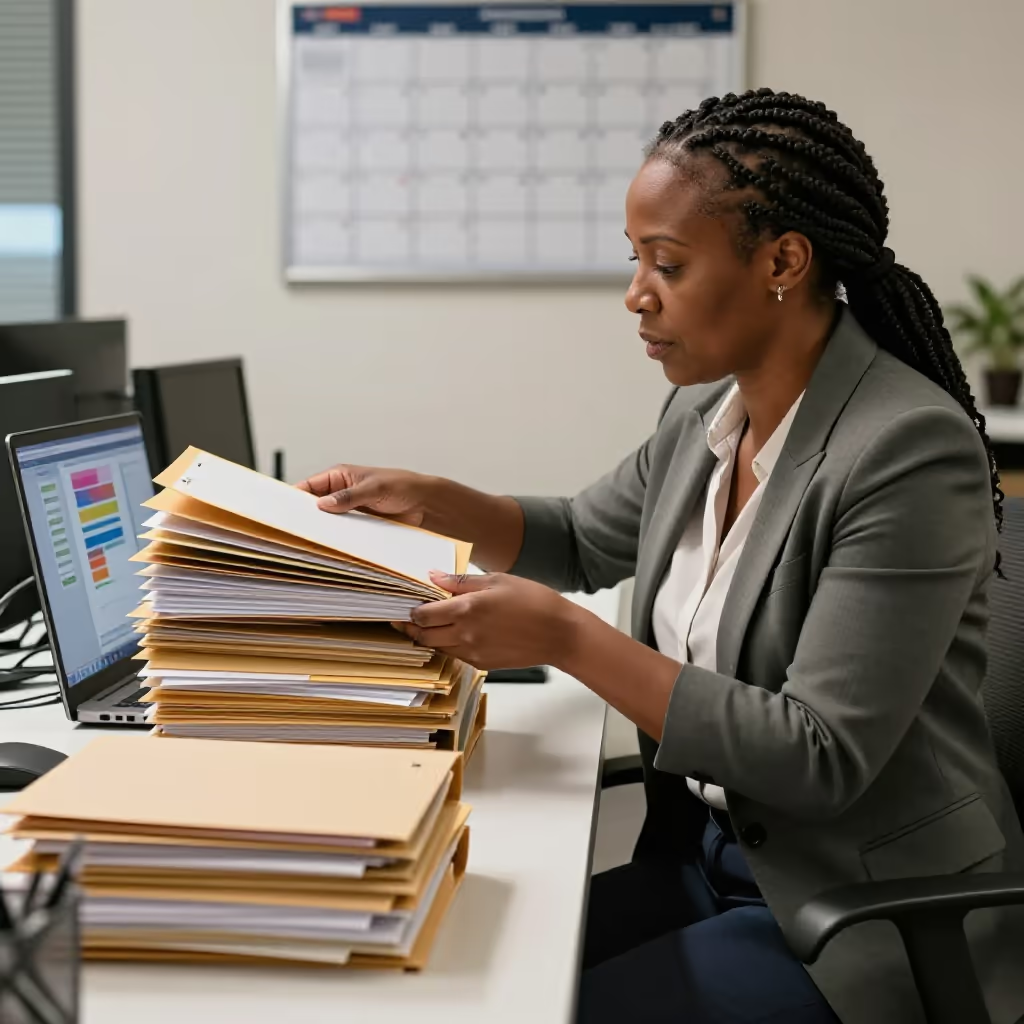
When it is about unfinished tasks, typical objects are 'ein Rückstand' (a backlog), 'ein Stapel Arbeit' (a pile of work), or 'Protokolle' (minutes/reports).
EXAMPLE
Nach dem Urlaub hatte sie einen riesigen Rückstand an Arbeit aufzuarbeiten.
After the vacation, she had a huge backlog of work to catch up on.
Compare with
near_synonym
aufarbeiten vs erledigen
to take care of / to finish
'erledigen' and 'aufarbeiten' can both mean finishing tasks. 'erledigen' fits with a single task, duty, or piece of work that you complete. 'aufarbeiten' is used more when many tasks have piled up and you work through them gradually. If you are finishing just one email, appointment, or assignment, 'erledigen' is more natural. If a lot of work has been left undone after a vacation, 'aufarbeiten' fits better.
aufarbeiten
Nach dem Urlaub muss Tom viele liegen gebliebene E-Mails aufarbeiten.
After his vacation, Tom has to catch up on many emails that have piled up.
erledigen
Vor dem Feierabend erledigt Lisa noch die wichtigste Aufgabe.
Before finishing work for the day, Lisa takes care of the most important task.