

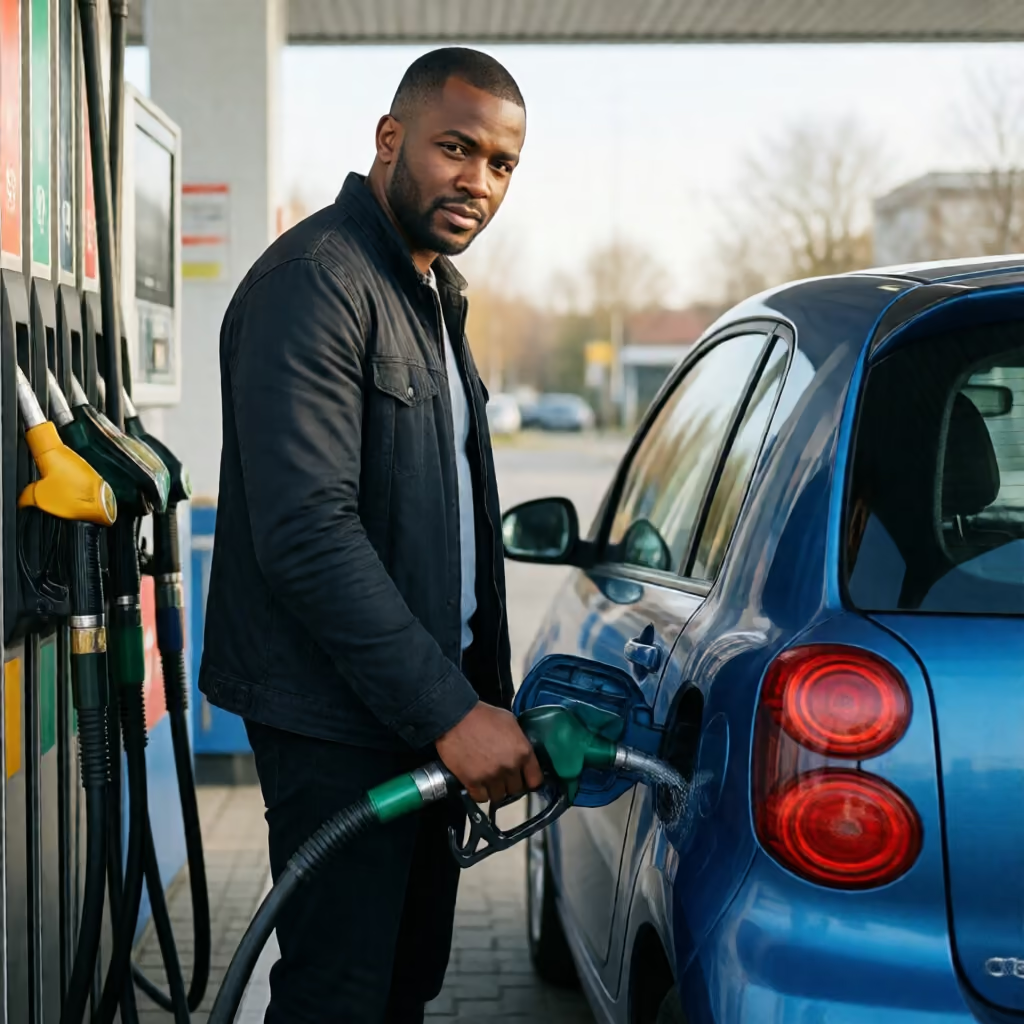
auftanken
to refuel
To fill a vehicle's or machine's tank with fuel or replenish its fuel supply.
EXAMPLE
Vor der langen Fahrt müssen wir das Auto noch auftanken.
We still need to refuel the car before the long journey.
to refuel
auftanken – tankte auf – hat aufgetankt
Loading your saved state.
to refuel
To fill a vehicle's or machine's tank with fuel or replenish its fuel supply.
Vor der langen Fahrt müssen wir das Auto noch auftanken.
We still need to refuel the car before the long journey.

to recharge
To recover and gain new strength or energy.
Am Wochenende möchte ich in der Natur auftanken.
I would like to recharge in nature over the weekend.
| ich | tanke auf |
|---|---|
| du | tankst auf |
| er/sie/es | tankt auf |
| wir | tanken auf |
| ihr | tankt auf |
| sie | tanken auf |
| ich | tankte auf |
|---|---|
| du | tanktest auf |
| er/sie/es | tankte auf |
| wir | tankten auf |
| ihr | tanktet auf |
| sie | tankten auf |
| ich | habe aufgetankt |
|---|---|
| du | hast aufgetankt |
| er/sie/es | hat aufgetankt |
| wir | haben aufgetankt |
| ihr | habt aufgetankt |
| sie | haben aufgetankt |
| du | tank auf! tanke auf! |
|---|---|
| ihr | tankt auf! |
| Sie | tanken Sie auf! |
| ich | hatte aufgetankt |
|---|---|
| du | hattest aufgetankt |
| er/sie/es | hatte aufgetankt |
| wir | hatten aufgetankt |
| ihr | hattet aufgetankt |
| sie | hatten aufgetankt |
| ich | werde auftanken |
|---|---|
| du | wirst auftanken |
| er/sie/es | wird auftanken |
| wir | werden auftanken |
| ihr | werdet auftanken |
| sie | werden auftanken |
| ich | tanke auf |
|---|---|
| du | tankest auf |
| er/sie/es | tanke auf |
| wir | tanken auf |
| ihr | tanket auf |
| sie | tanken auf |
Used for reported speech.
| ich | tankte auf |
|---|---|
| du | tanktest auf |
| er/sie/es | tankte auf |
| wir | tankten auf |
| ihr | tanktet auf |
| sie | tankten auf |
Used for wishes and “would”.
| infinitive | auftanken |
|---|---|
| with zu | aufzutanken |
| present participle | auftankend |
| past participle | aufgetankt |
'Auftanken' (to refuel) consists of 'auf' and 'tanken' (to fuel) and is separable. In a simple main clause, 'auf' goes at the end; in a subordinate clause, the verb stays together. With the infinitive with 'zu', 'zu' comes between 'auf' and 'tanken'.
Wir tanken vor der Abfahrt noch einmal auf.
We are refueling once more before departure.
Wir halten kurz an, weil wir noch auftanken müssen.
We are stopping briefly because we still need to refuel.
Ich habe vergessen, das Auto aufzutanken.
I forgot to refuel the car.
The vehicle can be used as an accusative object with 'auftanken' (to refuel). When it is clear from the context which vehicle is meant, the object can be omitted.
Die Fahrerin tankt den Lieferwagen auf.
The driver is refueling the delivery van.
An der nächsten Tankstelle müssen wir auftanken.
We need to refuel at the next gas station.
In its figurative meaning, 'neue Energie auftanken' (to recharge one's energy) and 'frische Kraft auftanken' (to regain one's strength) are typical collocations. 'Auftanken' (to recharge) is not used reflexively here, so it does not take 'sich'.
Bei einem Spaziergang im Wald kann ich neue Energie auftanken.
I can recharge my energy by taking a walk in the forest.