

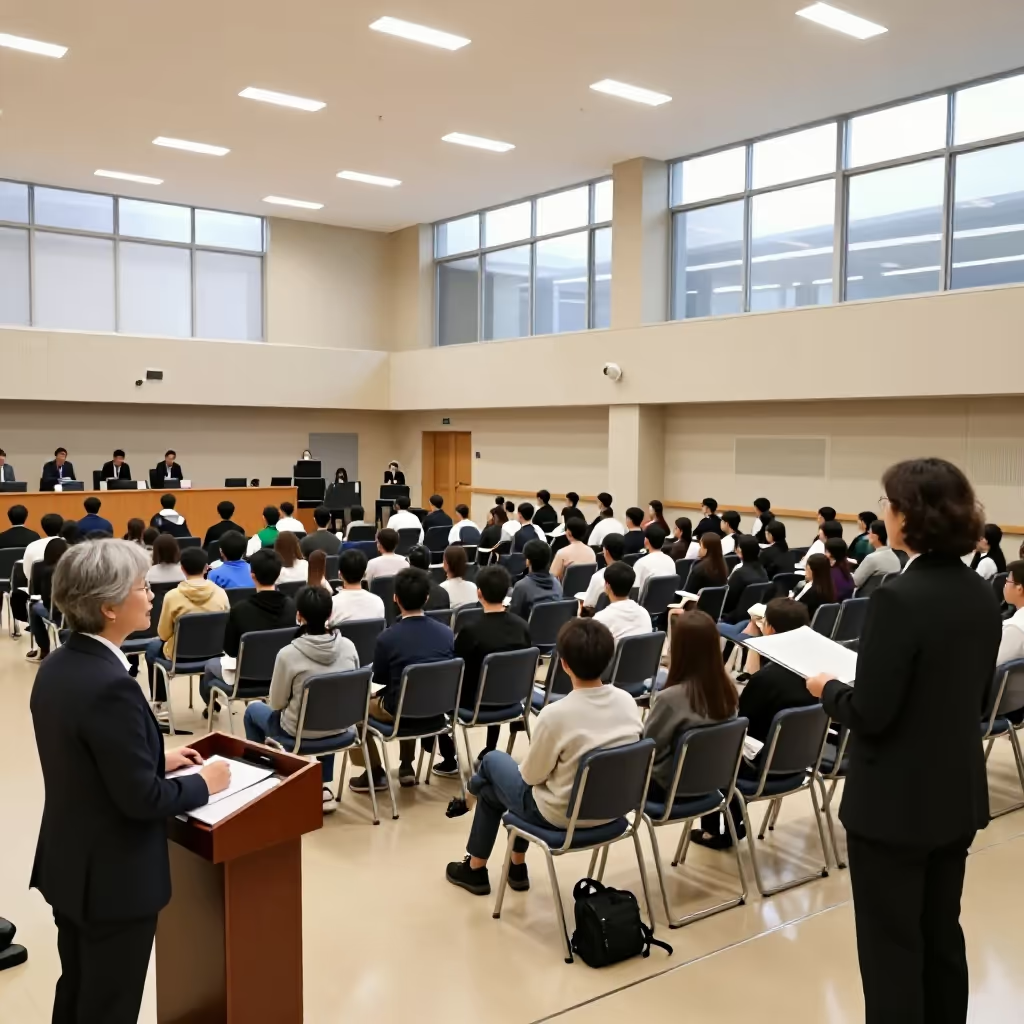
A large ceremonial or assembly hall in a school, university, or another public building.
example
Die Abschlussfeier der Schule findet dieses Jahr in der Aula statt.
The school's graduation ceremony is taking place in the auditorium this year.

Usage tips
Correct preposition
Since the Aula (auditorium) is a place, you use the preposition 'in'. For direction, use the accusative ('in die Aula gehen' — to go into the auditorium); for location, use the dative ('in der Aula sein' — to be in the auditorium).
EXAMPLE
Alle Schüler versammeln sich in der Aula.
All students gather in the auditorium.
Typical collocations
Certain events typically take place in an Aula (auditorium). Common verbs are 'sich versammeln' (to gather), 'stattfinden' (to take place), or 'eine Rede halten' (to give a speech).
EXAMPLE
Der Schulleiter hielt in der voll besetzten Aula eine Rede.
The principal gave a speech in the packed auditorium.
Typical context
The word 'Aula' (auditorium) is used almost exclusively in connection with public educational institutions such as schools, grammar schools, or universities.
EXAMPLE
Die Erstsemester wurden vom Rektor in der Aula der Universität begrüßt.
The first-year students were welcomed by the rector in the university auditorium.
Compare with
near_synonym · confusable
Aula vs Halle
hall
'die Halle' and 'die Aula' can both be large rooms with space for many people. However, 'Halle' is much more general and can be used for sports, work, storage, or events. 'Aula' especially means an assembly hall or ceremonial hall in a school, university, or public building. Learners may confuse the words when a large room in a school is meant. In this context, 'Aula' is often more precise, while 'Halle' is more neutral and broader.
Aula
Vor der Reise trifft sich die ganze Klasse in der Aula.
Before the trip, the whole class meets in the auditorium.
Halle
Am Abend findet das Basketballspiel in der großen Halle statt.
In the evening, the basketball game takes place in the large hall.