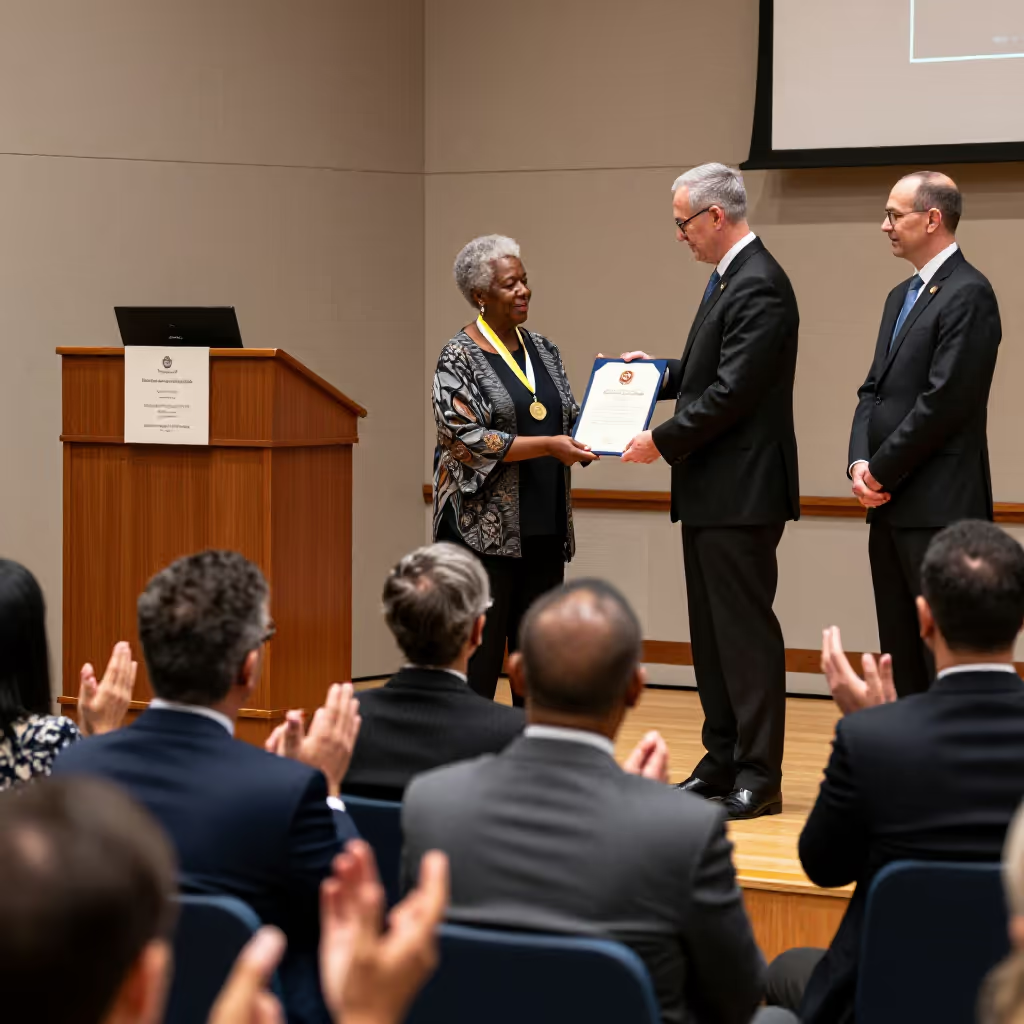
auszeichnen
to award
To honor someone for a special achievement with a prize, medal, or certificate.
Die Autorin wurde für ihren neuen Roman mit dem Deutschen Buchpreis ausgezeichnet.
The author was awarded the German Book Prize for her new novel.

to award / to distinguish
Loading your saved state.

to award
To honor someone for a special achievement with a prize, medal, or certificate.
Die Autorin wurde für ihren neuen Roman mit dem Deutschen Buchpreis ausgezeichnet.
The author was awarded the German Book Prize for her new novel.


to distinguish itself by
To stand out from others through a particular positive quality or ability; to be characterized by something special.
Dieses Produkt zeichnet sich durch seine hohe Qualität und Langlebigkeit aus.
This product distinguishes itself by its high quality and durability.

to price
To mark goods with a price; to attach a price tag to a product.
Der Verkäufer muss die neue Lieferung erst noch auszeichnen, bevor sie in den Verkauf kommt.
The salesperson still has to price the new delivery before it goes on sale.
'Auszeichnen' is a separable verb. The prefix 'aus-' goes to the end of the main clause. In subordinate clauses and in the infinitive, the verb stays together.
Der Bürgermeister zeichnet die Gewinner persönlich aus.
The mayor personally awards the winners.
The verb consists of 'aus-' and 'zeichnen' (to draw/mark). Literally, it means something like 'to mark out' or 'to highlight'. This idea fits all meanings: you highlight someone through an award, a quality makes a product stand out, or you highlight the price on the goods.
Dieses Modell zeichnet sich durch besondere Sparsamkeit aus.
This model distinguishes itself by its exceptional efficiency.
The grammatical form helps you recognize the meaning: the honoring sense (m01) often appears in the passive ('wurde ausgezeichnet' — was awarded). A quality (m02) is always expressed reflexively ('sich auszeichnen' — to distinguish itself). Attaching prices (m03) is usually in the active voice with an object such as 'Ware' (goods).
Er wurde für seinen Mut ausgezeichnet.
He was awarded for his courage.
When someone is honored, the passive construction is very common: 'Jemand wird (mit etwas) (für etwas) ausgezeichnet' (someone is awarded/honored with something for something). The preposition 'mit' names the prize, and 'für' names the reason.
Die Forscherin wurde mit dem Nobelpreis für ihre Entdeckungen ausgezeichnet.
The researcher was awarded the Nobel Prize for her discoveries.
To describe a special quality, the verb is always used reflexively and with the preposition 'durch' (+ accusative). The structure is: 'Etwas zeichnet sich durch eine Eigenschaft aus' (something distinguishes itself by a quality).
Das Hotel zeichnet sich durch seinen exzellenten Service aus.
The hotel distinguishes itself by its excellent service.
to lend / award / give
Auszeichnen and verleihen can both be used in an official ceremony in which someone receives a prize or medal. Auszeichnen emphasizes that someone is honored for a special achievement, while verleihen places more emphasis on the official act of granting the award. Choose between them depending on whether the focus is on the honor or on the presentation of the award.

Die Jury zeichnete die junge Musikerin für ihre besondere Leistung aus.
The jury honored the young musician for her special achievement.
Der Bürgermeister verlieh der jungen Musikerin die Ehrenmedaille.
The mayor awarded the young musician the Medal of Honor.