

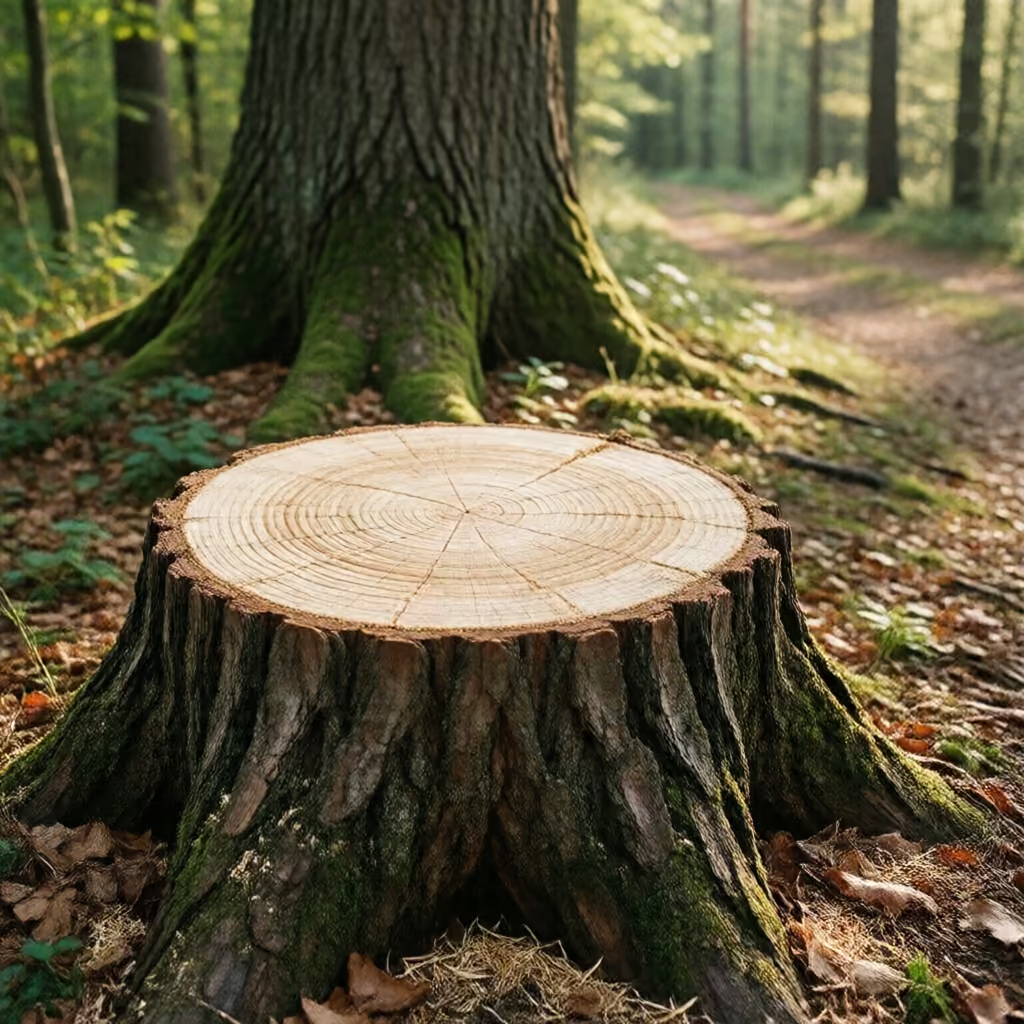
der Baumstumpf
tree stump
The lower part of a tree that remains in the ground after the trunk has been cut down or broken off.
EXAMPLE
Neben dem Weg stand noch der alte Baumstumpf.
The old tree stump was still standing beside the path.
tree stump
der Baumstumpf, die Baumstümpfe
Loading your saved state.
tree stump
The lower part of a tree that remains in the ground after the trunk has been cut down or broken off.
Neben dem Weg stand noch der alte Baumstumpf.
The old tree stump was still standing beside the path.
| gender | masculine der |
|---|---|
| plural | die Baumstümpfe |
| genitive | des Baumstumpfes |
| singular | plural | |
|---|---|---|
| nominative | der Baumstumpf | die Baumstümpfe |
| accusative | den Baumstumpf | die Baumstümpfe |
| dative | dem Baumstumpf | den Baumstümpfen |
| genitive | des Baumstumpfes des Baumstumpfs | der Baumstümpfe |
The article changes with the case; it is shown in colour.
„Baumstumpf“ (tree stump) is made up of „Baum“ (tree) and „Stumpf“ (stump). The base word „Stumpf“ refers to something that remains after a longer part has been cut off.
Im Garten musste ein alter Baumstumpf entfernt werden.
An old tree stump had to be removed from the garden.
Verbs such as „ausgraben“ (to dig up), „entfernen“ (to remove), „ausfräsen“ (to grind out), and „beseitigen“ (to clear away) are often used with „Baumstumpf“ (tree stump). These combinations describe work that makes the stump disappear from the ground or garden.
Die Gärtnerin ließ den Baumstumpf ausfräsen.
The gardener had the tree stump ground out.
A „Baumstumpf“ (tree stump) can also serve as a natural seat or a place to put things. That is why the word often appears in descriptions of forests, gardens, and paths.
Im Wald setzte sich das Kind auf einen Baumstumpf.
The child sat down on a tree stump in the forest.