

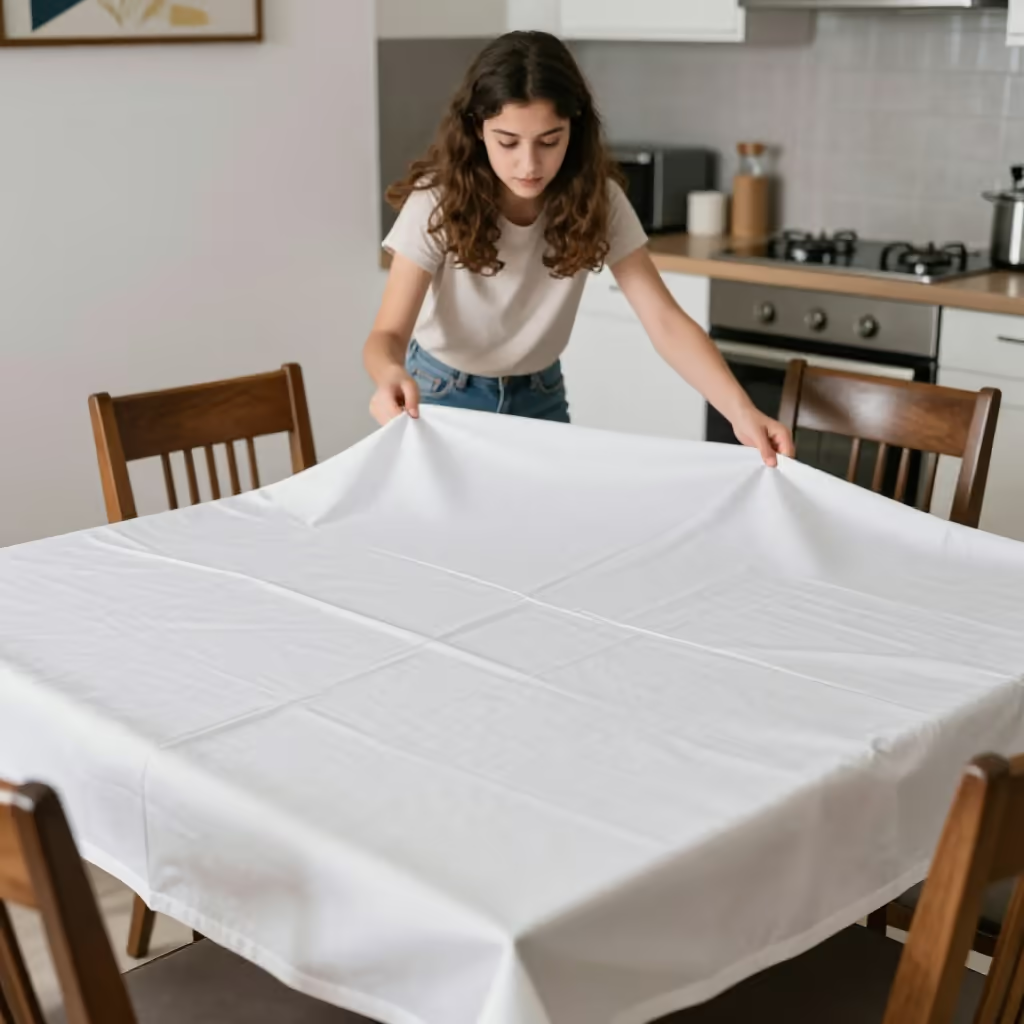
bedecken
to cover
To place or spread something over a surface so that it is no longer visible or only partly visible.
EXAMPLE
Im Winter bedeckt eine dicke Schneeschicht die Landschaft.
In winter, a thick layer of snow covers the landscape.
to cover
Loading your saved state.
to cover
To place or spread something over a surface so that it is no longer visible or only partly visible.
Im Winter bedeckt eine dicke Schneeschicht die Landschaft.
In winter, a thick layer of snow covers the landscape.

to cloud over
Used for the sky when it becomes covered with clouds and is no longer blue.
Der Himmel bedeckte sich schnell mit dunklen Wolken und es begann zu regnen.
The sky quickly clouded over with dark clouds, and it began to rain.

to cover
To deal with or include a topic or area in terms of content, for example in a report or presentation.
Der Artikel bedeckt alle wichtigen Aspekte der aktuellen politischen Lage.
The article covers all important aspects of the current political situation.
'Bedecken' (to cover) is an inseparable verb. The prefix 'be-' remains firmly attached to the stem 'decken' in all sentence forms. It makes the action directed toward an object.
Sie bedeckte das schlafende Kind mit einer warmen Decke.
She covered the sleeping child with a warm blanket.
When you want to state what something is covered with, you use the preposition 'mit' followed by the dative. The pattern is: subject covers accusative object with dative object.
Er bedeckte den Kuchen mit Schokoladenglasur.
He covered the cake with chocolate icing.
The reflexive form 'sich bedecken' (to cloud over/become covered) is used almost exclusively for the sky when it becomes covered with clouds. The subject is always 'der Himmel' (the sky).
Plötzlich bedeckte sich der Himmel und ein Gewitter zog auf.
Suddenly the sky clouded over, and a thunderstorm was approaching.
In the meaning 'to deal with a topic', 'bedecken' (to cover) is rather formal and is mainly used in written language, for example in reports, analyses, or academic texts.
Die Studie bedeckt ein breites Spektrum an sozialen Fragen.
The study covers a broad spectrum of social issues.
to book / prove / top
Belegen and bedecken can both mean that something partially or completely conceals a surface. Belegen is the specific culinary term used when bread or a bread roll is topped with food; bedecken describes covering something more generally. For bread topped with cheese, belegen is usually the better choice; for other surfaces, bedecken is used.

Der Käse bedeckt das Brot fast vollständig.
The cheese covers almost the entire bread.
Ich belege das Brot mit Käse und Tomaten.
I am topping the bread with cheese and tomatoes.